An EU-commissioned study points out that 'combating piracy has not been sufficiently effective,' and the goal should be 'real-time blocking within 30 minutes.'

Rights holders have long urged the European Commission to take urgent and decisive action to address copyright infringement in live streaming of sports and events. While the EU has issued specific recommendations to member states, and some have strengthened their efforts to combat piracy, a new investigation commissioned by the European Parliament's Legal Affairs Committee has concluded that 'the current EU-wide response is insufficient.'
Countering online piracy of sports and broadcast in the EU | Think Tank | European Parliament
EU Study: Block Live Sports Piracy in 30 Minutes, Across DNS Resolvers, VPNs and CDNs * TorrentFreak
https://torrentfreak.com/eu-study-block-live-sports-piracy-in-30-minutes-across-dns-resolvers-vpns-and-cdns/
In 2023, the European Commission issued a recommendation urging member states to take swift action against live streaming of online pirated content. However, this recommendation is not legally binding, and there are significant differences in the actual measures taken by member states. For example, Italy's 'Anti-Piracy Law' introduced a program called ' Piracy Shield ,' which is said to have blocked thousands of IP addresses and domains within a year of its implementation, while some member states have not put in place real-time anti-piracy measures.
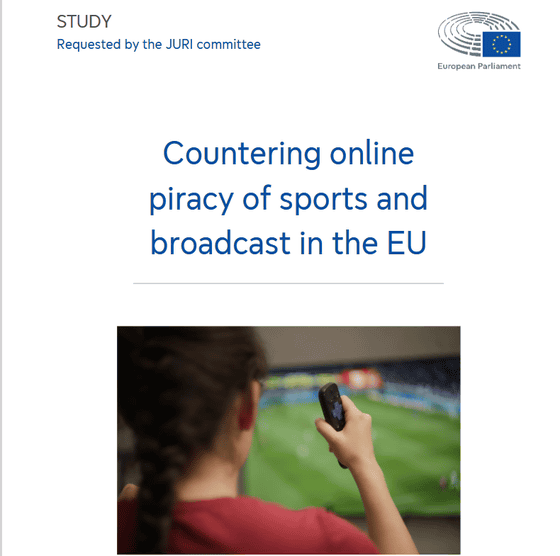
A report titled 'Online Copyright Infringement in Sports and Broadcasting in the EU,' written by Professor Giovanni Maria Riccio of the University of Salerno, Italy, at the request of the European Parliament's Legal Affairs Committee (JURI), has been published. In the report, Professor Riccio points out that 'the current EU response to copyright infringement of live content is fragmented and does not adequately address the speed and technical complexity of live broadcasting. While existing regulations provide useful tools, they do not guarantee consistent and timely enforcement across member states.'
The survey places particular emphasis on real-time blocking of 'live piracy' such as sports broadcasts. Unlike movies and music, the effectiveness of anti-piracy measures against live streaming diminishes significantly after the match or event has ended. Therefore, it is crucial to block access as quickly as possible after detecting illegal streaming.
Professor Riccio therefore suggests that streaming intermediaries should be required to take swift removal measures within a certain timeframe. He proposes extending this to include not only regular ISPs, but also multiple intermediaries involved in the distribution of illegal content, such as DNS resolvers, VPNs, CDNs, and dedicated servers. As an example of 'swift removal measures,' he suggests a time limit modeled after Italy's piracy shield, requiring content to be blocked within 30 minutes of a request from the rights holder.

In Italy, the communications regulator AGCOM oversees the blocking of pirated websites. The report proposes using this as a model to establish independent administrative bodies in each EU member state to supervise and enforce blocking and coordinate between countries.
On the other hand, Professor Riccio points out that 'blocking by IP address and DNS is essentially a crude method and cannot reliably distinguish illegal streaming from legitimate services that share the same infrastructure.' In fact, the piracy shield has caused problems by immediately blocking targeted IP addresses despite insufficient checks, resulting in access to multiple school websites, telecommunications companies, and ticketing services.
Google Drive was unusable for over 12 hours due to a mistake in domain blocking implemented as a copyright infringement prevention measure - GIGAZINE

While warning of problems such as 'excessive blocking,' Professor Riccio recommends implementing anti-piracy measures across the EU. As a way to balance swift blocking with measures against excessive blocking, he proposes safety measures such as limiting blocking to only the duration of live streaming, maintaining judicial or administrative oversight, and adhering to the principle of proportionality established by the European Court of Justice.
Finally, Professor Riccio wrote in his report that 'if watching sports legally is a costly and cumbersome process, then no amount of blocking will eradicate piracy,' and pointed out that decentralized and expensive streaming services are one of the reasons that encourage piracy.
It should be noted that this report is third-party advice and does not directly affect laws or regulations. However, because this report was published while the European Commission's 'Review of the Copyright Directive in the Digital Single Market' is in progress, its impact on the review is being closely watched.
Related Posts:







in Web Service, Posted by log1e_dh