Cloudflare releases Kitesurf, a browser for AI agents, which significantly reduces CPU and memory consumption compared to Chromium.

Cloudflare, an internet infrastructure company, has announced Kitesurf, a new browser specifically designed for AI agent-based web navigation. It omits common features found in human browsers, such as tabs, themes, and extensions, prioritizing CPU and memory consumption and scalability for AI agents reading and interacting with web pages. It runs on Cloudflare's serverless platform, 'Workers.'
Kitesurf - stateless browser entirely running on Workers

Introducing Kitesurf: The agent-first browser that runs in V8 isolates on Cloudflare Workers | Cloudflare Blog
https://blog.cloudflare.com/kitesurf/
Cloudflare launches Kitesurf, a browser built for AI agents | TechCrunch
https://techcrunch.com/2026/08/07/cloudflare-launches-kitesurf-a-browser-built-for-ai-agents/
AI agents are increasingly performing a range of tasks on behalf of humans, not only answering questions in chat, but also opening websites to gather information and filling out forms. These tasks require a browser, but Chromium, used in Chrome and other browsers, was originally designed for humans, so it contains many features that are unnecessary for AI agents, and this has become a problem as it consumes memory and computing resources.
For example, when humans use a browser, tabs, themes, extensions, cross-device synchronization, and smooth scrolling are important, but many of these features are unnecessary for AI agents. For browsers designed for AI agents, it is important that the page content is easy to read, that a large amount of processing can be done with limited computing resources, and that costs are kept down. In addition, security issues different from those for human browsers must be considered, such as 'prompt injection,' where the AI performs unintended actions due to instructions embedded in the web page.
Therefore, Cloudflare began developing a dedicated browser for AI agents around May 2026. Kitesurf runs on Cloudflare Workers and is based on a stateless mechanism that allows it to be discarded without leaving any state behind once processing is complete. As such, it is suitable for use cases where multiple browsers are run only when needed and terminated once processing is finished.
Kitesurf didn't develop its entire browser architecture from scratch. It uses parts of the Rust-based ' Blitz ' library to read the HTML of web pages and assemble the screen, and employs ' Stylo ,' which is also used in Firefox, to parse the CSS that specifies the appearance of the page. In addition, it uses the Rust-based ' Boa JS ' library for some JavaScript processing.
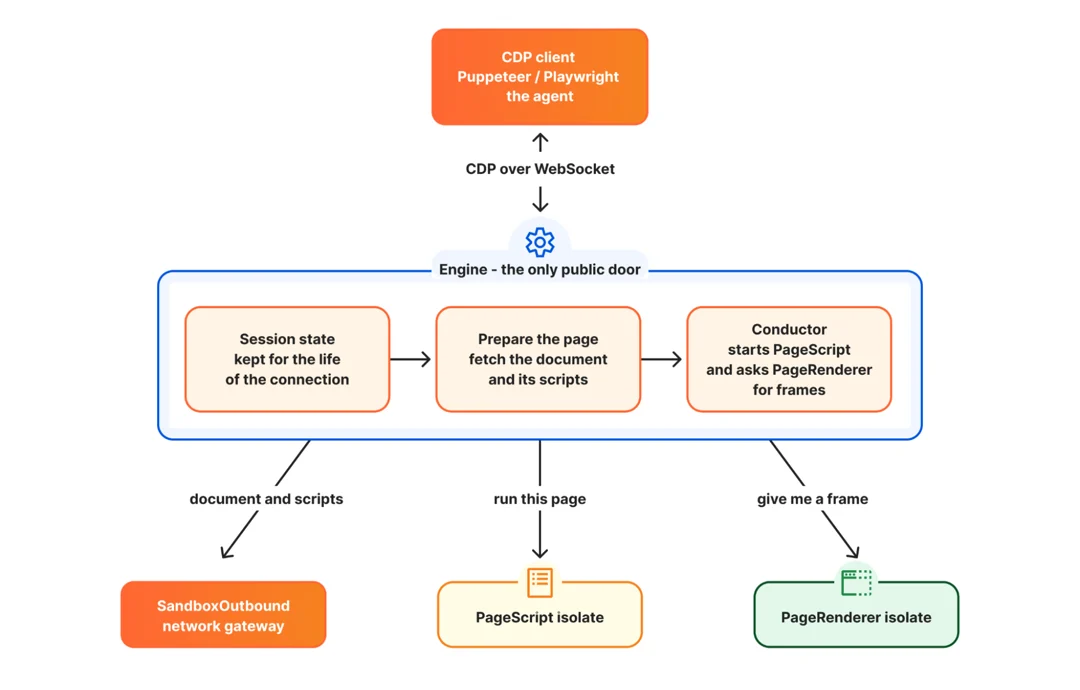
Kitesurf's internal structure is mainly divided into three parts: 'Engine,' 'PageScript,' and 'PageRenderer.' The Engine manages the overall state of the browser, PageScript reads HTML and CSS and executes JavaScript, and PageRenderer creates the final screen, screenshots, PDFs, etc.
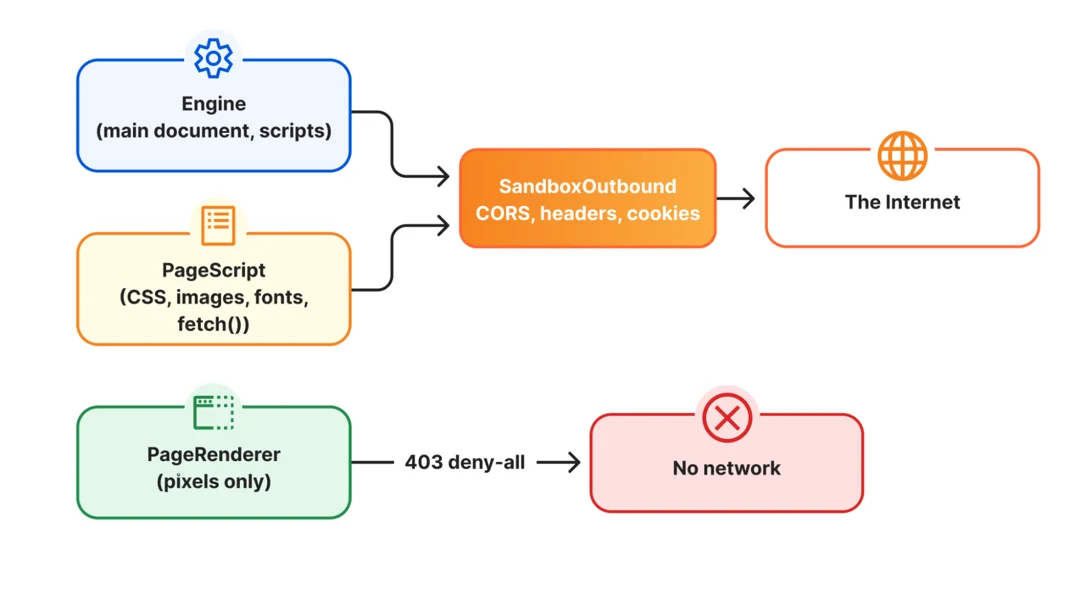
Furthermore, images, fonts, CSS, JavaScript, and other elements loaded from web pages are all obtained through a dedicated section called 'SandboxOutbound.' By preventing direct access to the internet from other parts of the system, the impact of any website the AI agent opens is kept to a minimum.
Kitesurf supports a portion of
Cloudflare measured performance five times for 14 URLs and compared the median values with Chromium, demonstrating that Kitesurf can process tasks with less CPU and memory. CPU usage for screenshot acquisition was 1173 milliseconds for Chromium compared to 380 milliseconds for Kitesurf, and for HTML extraction it was 877 milliseconds compared to 229 milliseconds for Kitesurf. Memory usage also decreased from 271.0 MiB to 57.8 MiB for screenshot acquisition and from 273.7 MiB to 39.4 MiB for HTML extraction.
However, the processing time itself is currently shorter with Chromium. For screenshot acquisition, Kitesurf took 1148 milliseconds compared to Chromium's 637 milliseconds, and for HTML extraction, Kitesurf took 820 milliseconds compared to Chromium's 472 milliseconds. According to Cloudflare, much of this difference lies in the process of converting the screen to an image and converting to JPEG/PNG, and they plan to improve this in the future.
Furthermore, in the 'Web Platform Tests,' which examine the extent to which browsers comply with web standards, Kitesurf has already passed more than 215,000 tests. Cloudflare is also making progress in supporting crucial elements for AI agents to handle web pages, such as HTML, CSS, DOM, and SVG, and is passing hundreds of tests every week.
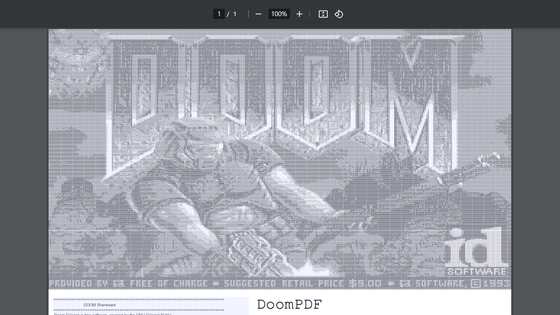
Furthermore, Cloudflare also ran 'DOOM' to verify Kitesurf's functionality. The test used was '

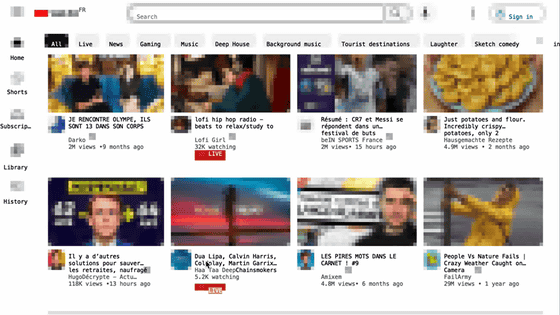
In actual websites, Cloudflare can correctly display Wikipedia, Hacker News, the Cloudflare Blog, and TodoMVC, which is built with React, Vue, Angular, and Preact. However, it cannot yet display all websites perfectly, and Cloudflare is continuing to improve its capabilities by increasing the number of supported web standards and handling more complex pages.
Kitesurf is particularly well-suited for short tasks such as extracting web page content or creating screenshots and PDFs. However, it is currently unsuitable for tasks like video playback, accessing WebGL-based pages, visiting sites with strict bot protection, or maintaining long-term login states. For such cases, using a Chromium-based Browser Run is recommended.
Related Posts: