Meta has released a beta version of 'Muse Code,' a terminal coding agent powered by Muse Spark 1.2.

On August 5, 2026, Meta announced the beta version of Muse Code , a coding agent that runs on the terminal, and its underlying model, Muse Spark 1.2 . It handles large code repositories, providing end-to-end support for planning, implementing, and verifying changes, and is suitable for complex software development projects that span long periods.
Introducing Muse Code and Muse Spark 1.2 | Meta AI Research
Muse Code is a coding agent available from the terminal on macOS or Linux. It not only generates code snippets, but also surveys entire repositories to plan necessary changes, and even performs testing and verification after you've written the code.
One of its key features is the 'asynchronous background agent,' which operates in parallel with the main agent. The auxiliary agent continuously gathers information and performs verification, reporting the results when necessary, allowing the main agent to focus on overall strategy and implementation.
Muse Code records actions such as instructing models, running tools, editing files, and user approvals in a local event log. This log is used to restore the state, so even if processing crashes, you can resume work from where you left off.
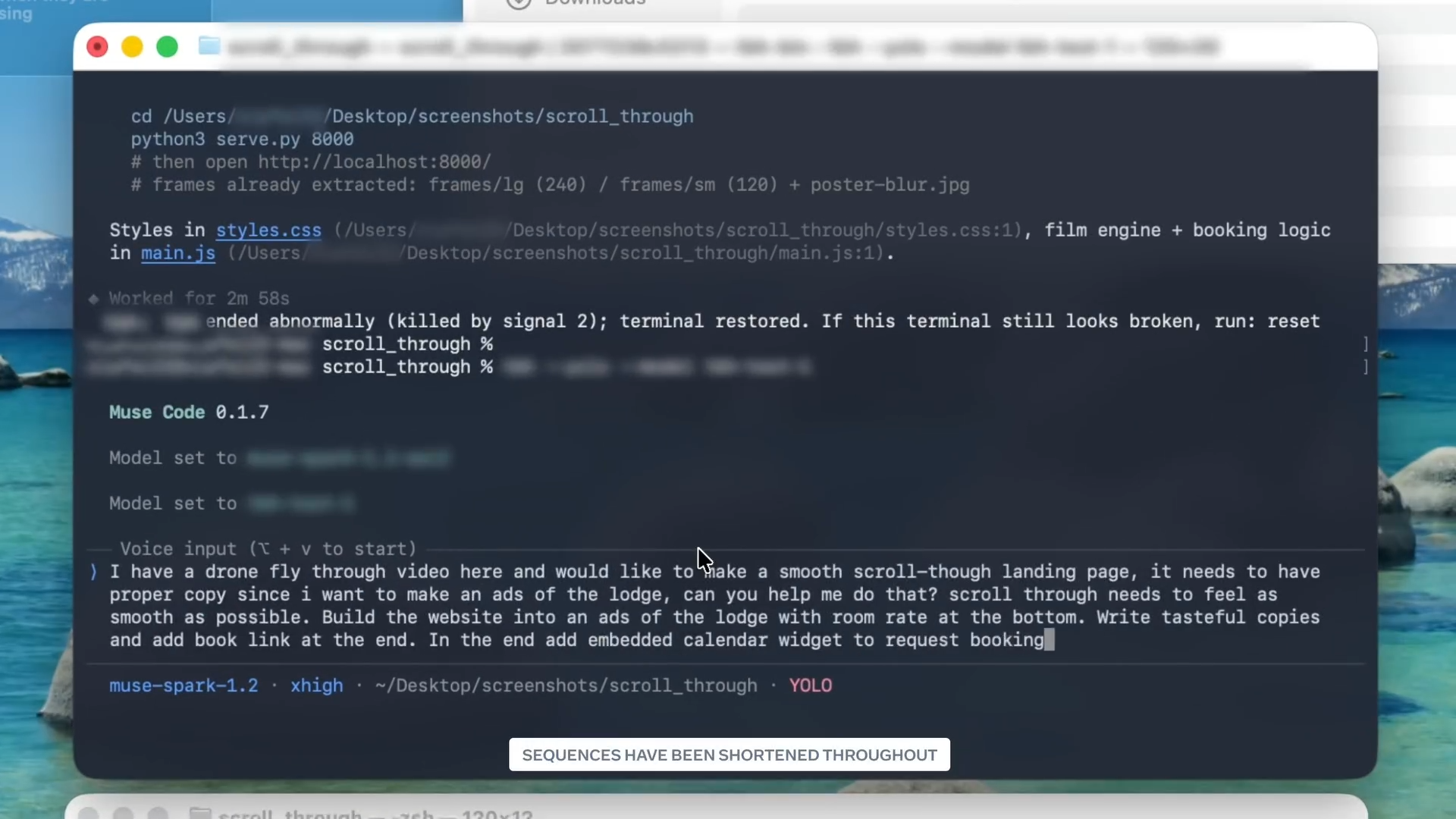
Commands are also available to assist with your work: '/plan' breaks down tasks into execution plans, and '/grill' checks for weaknesses in those plans. '/goal' is a function that allows you to continue working until you achieve a specified goal.
The foundational Muse Spark 1.2 is a refined version of the previous
Muse Spark 1.2 and Muse Code are jointly trained to deliver high performance when used together. The training process utilizes rejection sampling, which selects the best execution history from multiple execution histories, enhancing the ability to maintain goals over long periods of time, compress necessary information and retain it in context, and appropriately utilize auxiliary agents.
According to Meta, the older Muse Spark 1.1 model was also used to create the training data. They built the training data for Muse Spark 1.2 by having Muse Spark 1.1 generate difficult coding tasks and instructions and score whether the answers met the requirements.
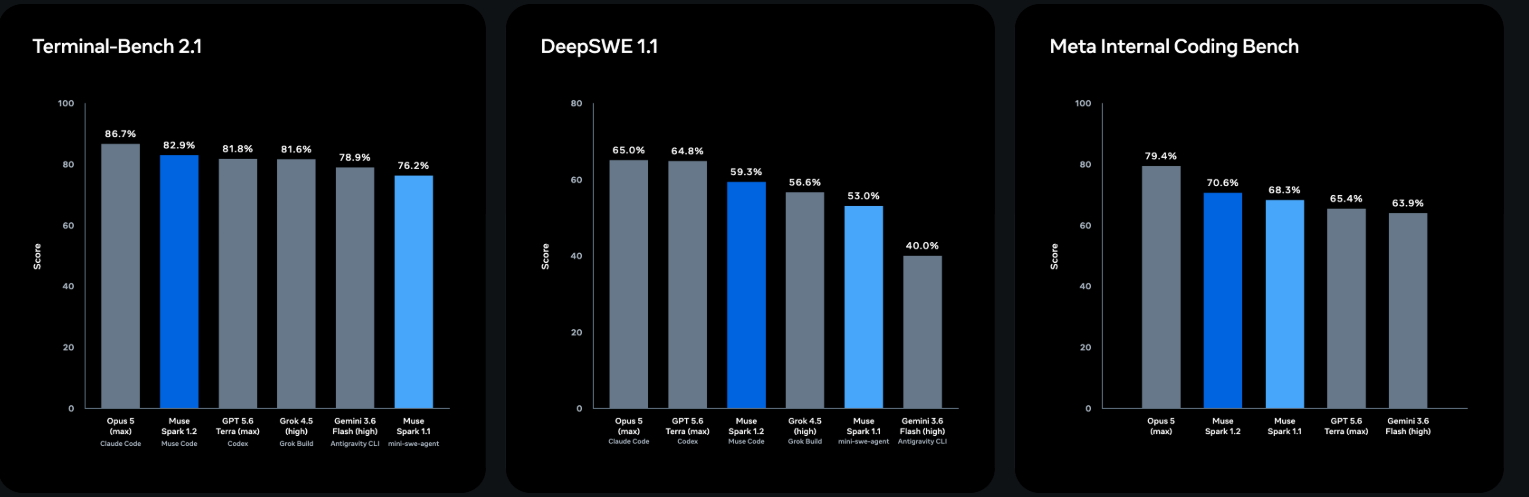
In various benchmarks, the combination of Muse Spark 1.2 and Muse Code scored 82.9% in Terminal-Bench 2.1, which measures how well it can handle tasks in the terminal, placing it second behind Claude Opus 5 and Claude Code at 86.7%. In DeepSWE 1.1, which measures the ability to actually modify repositories, it scored 59.3%, placing it third behind Claude Opus 5 at 65.0% and GPT-5.6 Terra at 64.8%.
On the other hand, an evaluation using 440 development challenges within Meta showed a score of 70.6%. While this fell short of Claude Opus 5's 79.4%, it surpassed the previous models Muse Spark 1.1 (68.3%) and GPT-5.6 Terra (65.4%). However, Meta cautions that these results do not represent a strict comparison of the performance of the individual models, as different coding agents were used in combination with each model.
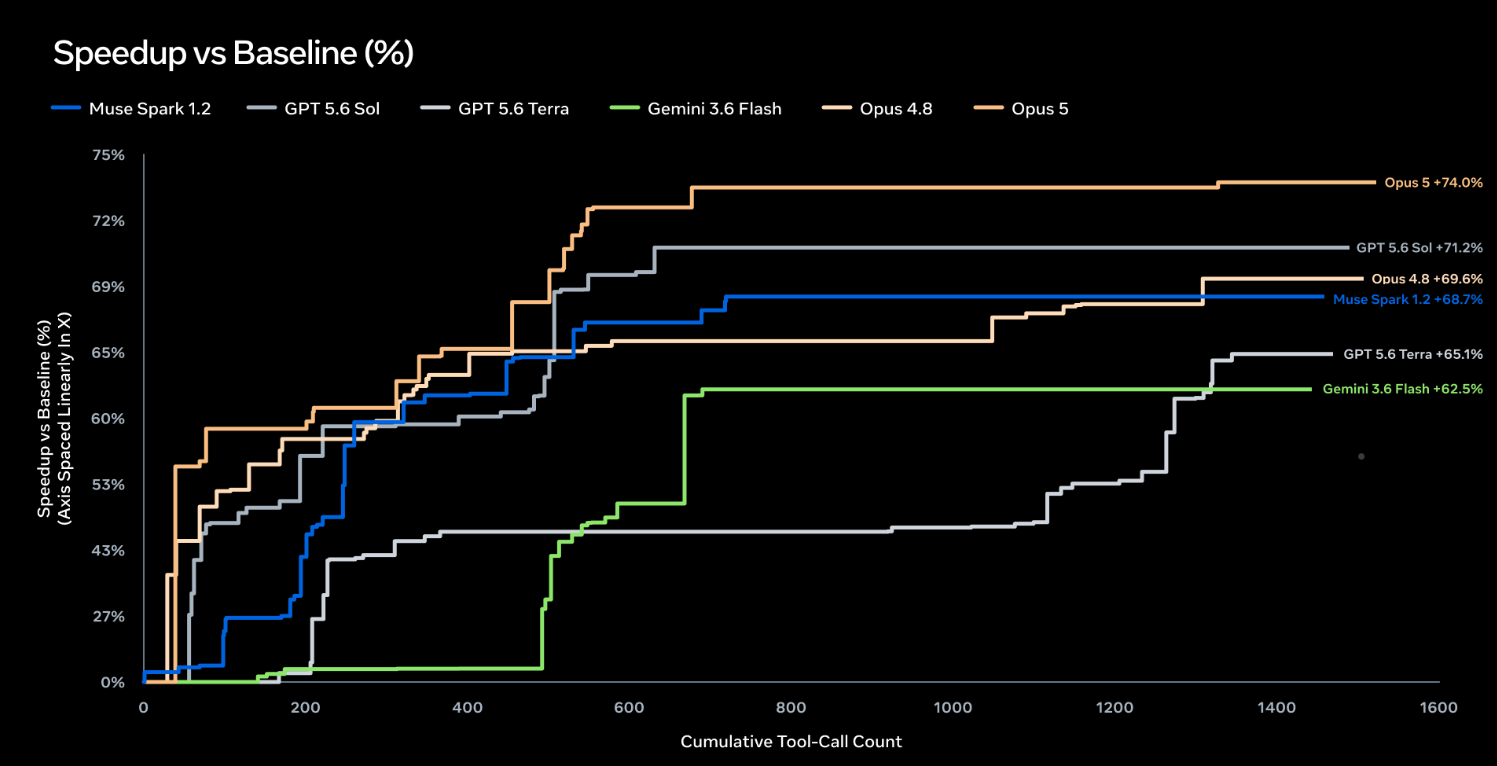
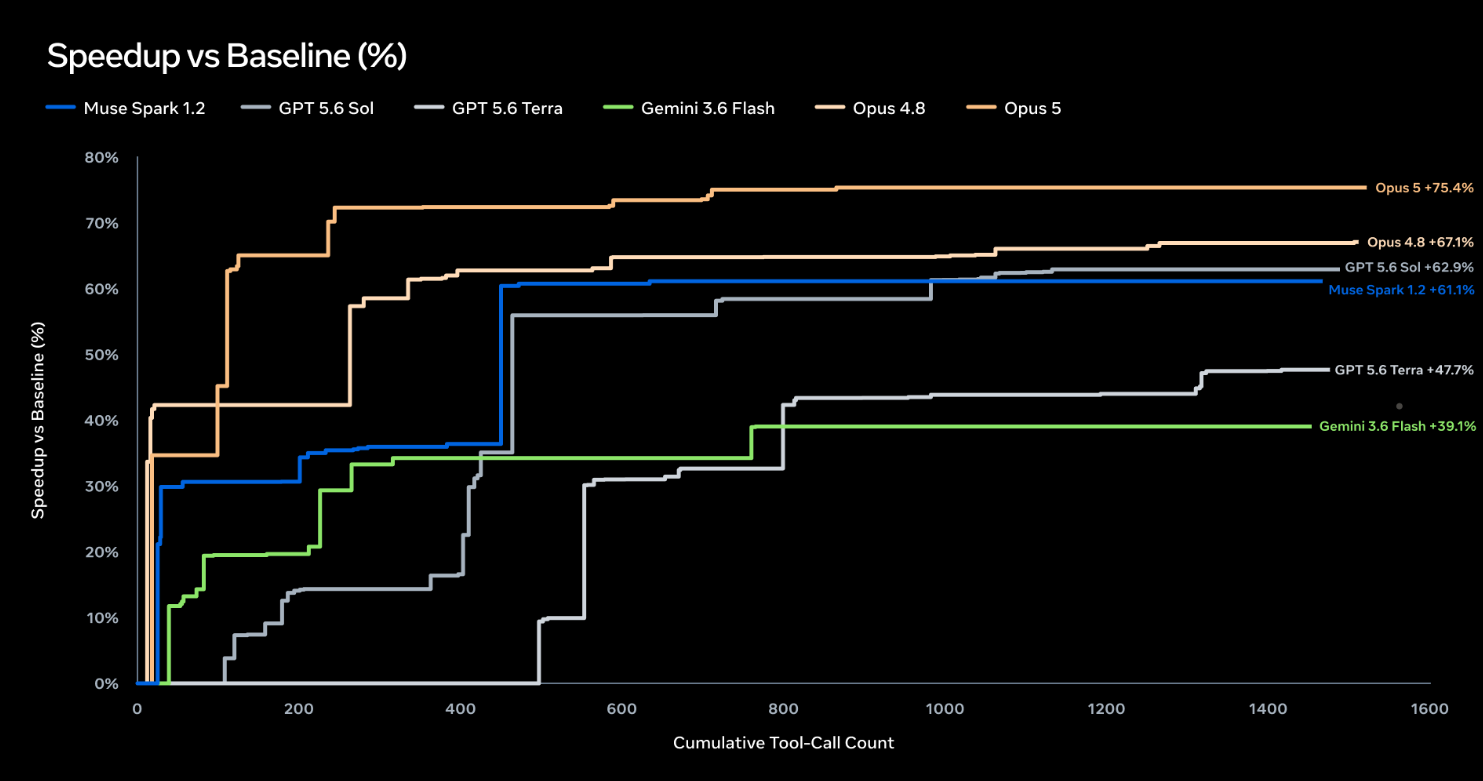
To determine if autonomous development could proceed over extended periods, Meta also conducted experiments to accelerate kernels handling two types of processing, KDA and MLA, for NVIDIA's Hopper generation GPUs. The combination of Muse Code and Muse Spark 1.2 involved repeatedly creating, compiling, measuring performance, and modifying code, executing over 1,000 tool calls over up to 24 hours, and significantly accelerating the baseline implementation.
The graph below shows the cumulative number of tool calls on the horizontal axis and the speedup rate compared to the baseline implementation on the vertical axis, with higher lines indicating a greater speedup rate. In the KDA, Muse Spark 1.2 ultimately achieved a speedup of 68.7%, following Opus 5 at 74.0%, GPT-5.6 Sol at 71.2%, and Opus 4.8 at 69.6%.
The MLA (Multiple Listing Agreement) compares how much faster each implementation is compared to a standard PyTorch implementation, under specific conditions. Muse Spark 1.2 exceeded a 60% speedup when the tool calls reached approximately 450, and ultimately achieved a 61.1% speedup. While this fell short of Opus 5's 75.4%, Opus 4.8's 67.1%, and GPT-5.6 Sol's 62.9%, it surpassed GPT-5.6 Terra's 47.7% and Gemini 3.6 Flash's 39.1%.
To speed things up, Meta reduced redundant calculations and data transfers by sharing the compressed data that serves as the basis for both the key (K) and value (V) that the AI uses when processing text. Furthermore, Meta reports that they designed a Triton pipeline consisting of two kernels by combining 'kernel fusion,' which combines multiple processes that were originally separate, and 'tiling,' which divides data into smaller units for processing.
Muse Spark 1.2 is integrated into Muse Code and is also available through the Meta Model API. Muse Code is in beta at the time of writing, and Meta plans to expand the agent environment's functionality and introduce larger, higher-performance models in the future.
Related Posts: