Night owl men are more prone to developing premature ejaculation.

Recent research has revealed that men who prefer to stay up late are more likely to develop acquired premature ejaculation, and their symptoms tend to be more severe than those of men who wake up early.
Chronotype is associated with acquired premature ejaculation: evidence from moderated mediation analysis | The Journal of Sexual Medicine | Oxford Academic
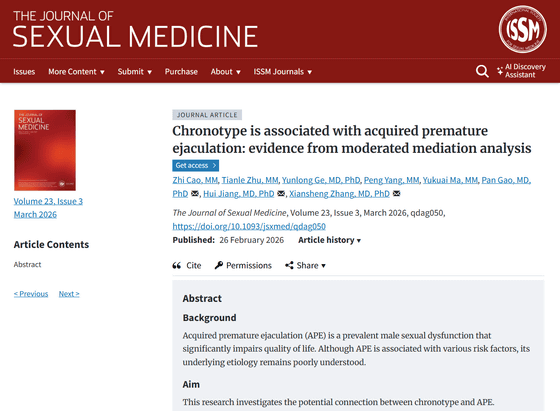
Night owls may face a higher risk of acquired premature ejaculation
https://www.psypost.org/night-owls-may-face-a-higher-risk-of-acquired-premature-ejaculation/
Premature ejaculation is one of the most common sexual dysfunctions seen in men worldwide. Doctors classify premature ejaculation into two main types based on when it started. One is ' lifelong (primary) premature ejaculation .' This type of premature ejaculation exists from the time of the first sexual experience and is characterized by ejaculation occurring much earlier than desired and remaining uncontrollable.
In contrast, acquired ejaculatory dysfunction is called 'acquired premature ejaculation.' This condition typically involves ejaculation occurring in less than three minutes. This change can cause psychological distress and rapidly reduce the quality of life.
Medical professionals have identified several risk factors for acquired premature ejaculation, including chronic pelvic pain, anxiety, and thyroid disorders. However, the exact biological and behavioral roots of this condition remain largely unknown.
Among physicians in clinical practice, common patterns among patients with acquired premature ejaculation have been identified, such as 'going to bed late' and 'having an irregular sleep schedule.' Furthermore, it appears that many patients who experience extreme mood swings and have difficulty maintaining a healthy daily life also suffer from acquired premature ejaculation.
Based on this pattern, some researchers have come to believe that
Generally, humans are classified into morning types, intermediate types, and evening types based on their circadian rhythms. Of these, evening types tend to have poorer sleep quality and are known to be more prone to anxiety and depressive symptoms. Furthermore, anxiety and depressive symptoms are known risk factors for sexual dysfunction.
Dr. Zi Cao, the lead author of a paper published in the academic journal *The Journal of Sexual Medicine*, and a research team from the First Affiliated Hospital of Anhui Medical University and the First Hospital of Peking University in China are investigating the relationship between acquired premature ejaculation and circadian rhythms.
The research team also examined the impact of specific behavioral habits on acquired premature ejaculation. Specifically, they focused on lifestyle habits that promote health, such as a balanced diet, regular exercise, and proactive stress management. Previous studies have linked health-promoting habits to improved erectile function and a reduced risk of sexual dysfunction in general.
The study involved 516 male patients diagnosed with acquired premature ejaculation and 495 healthy control subjects. Participants completed questionnaires regarding ejaculation control ability, basic erectile function levels, and circadian rhythms. The study also investigated lifestyle habits they practiced for health promotion.
Furthermore, men diagnosed with acquired premature ejaculation also completed an additional questionnaire to measure their awareness of the condition. The research team explained, 'A high level of awareness of the condition means that patients feel a deep burden and despair about their symptoms, while a low level of awareness suggests that they perceive the condition as manageable.'

The study revealed that patients with acquired premature ejaculation generally had lower scores for morning-person tendencies and lifestyle habits compared to a healthy control group. In other words, the stronger the tendency to stay up late, the worse the ejaculation control tended to be.
Circadian rhythms regulate numerous physiological processes, including the production of important neurotransmitters such as serotonin and dopamine. Animal studies have shown that serotonin levels fluctuate with circadian rhythms, and serotonin in the central nervous system has been shown to be closely related to intravaginal ejaculation latency . Therefore, it is quite possible that disruptions in circadian rhythms, which are common in night owls, affect ejaculation at a biological level.
In addition, it has become clear that night owls tend to engage in health-promoting behaviors less frequently. This decrease in healthy habits is also correlated with the worsening of acquired premature ejaculation symptoms.
Furthermore, men who felt a strong threat and lack of control regarding their sexual health showed a weaker positive correlation between being a morning person and having better lifestyle habits. In other words, people who have a high level of anxiety or caution about acquired premature ejaculation may not reap the full benefits of leading a healthy lifestyle.
However, this study does not assert that being a night owl is a direct cause of acquired premature ejaculation. Furthermore, it should be considered that the study's subjects were recruited from a single hospital, making it a very limited demographic sample.
Related Posts:






in Science, Posted by logu_ii