'Inclusive Color Space' is a new color space that expresses human skin tones by manually analyzing data to determine 'What color are we?'
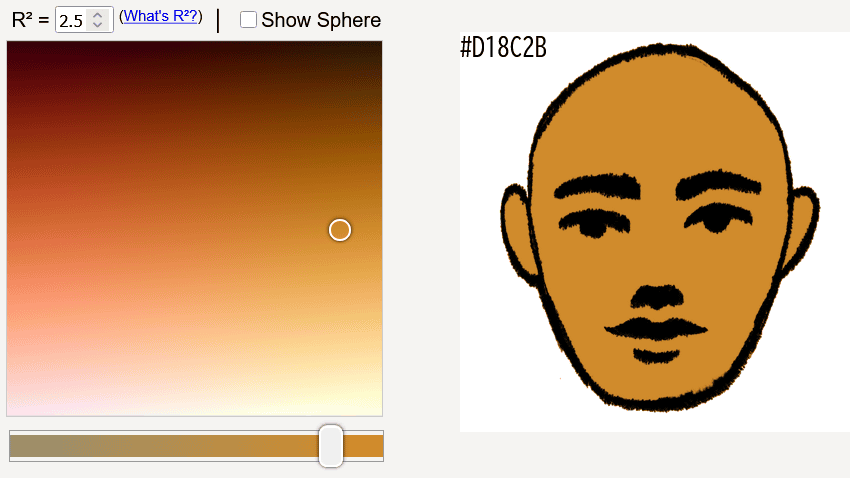
When coloring portraits, it's often difficult to decide what color to use to represent 'human skin tone.' In the 2000s, as part of efforts to combat discrimination, the name '
What Colors Are We? Constructing A Color Space For Skin Tones
https://toneyalexander.github.io/inclusive-color-space/
Inclusive Color Space is an experimental color space released by software engineer Tony Alexander. Alexander says, 'Representing human skin tones digitally is a very difficult problem. Often, it is said that the full range of diversity can be covered with a limited number of color combinations, but using certain color combinations may not accurately represent many people or may unintentionally exclude them. The goal of this project is to identify the widest color gamut in the RGB color space that corresponds to reasonable yet simplified skin tones. In particular, we aimed to identify a simple and sufficient equation to define that range and make it usable in a variety of situations.'
Alexander first manually labeled the dataset with RGB colors to get a rough understanding of its shape. He then performed a 3D (N=3) principal component analysis on the dataset to transform it into a more manageable shape. From there, he used graphing software to manually create equations that map the spheres in the target space to transformed data in XYZ or PCA space. Alexander cautioned that this method was 'unscientific,' and stated that engineers 'don't need to be perfect.'
The data is graphed below. It takes the shape of a banana flowing between '0, 0, 0' and '255, 255, 255'.
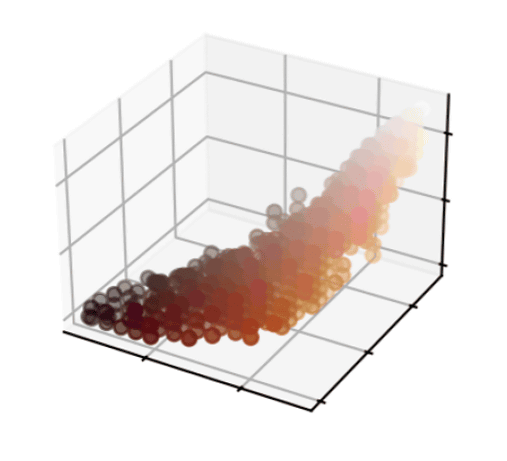
Alexander applied
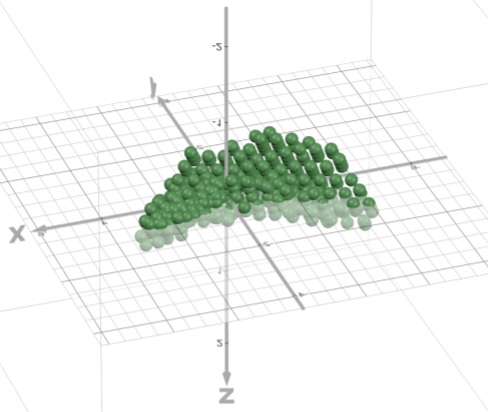
Alexander then manually refined a simple mathematical formula that could approximate the entire skin tone data distributed in the PCA space. This formula allowed him to mathematically represent the 'reasonable range for human skin tone,' and he used the results to build the Inclusive Color Space color picker.
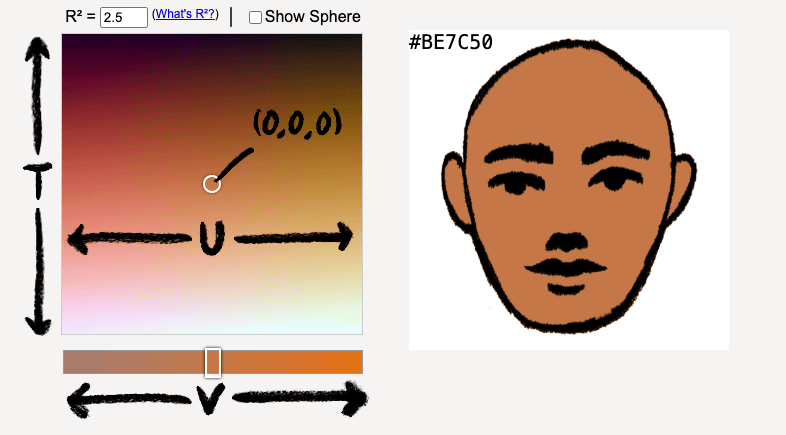
While typical color pickers allow you to adjust 'RGB' or 'Hue, Saturation, and Brightness,' the Inclusive Color Space uses vertical axes for 'Dark/Light Colors (T),' horizontal axes for 'Reddish/Ochre Colors (U),' and horizontal sliders for 'Cool/Warm Colors (V).' By actually manipulating the settings on the site, the color of the face illustration on the right will change.
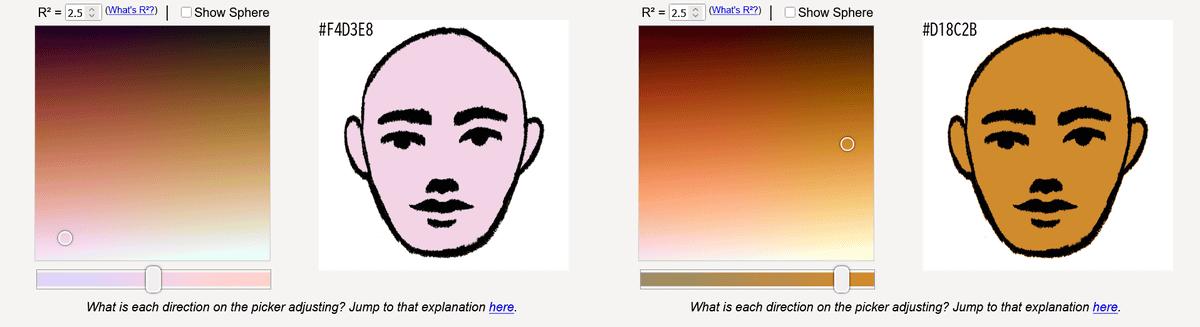
Alexander said, 'We've managed to put together a color space, a corresponding picker, a procedural generation algorithm, and a methodology for creating new spaces or modifying existing ones. Overall, I'm very happy with the result. It's not perfect, of course, but I don't think there's a simple, perfectly correct solution. I've already tried using the picker in digital painting and got the results I expected. I'm looking forward to using the generator in future projects. My challenge now is to organize the code and post it to the repository on this page so that others can easily reproduce and improve upon this work.'
The Inclusive Color Space repository is publicly available on GitHub.
GitHub - Toney Alexander/inclusive-color-space · GitHub
https://github.com/ToneyAlexander/inclusive-color-space
Related Posts:


in Web Service, Creation, Posted by log1e_dh