How does sighing affect attention?

Sighs, which occur when we are tired or bored, are thought to have the potential to improve not only our breathing but also our attention span. A research team at Trinity College Dublin in Ireland has reported the results of an analysis of how breathing, pupils, and attention change before and after sighing.
Sighs Shape Respiratory Variability and Pupil Dynamics and Adapt to Sustained Attention Demands - Andrews - 2026 - Psychophysiology - Wiley Online Library
Scientists reveal what is actually happening to your body when you let out a random sigh
https://www.psypost.org/scientists-reveal-what-is-actually-happening-to-your-body-when-you-let-out-a-random-sigh/

Human breathing is not always constant in terms of speed or depth; it naturally changes in response to factors such as physical activity, emotions, and arousal level. While this variation in breathing allows the body to adapt to changing situations, it is thought that the accumulation of irregular variations leads to occasional deep breaths that regulate the breathing pattern. In this study, 'sighing' refers not only to exhalations caused by disappointment, but also to naturally occurring deep breaths where one inhales more deeply than usual.
Ralph W.G. Andrews and colleagues at Trinity College Dublin used data from two sustained attention tasks obtained in a separate study to investigate whether sighing resets not only breathing but also arousal and attention.
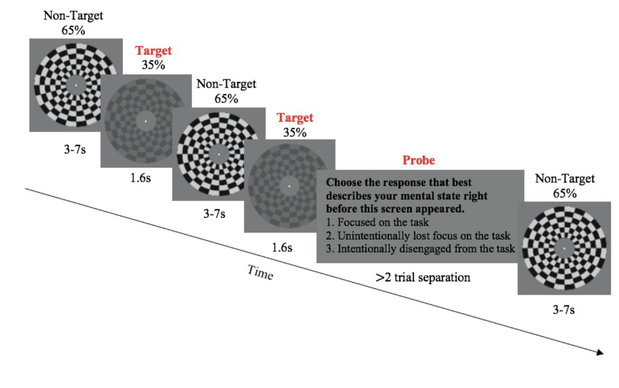
The first task involved 72 participants in a visual task where they had to continuously stare at a circular pattern displayed on the screen and click the mouse when the pattern's contrast decreased. The task consisted of eight 8-minute blocks, with questions about their attentional state immediately prior to the task appearing in between.
The following diagram illustrates the flow of the visual task, where '65%' and '35%' indicate the contrast of the pattern. The contrast of the pattern decreases from 65% to 35% over 1.6 seconds, and a question screen appears midway through, asking the participant to select their attentional state immediately before the task from three options: 'concentrated on the task,' 'unconsciously distracted,' or 'intentionally taking their attention away from the task.'
The second auditory task involved 57 participants who listened to a 21-minute cycle of high and low pitches, clicking a mouse in time with the sound changes. Participants were randomly assigned to two groups in the original experiment; 32 of the participants in this analysis were given no breathing instructions, while the remaining 25 were instructed to inhale during the high pitches and exhale during the low pitches. The high and low pitch cycles were not constant, gradually slowing from 0.15Hz to 0.1Hz before returning to 0.15Hz.
In both tasks, the research team measured participants' breathing using a belt attached to the lower part of their chest, and defined a breath with an inhalation depth more than twice the average for each participant as a 'sigh.' Simultaneously, pupil diameter was recorded with a camera to examine how breathing and responses to the task changed before and after sighing, and to compare pupil changes associated with sighing and normal breathing.
The results showed that in both the group performing the visual task and the group that did not receive instructions on breathing techniques during the auditory task, the frequency of sighing increased as the task progressed, and the overall variability in breathing rate and depth also increased. Furthermore, immediately after sighing, the variability in breathing rate and depth decreased, and the changes in breathing depth became more regular. On the other hand, the regularity of breathing rate decreased in the group performing the visual task, while there was no significant change in the group performing the auditory task, leading the research team to conclude that 'sighing adjusts breathing patterns according to the situation.'

Furthermore, the group that was not instructed on breathing techniques during the auditory task sighed an average of 0.45 times per minute, compared to an average of 0.17 times per minute in the group that was instructed to breathe in time with the rhythm of the sound. In the group that was instructed to breathe in time with the rhythm of the sound, no significant change in breathing variability was observed before and after sighing.
Changes associated with sighing were also observed in pupil size. Participants in the visual task showed gradual pupil dilation during sighing, while in the auditory task group, who were not instructed on breathing methods, pupils dilated significantly after the start of inhalation before constricting. Since pupil diameter is used as an indirect indicator of noradrenaline activity related to arousal levels, the research team believes that sighing may also be involved in physiological changes in arousal. However, because the difference in pupil changes between sighing and normal breathing was no longer statistically significant after statistical adjustment, the research team considers the results regarding pupils to be 'exploratory evidence.'
Furthermore, there was no significant difference in reaction time to the task or its variability before and after sighing. Responses to the visual task question, 'Were you concentrating on the task or thinking about something unrelated to the task?', also did not change before and after sighing. Under these conditions, while physical changes associated with sighing were observed, no improvement in objective task performance or subjective concentration was confirmed.
The research team states that the tasks used in this experiment were monotonous and of low difficulty, and the participants' performance was stable, so 'it is possible that the change in attention caused by sighing was too small to be detected.' They also say that because sighing was judged solely by the depth of breathing, it is possible that yawns were mistakenly identified as sighs. The research team points out that different results may be obtained with more difficult tasks or in situations with higher levels of arousal, and that further research is needed to investigate the effect of sighing on attention.
Related Posts:







in Science, Posted by log1b_ok