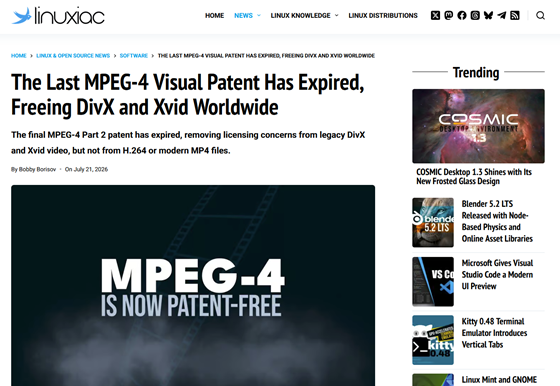
The last patent held by Via for the video compression standard 'MPEG-4 Visual,' known as DivX and Xvid, has expired.

The last remaining patent for the ' MPEG-4 Visual (MPEG-4 Part 2)' video compression standard used in DivX and Xvid expired in Brazil on July 19, 2026, according to the patent list of the Via Licensing Alliance, which manages and licenses the patents.
The Last MPEG-4 Visual Patent Has Expired, Freeing DivX and Xvid Worldwide
https://linuxiac.com/the-last-mpeg-4-visual-patent-has-expired/
MPEG-4 Visual is an international standard that defines a method for reducing the size of video data for storage and transmission. It became widely adopted in the 2000s through its use in DivX and the open-source Xvid. To incorporate MPEG-4 Visual into a product and provide that product in countries and regions where related patents are valid, permission to use the patents necessary for implementing the standard must be obtained from the rights holders. The Via Licensing Alliance compiled patents from multiple companies that it deemed necessary for implementation into a single patent portfolio called the 'MPEG-4 Visual Patent Portfolio,' allowing users to obtain permission to use them all at once without having to negotiate with individual patent holders. This type of system is called a ' patent pool .'
Because patents are valid on a country-by-country/region-by-region basis, the expiration dates of patents related to the same technology are not uniform. The Via Licensing Alliance's patent list (PDF file) as of January 1, 2026, showed only two patents valid in Brazil. Of these, the patent held by Dolby Laboratories Licensing Corporation expired on January 26, 2026, leaving only Siemens AG's 'BR PI0109962-0' in the final list (PDF file) as of July 1, 2026. With this patent expiring on July 19, 2026, there are no longer any valid patents in the Via Licensing Alliance's patent pool.
Linuxiac, a media outlet specializing in Linux and open source, points out that the expiration of the patent will have 'little to no visible change for the average user.' This is because video playback software such as ' VLC media player ' and ' FFmpeg ,' which is used for video conversion and processing, have long supported MPEG-4 Visual, and the expiration of the patent itself does not improve the image quality or playback quality of older videos.

On the other hand, software developers and distributors will be affected because they will no longer need to consider licensing fees based on the Via Licensing Alliance patent pool when incorporating MPEG-4 Visual encoding and decoding capabilities into their products. According to Linuxiac, Linux distributions that are strict about handling patented technologies may have less reason to restrict or separate MPEG-4 Visual-related components into different repositories.
Furthermore, digital archives that store videos compressed with DivX or Xvid in the 2000s will now be able to continue supporting older video formats without having to consider whether or not licensing is necessary for patents managed by the Via Licensing Alliance.
It should be noted that, although the names are similar, MPEG-4 Visual and the video file format 'MP4' are different things. MPEG-4 Visual defines a method for compressing video, while MP4 is a container format that can store video using various compression methods. Linuxiac explains that most MP4 files currently created use 'H.264/AVC,' and that this expiration will not affect the H.264/AVC patents or licenses.
However, it's important to note that the Via Licensing Alliance has not guaranteed that 'all the patents necessary for implementing MPEG-4 Visual were included in this patent pool.'
Related Posts:




in Software, Posted by log1b_ok