A Canadian government has issued a site blocking order that includes 'piracy sites that may emerge in the future,' allowing for blocking without legal action even if the sites are circumvented by changing their domain names.

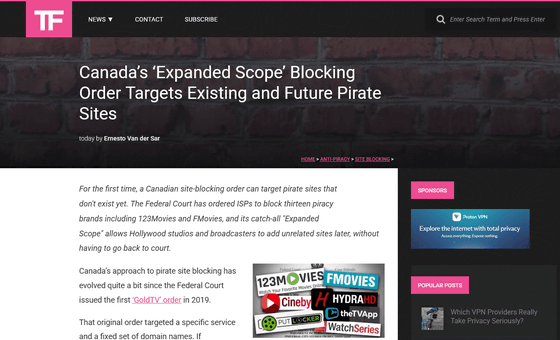
A Canadian federal court has granted a blocking order requested by various Hollywood studios, including Netflix, Disney, and Warner Bros., ordering internet service providers (ISPs) to block 13 pirated websites. The order includes a comprehensive 'expansion of scope,' allowing rights holders to add sites not included in the blocking order without having to reapply to the court.
Canada's 'Expanded Scope' Blocking Order Targets Existing and Future Pirate Sites * TorrentFreak
When the Canadian Federal Court first issued a 'piracy site blocking order' in 2019, it targeted specific services and fixed domain names. Therefore, if a new piracy site appeared or a regulated site changed its domain and continued operating, it was necessary to file another appeal with the court.
Subsequently, in June 2026, orders were issued against several streaming services that broadened the scope of blocking, allowing rights holders to add 'potentially emerging alternative domains' and 'counterfeit sites of already designated brands' to their blocklists. This eliminated the need for rights holders to file new lawsuits every time a new domain appeared, but the process of 'filing another petition with federal court and obtaining a new order' was still required to block new sites.
Then, in July 2026, a block order targeting 13 pirated brands, requested by Rogers, TVA, Netflix, and various Hollywood studios such as Disney and Warner Bros., included not only existing domain names but also future domains using the same brand name, regardless of whether they were operated by the same company as existing pirated sites. This injunction had a new feature called 'expanded scope,' which extended the scope beyond a single brand and its imitations to include 'similar infringing platforms operating under other brand names.' This effectively means that new pirated sites and services that meet certain conditions can be added to the block list without having to file another lawsuit.

The federal judge wrote in the order, 'When pirated sites are blocked by court order, new pirated sites quickly gain popularity and replace the blocked sites. This measure is necessary to address this never-ending battle against piracy.'
If a new pirated content site actually appears, the rights holder must submit an affidavit to their ISP confirming that the site meets the conditions of the order. These conditions include: 'the sole or primary purpose of the service in question is the unauthorized distribution of studio movies or television programs'; 'it operates in a similar manner to IPTV or open web pirated content services'; 'it is accessible within Canada'; and 'the operator has been sent an infringement notice and asked to respond within 7 days.'
If the affected ISP does not submit a notice of objection within five business days, the blocking list will be updated without any hearing or additional court order. The list will be updated without any objection, even if the ISP has not explicitly consented, and the court will not be involved in any way.
However, this order did not grant all of the rights holders' demands. The rights holders had hoped that the new order would apply to 'all works for which the petitioner owns the copyright,' but the order limits its scope to 'the petitioner's works,' that is, 'the works specifically listed in the judgment.' As a result, the film studios cannot add works to the list based on newly acquired copyrights in the future, and in that case they would need to seek a court decision again.
Canadian ISP TekSavvy has protested the ruling, stating, 'We consider the blocking order a serious breach of network neutrality and a fundamental change to our operations as an ISP. The principles of common transport and network neutrality mean that ISPs transmit traffic to end users in the most neutral way possible.'
This order is valid for two years, and at the time it was issued, the blocklist included 13 domains and 5 subdomains. It remains to be seen how many more domains will be added without court intervention before the order expires.
Related Posts:








in Web Service, Posted by log1e_dh