The Canadian province of Ontario is being sued for allegedly using an AI-powered prisoner classification system to unfairly assign Black prisoners to high-security facilities.
In prisons in Ontario, Canada, an AI-powered security assessment tool called 'SAFER' has been used since 2021 to assign risk scores to inmates based on factors such as arrest and disciplinary records. SAFER has drawn criticism for assigning unfairly high risk scores to Black inmates, and a class-action lawsuit has been filed.
Black prisoners are assigned harsher living conditions in Ontario jails—thanks to AI ⋆ The Breach
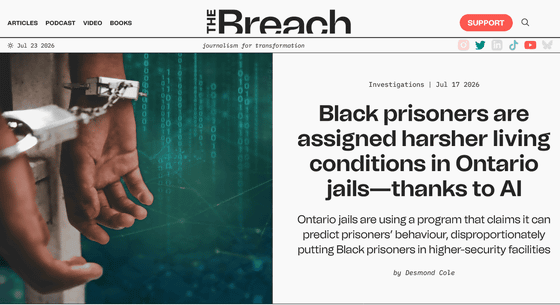
The Security Assessment for Evaluating Risk (SAFER) program is an algorithm that has been in operation in Ontario prisons since early 2021. By inputting personal information about inmates, such as arrest records, indictments, and disciplinary records, the AI assigns each inmate a score from 0 to 100. Based on their score, inmates are assigned to facilities with the lowest, medium, or highest level of security. Specifically, in medium-security facilities allow for two glass-enclosed visits per week, while highest-security facilities only allow one video visit per week, and inmates' freedoms are severely restricted in other aspects as well.
Critics of SAFER claim that the data provided to SAFER is racially biased. They argue that while SAFER is an algorithm that performs risk assessments mechanically, because police and courts impose harsher penalties on Black people due to racial discrimination, SAFER uses this data to apply harsher risk assessments to Black inmates.
The Breach , a Canadian news site that covers issues such as racial discrimination, points out that the Ontario government agency responsible for prisoners also agrees with the criticisms of SAFER. According to internal training documents obtained exclusively by The Breach, the agency stated that 'Indigenous peoples and racial minorities are subjected to systemic discrimination in the judicial system. Therefore, assessments like SAFER are likely to lead to overcrowding of Indigenous prisoners in high-security prisons.'
While Ontario has included several measures to reduce the number of Indigenous prisoners in its SAFER (Safeguards for Racial Retention) program, it has not taken any similar measures for Black prisoners. Nana Yanhull, a human rights lawyer specializing in racial justice, has strongly condemned the decision, telling The Breach in an interview, 'They are deliberately complicit in a program that will further worsen the conditions in Black prisons.'
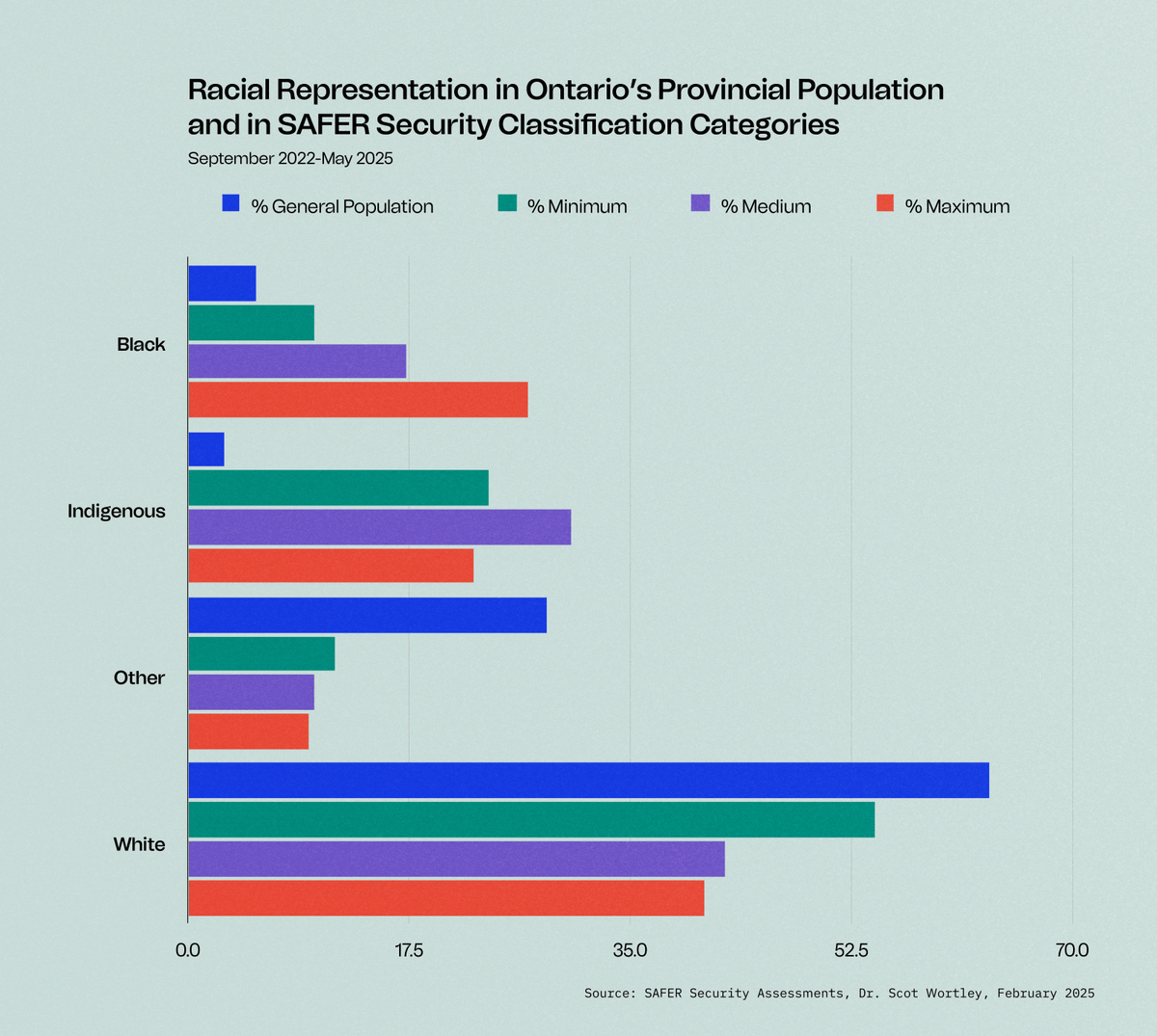
According to government data analyzed by Scott Wortley, a criminologist and professor at the University of Toronto, Black people, despite making up only 5.4% of Ontario's population, accounted for approximately 27% of all prisoners in high-security prisons between 2022 and 2025. In contrast, while white people make up 63.3% of Ontario's population, they accounted for only about 41% of prisoners in high-security prisons, a relatively small proportion of the population. Black women, in particular, were affected, with the study noting that in the 16-month period between 2024 and 2025, the proportion of Black women designated as high-security prisons by SAFER was more than twice that of white women.
Prison officials can overturn decisions made under the SAFER program and reassign prisoners to a different security classification. According to Worley's analysis, 39% of past SAFER decisions that were overturned involved Native American prisoners and 36% involved Black prisoners. However, Worley's report points out that the data does not show whether the reversal resulted in a change to a lower or higher security level.
A class-action lawsuit was filed in 2025 based on the disparity in treatment resulting from SAFER's assessments. The lawsuit alleges that SAFER violates the chartered rights of Black inmates by denying them their right to equal protection and equal benefits under the law.
Caitlin Leach, an attorney at the Koski-Minsky law firm handling the class action lawsuit, said, 'Biased decisions by police officers, judges, probation officers, and prison guards in the criminal justice system can lead to bias in the SAFER data. A Black person may be charged with a crime, while a white person in the same situation may not be. As a result, if they are incarcerated, they will have different types of criminal records, which becomes a factor in the algorithm's decision-making. The department in charge has not disclosed the specifics of how SAFER works.'
Few details have been revealed about SAFER or the specific data used for its evaluation. Documents from the Ontario Department of Incarceration claim that 'SAFER's accuracy in predicting these incidents is just as accurate for Indigenous and racial minority prisoners as it is for other groups.' The Breach contacted the Attorney General's Office to request evidence and justification for SAFER, but the department did not respond to multiple requests for comment. The Breach also contacted Dr. Grant Due, the research director of the Minnesota Department of Corrections, who is believed to be the designer of SAFER, but he also did not respond to requests for comment.
The Ontario Ombudsman, an independent body that protects citizens' rights from unfair treatment by the Ontario government and public services, has pointed out that 'the use of AI in Canadian prisons and detention centers poses a serious threat to accuracy and accountability,' and warns against relying on AI judgments that function as a 'black box' that cannot rationalize or explain the decisions and recommendations it makes. According to the Ombudsman's report, a review of the implementation of the SAFER program by government ministries is underway, but since class action lawsuits typically take several years to resolve, the SAFER program may continue to operate without modification while the lawsuits are ongoing.
Related Posts:





in AI, Posted by log1e_dh