It has been discovered that 'Bun v1.4.0,' a Rust migration version, was incorporated into Claude Code prior to its official release.

Software developer Simon Willison examined the executable file of the AI coding tool 'Claude Code' and discovered that it included 'Bun v1.4.0,' a version that had not yet been officially released. This Bun v1.4.0 is a new version that ported approximately 530,000 lines of the previous Zig code to Rust, and was actually being used on Claude Code prior to its public release.
Claude Code uses Bun written in Rust now
Bun is a 'runtime' for executing JavaScript and TypeScript programs. Although Claude Code is distributed as a standalone executable file, it uses Bun as the underlying operating system for its programs.
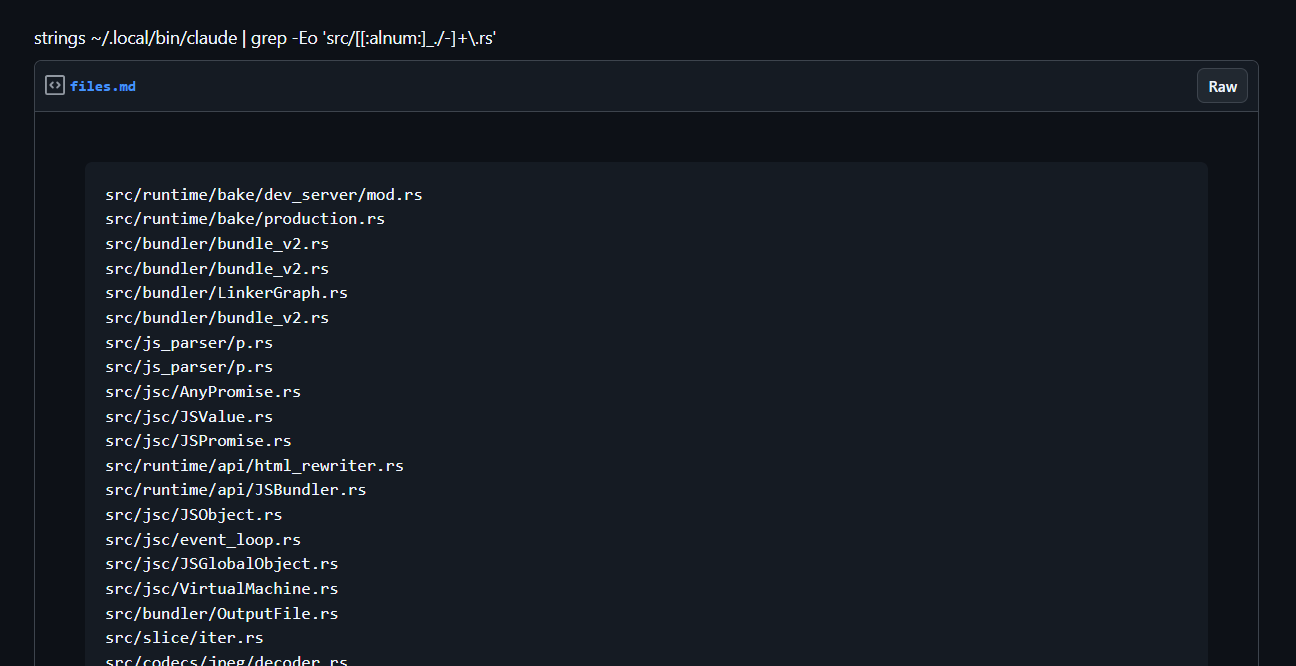
When Mr. Wilson investigated the Claude Code executable files , he found numerous strings that appeared to be Rust source filenames with the '.rs' extension, in addition to the notation 'Bun v1.4.0'.
Bun had previously been developed primarily in
Jared Sumner, the Bun developer responsible for the porting, revealed that they utilized Anthropic's AI coding tool, Claude Code. He stated that they ran multiple Claude Code instances simultaneously to distribute the tasks of code conversion and verification, and completed the project in about 11 days, bringing it to a state where it passed all tests.
Using the AI 'Claude,' all 530,000 lines of Zig code in the development tool 'Bun' were rewritten in Rust, and the creator of Zig responded on his blog - GIGAZINE

According to Sumner, Bun decided to migrate to Rust because they wanted to make memory management more secure. In Zig, developers often had to manually free up memory after use, which could lead to memory leaks due to forgetting to free memory or bugs where memory that had already been freed was being used.
On the other hand, Rust has a mechanism that allows the compiler to check how long data can be used. This makes it easier to find many memory-related problems before the program is executed, thus improving the stability of long-running software.
As of July 19, 2026, when Mr. Wilson published his findings, Bun v1.4.0 had not yet been released as a regular official version. Although the version number in Bun's code had been updated to 1.4.0 on May 17, only a canary development version had been released. This means that a pre-release Rust version of Bun was already running on many users' devices through Claude Code.
Sumner stated that 'almost no one using Claude Code noticed' the transition to the Rust version of Bun. Wilson also quoted this statement, praising the fact that the transition was made with virtually no changes to external behavior.
Related Posts: