For the first time, the names of scholars from that era have been revealed through mathematical formulas inscribed on the walls of Mayan ruins, and the research team has assessed them as 'comparable to great mathematicians of ancient times.'
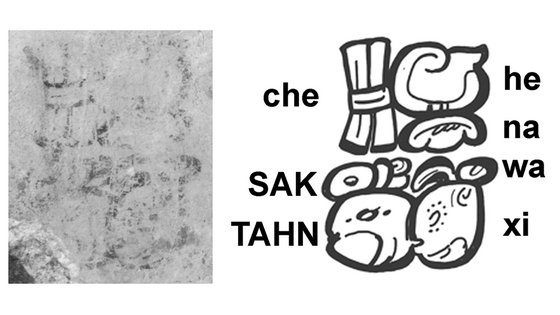
A research team from Skidmore College in the United States has deciphered mathematical formulas inscribed on a wall at the Mayan site of
The identification and work of an eighth-century Maya mathematician | Antiquity | Cambridge Core
https://www.cambridge.org/core/journals/antiquity/article/identification-and-work-of-an-eighthcentury-maya-mathematician/FDE9610F9D80ADBC245CAC2B8F204070
Mathematics formula found on Maya wall rivals insights of ancient masters
https://www.nature.com/articles/d41586-026-02170-8
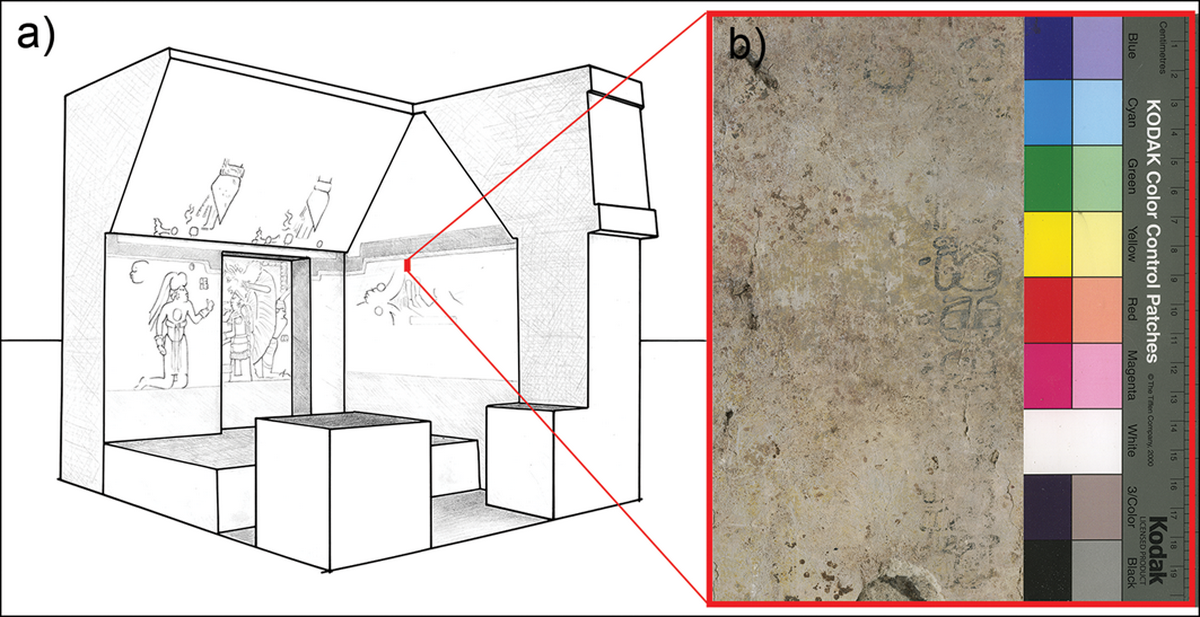
Xultun is an ancient Mayan city ruin located in northern Guatemala. Excavations were conducted between 2010 and 2012 in a small chamber of 'Xultun Structure 10K-2,' which was the subject of the study, and numerous records of calculations related to celestial periods were found, including murals, hieroglyphs, and celestial periods.
The room's walls were adorned with approximately 52 drawings of men sitting or kneeling, along with various documents. These included lunar periodic tables, extremely large numbers, and calculations correlating the cycles of Mars and Venus with calendars. The research team believes the room was a workshop for scribes or specialists who created bark manuscripts.
The document deciphered this time is a small piece of writing called 'Text 19,' painted in black pigment on the east wall. Eleven hieroglyphs are arranged in an inverted L shape, and it is only about 19.2 cm high and about 2.8 cm wide at its narrowest point. Due to the deterioration of the wall surface, the research team used infrared and multispectral imaging, as well as image processing to enhance the colors, in addition to regular photography to restore the characters.
The following image shows the reconstruction (right) of hieroglyphs from the characters (left) found in Text 19. The first nine characters of Text 19 recorded five dates spanning a total of 2920 days, along with calculations indicating the interval between them. 2920 days is five times the synodic period of Venus, which is 584 days, and also eight times the solar year of 365 days, corresponding to the period during which Venus's position relative to the sun returns to almost its original position.
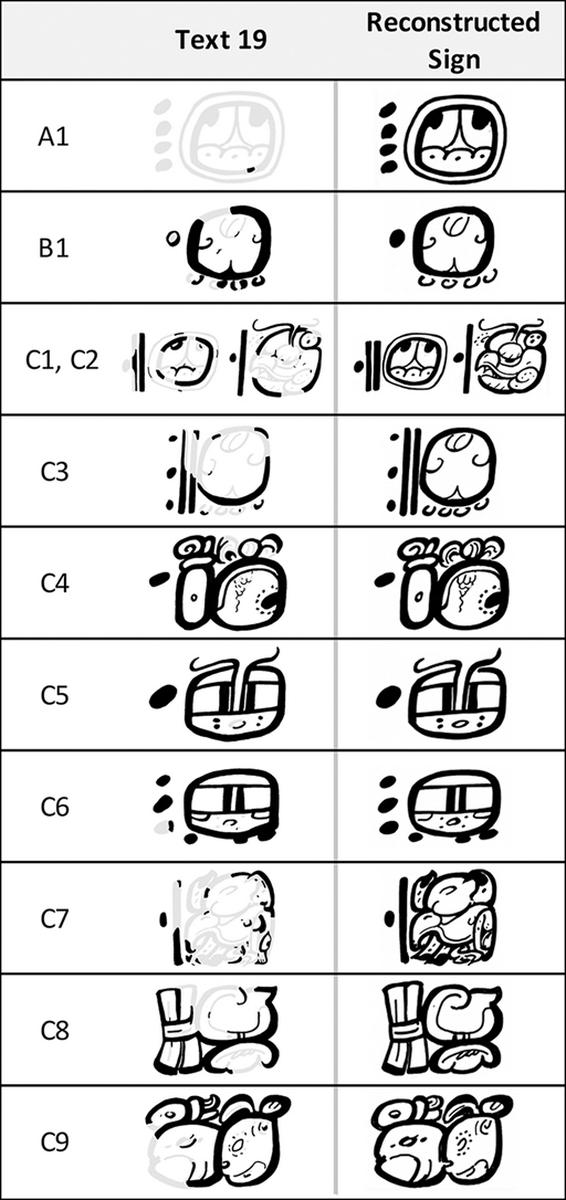
Furthermore, this formula incorporated at least six different time units: the 20-day 'winal,' the 260-day ritual calendar 'tzolkin,' the 360-day 'tun,' the 365-day solar calendar 'haab,' the 584-day Venusian cycle, and the 780-day Martian cycle. It is said that a unique feature not found in other Mayan texts is that it not only lists well-known cycles, but also integrates their relationships into a single calculation in its own unique way.
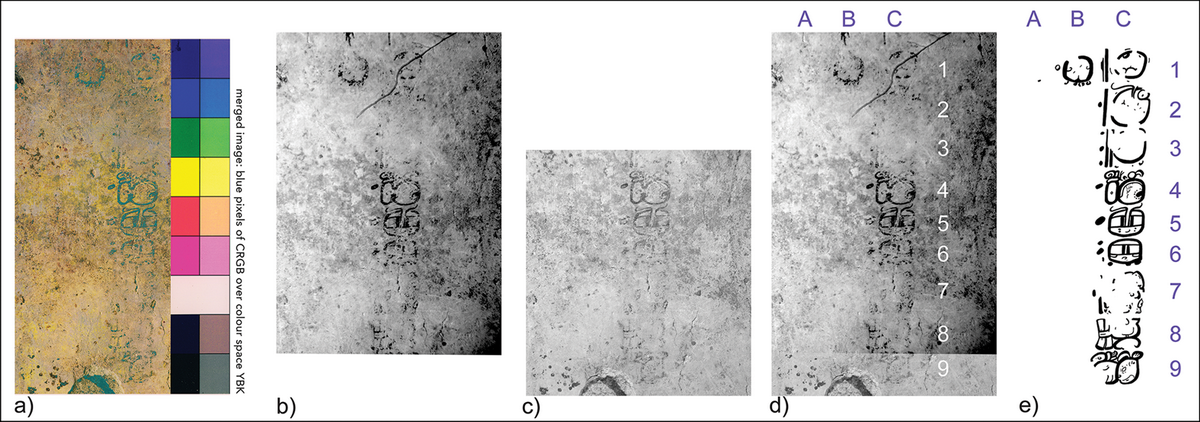
The formula represented a large cycle of 2920 days by dividing it into multiple intervals of 20 days, 260 days, 1560 days, and 1080 days. Of these, 1560 days corresponds to two 780-day cycles of Mars, and 2920 days corresponds to five 584-day cycles of Venus, as well as eight 365-day solar years. Furthermore, if we look at the number of cycles that appear in the formula, we find a sequence of '1, 1, 2, 3, 5': one 20-day unit, one 260-day cycle, two Martian cycles, three 360-day years, and five Venusian cycles. This matches
The crucial clue was the last two letters following the calculation. The second-to-last letter was read as 'Chehen,' meaning 'to say so' or 'thus speaks,' and the last letter was the male name 'Sak Than Vash,' meaning 'white-chested fox.'
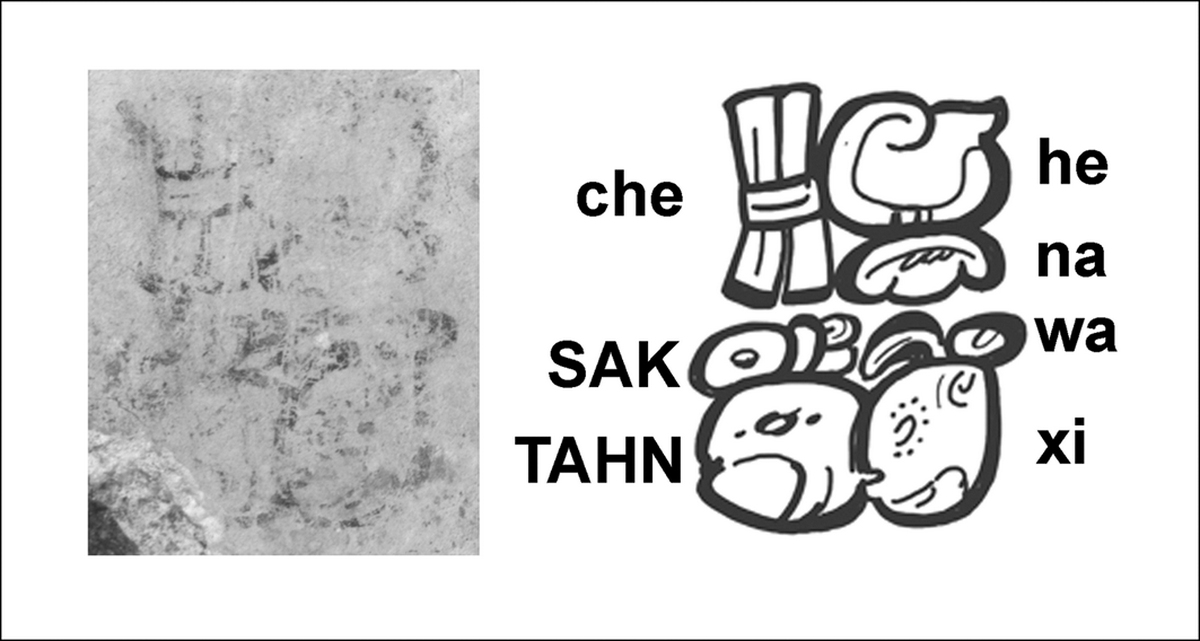
Based on this expression, the research team interprets the series of mathematical formulas as belonging to Sak Tarn Warsh. However, it is possible that he calculated them himself and wrote the characters on the wall, or that another scribe attributed the work to a prominent mathematician. In any case, no Classic Mayan documents directly linking mathematical or astronomical achievements to a specific individual have been found until now.
The research team states that Sak Tan Vash's work can be evaluated in the same context as that of historical mathematicians and astronomers such as Archimedes, Ptolemy , and the mathematician al-Khwarizmi . However, while the Mayan scholars dealt with positional numerals, advanced arithmetic, algebraic relations, negative numbers, and multiplicative coefficients, there is no evidence that they used geometric models capable of predicting solar eclipses with high accuracy.
According to the research team, Text 19 may have been more than just a practical calendar creation; it may have been an intellectual attempt to creatively combine known cycles. The team also stated that the inclusion of names at the end of the mathematical formulas suggests that intellectual professions such as mathematicians and astronomers, as well as artists, were highly valued in ancient Mayan society.
Related Posts:

in Science, Posted by log1i_yk