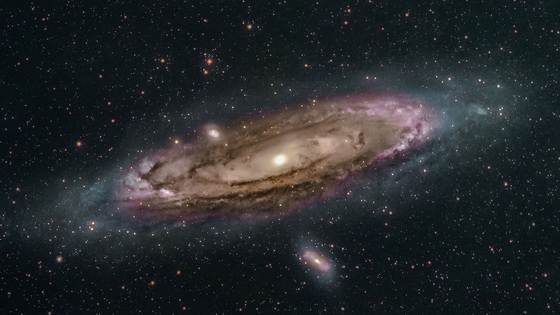
Sugar molecules discovered for the first time at the center of a galaxy may provide clues to the origin of life.
The sugar
Detection of a four-carbon sugar in interstellar space | Nature Astronomy
https://www.nature.com/articles/s41550-026-02905-7
First 'true sugar' molecule found in space — offering hints to life's origins
https://www.nature.com/articles/d41586-026-02173-5
A research team led by Isaacun Jimenez-Sela of the Spanish National Research Council observed the molecular cloud 'G+0.693-0.027' in the galactic center region, approximately 26,700 light-years from Earth, and discovered a sugar molecule called erythritolose. This molecular cloud is a region rich in chemical substances with a wide variety of molecules, making it suitable for studying chemical reactions in molecular clouds where stars and planets are born.
Sugars not only function as an energy source and energy storage substance, but are also important components of nucleic acids such as DNA and RNA. However, experiments recreating the early Earth have shown that sugars are not easily produced at sufficient concentrations, leading to the suggestion that some of the sugars present on the early Earth may have been transported from space by meteorites. Indeed, sugars such as ribose and glucose have been found in meteorites and samples from the asteroid Bennu.
In 2000, glycolaldehyde , which contains two carbon atoms, was detected in interstellar space. Although glycolaldehyde is sometimes called the 'simplest sugar,' it is strictly speaking a hydroxyaldehyde and does not qualify as a formal sugar with a skeleton of at least three carbon atoms. The erythritolose discovered this time is a sugar molecule with four carbon atoms and is also the most complex sugar confirmed outside our solar system.
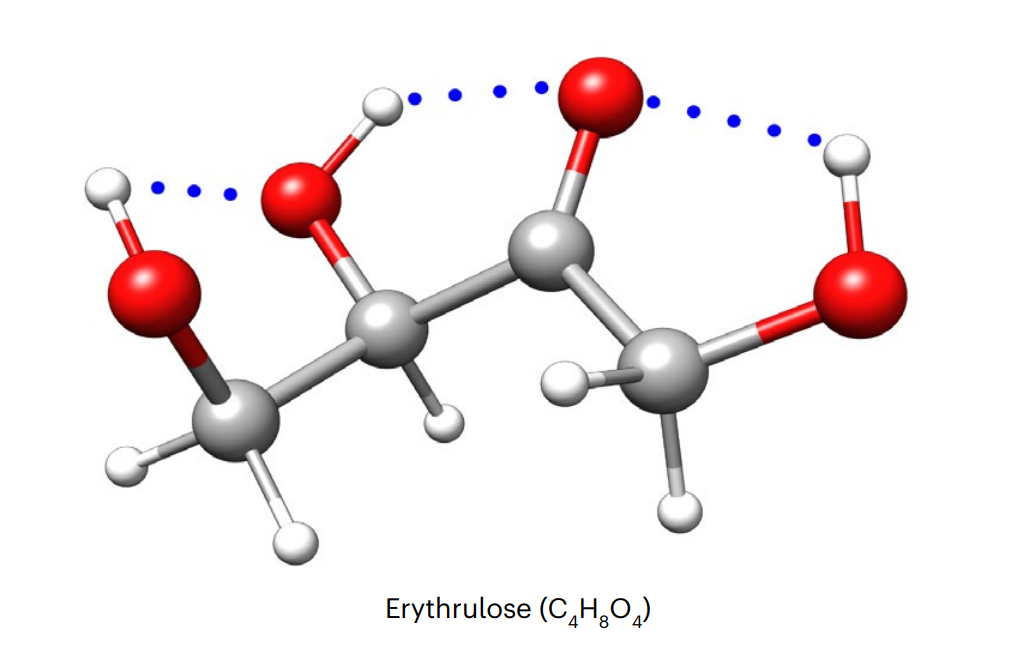
This is the molecular structure of erythritolose, a sugar detected for the first time in interstellar space. Gray represents carbon, red represents oxygen, and white represents hydrogen.
The research team used the Yeves 40m radio telescope and the IRAM 30m radio telescope in Spain to analyze the radio waves emitted when molecules rotate. Because the combination of radio wave frequencies differs for each molecule, they compared the observational data with erythritolose-specific characteristics measured in the laboratory, and identified signals corresponding to a total of 17 transitions. In particular, the probability of the six signals with minimal interference coincidentally matching is estimated to be 0.2%, strongly supporting the detection.
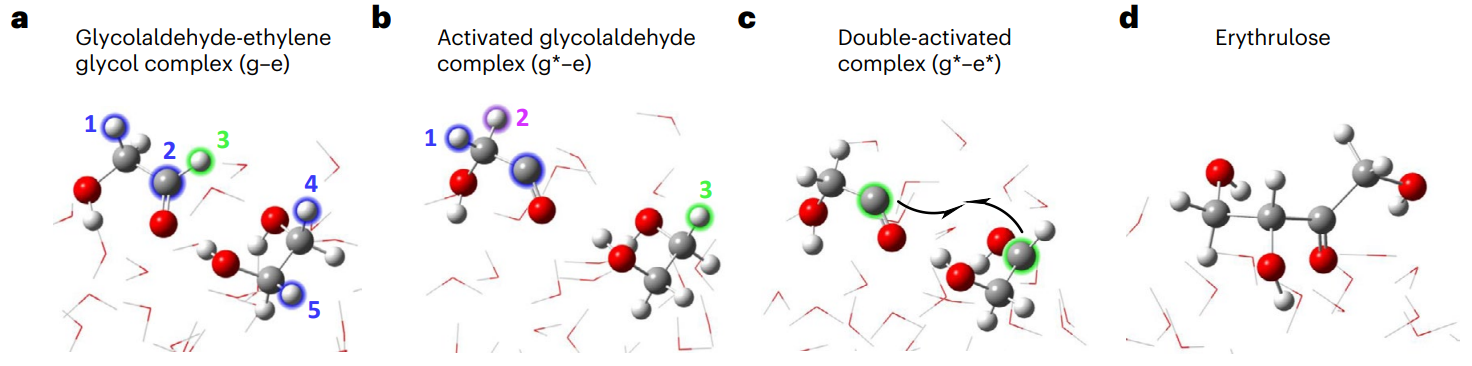
Observations did not detect glyceraldehyde or dihydroxyacetone, which contain three carbon atoms, while it was estimated that there were at least 8 to 17 times more larger erythritolose molecules. This result does not align with the simplistic view that complex molecules grow by adding one carbon atom at a time. The research team suggests that fragments from glycolaldehyde and ethylene glycol, each containing two carbon atoms, may have bonded on the ice covering the dust surface to form erythritolose.
The following is a thought-provoking reaction pathway in which erythritolose is formed from molecular fragments derived from glycolaldehyde and ethylene glycol on the water ice covering interstellar dust.
It is thought that erythritolose, formed within the molecular cloud, was released from the dust surface into the gas by shock waves, becoming detectable by these radio observations. Ketoses like erythritolose readily convert to aldose in water, so they may have been transported to young planets, becoming a source of sugars that could be used for early metabolic reactions and the formation of genetic material.
While this discovery alone doesn't fully explain the origin of life, it demonstrates that complex sugars essential for life can be naturally produced even in cold molecular clouds before stars and planets form. The research team plans to continue searching for even more complex sugars and investigate how well these sugars can survive when exposed to ultraviolet light and other elements.
Related Posts:

in Science, Posted by log1i_yk