A South Korean research team has developed 'self-healing contact lenses' that can repair damage when exposed to ultraviolet light.
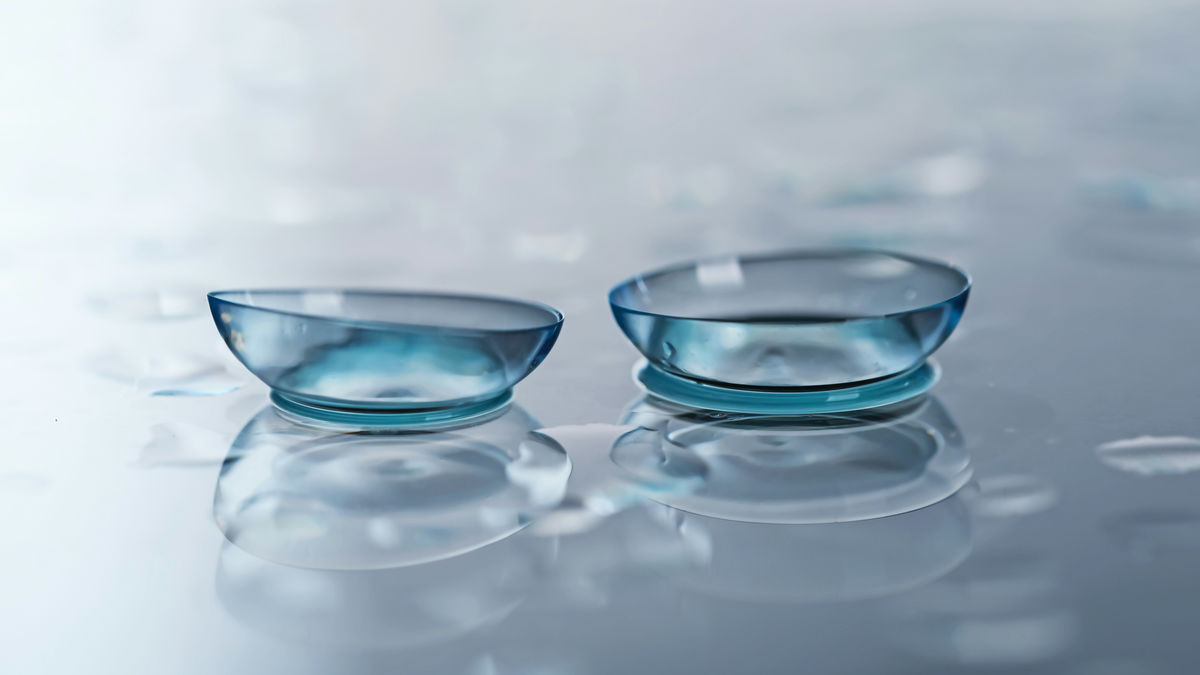
Commonly available soft contact lenses tend to get tiny scratches from daily insertion, removal, and cleaning, and these small scratches can damage the eye and negatively affect vision. A research team at
Room-Temperature UV-Induced Self-Healing Hydrogels with Antifouling and Antiscratch Surfaces for Soft Contact Lenses | ACS Applied Polymer Materials
https://pubs.acs.org/doi/10.1021/acsapm.5c04803
Scientists Just Made Contact Lenses That Fix Their Own Scratches – Without Needing Replacing : ScienceAlert
https://www.sciencealert.com/new-self-healing-contact-lenses-can-repair-themselves-in-uv-light
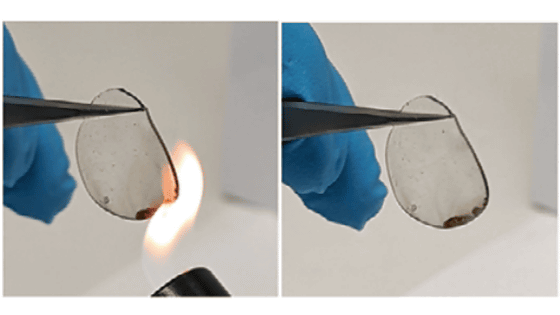
Choi Jong-hyun and Cho Byung-gi of Dankook University have created a 'self-healing hydrogel (DS-hydrogel)' as a contact lens material with self-healing capabilities. It has been discovered that DS-hydrogel can recover up to 90% under high temperatures and UV irradiation. Furthermore, it has been reported that surface damage was effectively repaired even with simple UV irradiation at room temperature. While similar self-healing hydrogel studies have been conducted in the past, they all required high temperatures, making this a remarkable advance in related technology.
At the core of DS-hydrogels is a substance called a 'disulfide crosslinking agent,' which is a small molecule with disulfide bonds between sulfur atoms. Its characteristic feature is that it can form new bonds even after being broken. The disulfide crosslinking agent is bonded to methacrylic acid polymer (acrylic resin) to form long molecular chains, and when damaged, the physical bonds between these polymers are broken, but they can be rebonded when exposed to ultraviolet light, thus repairing the damage.
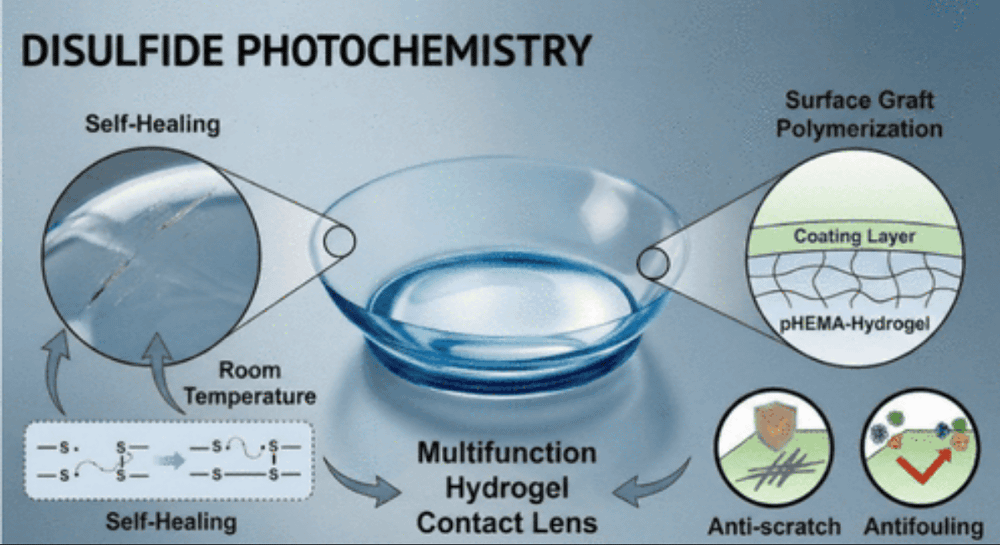
The researchers explained, 'In this study, we describe in detail the synthesis, mechanical property evaluation, and functional evaluation of this disulfide-crosslinked hydrogel system, and demonstrate its application from hydrogel samples to practical molded contact lens forms.'
The newly developed material possesses not only self-healing properties but also water retention and excellent scratch resistance comparable to existing soft lenses. Furthermore, the research demonstrates that the sulfur-based chemical method used is effective in producing plastics with self-healing and protective properties, suggesting that commercially available standard UV cleaning machines may be usable not only for cleaning but also for repair.
The researchers stated, 'This disulfide-crosslinked hydrogel platform, which combines self-healing capabilities, durable stain resistance, and enhanced scratch resistance, holds great potential as a next-generation functional contact lens. Overall, the material design strategy presented here provides a promising pathway for realizing hydrogel-based ophthalmic medical devices that are durable, resilient, and high-performance.'
Related Posts:


in Science, Posted by log1e_dh