A Japanese study found that fathers whose first child is a daughter tend to be more positive about gender equality.

Political values can be transmitted not only from parent to child, but also from child to parent. Professor Yoshikuni Ono of the Faculty of Political Science and Economics at Waseda University and Associate Professor Daina Chiba of the Faculty of Government and Public Administration at the University of Macau used a large-scale social survey in Japan to analyze the relationship between the gender of the firstborn child and fathers' awareness of gender equality and support for policies. The research results were published in the academic journal 'Public Opinion Quarterly' on June 12, 2026.
Do Daughters Change Their Fathers? Evidence from the First-Daughter Effect in Japan | Public Opinion Quarterly | Oxford Academic
Can a daughter change her father's gender perceptions? – Global Research Center (GRC), Waseda University Research Activities
https://www.waseda.jp/inst/research/news/84704
The first-daughter effect: How raising girls changes fathers' political views in Japan
https://www.psypost.org/the-first-daughter-effect-how-raising-girls-changes-fathers-political-views-in-japan/
The process by which parents impart political values to their children is called 'political socialization.' In contrast, the phenomenon in which parents' thinking changes through their interactions with their children is called 'reverse political socialization.' In Europe and the United States, the 'firstborn daughter effect' has been reported, in which fathers of firstborn daughters tend to be more positive about gender equality than fathers of firstborn sons. However, a clear effect has not been confirmed in China or South Africa, and it was unknown whether the same trend would occur outside of Europe and the United States.
Therefore, Ono et al. used data from the Japanese General Social Survey (JGSS), conducted from 2000 to 2018, to compare fathers of girls and fathers of boys among men with one or more children. In Japan, since official statistics began in 1899, the male-to-female ratio at birth has remained stable at approximately 105 boys for every 100 girls, so Ono et al. treated the sex of the first child as a condition close to a natural experiment.
Ono et al. analyzed fathers' views on gender equality and their support for policies using the following six items. Each item was surveyed in a different year, and the number of valid responses ranged from 760 to 10,984.
- Traditional gender roles : Pros and cons of the idea that 'the husband's role is to earn income, and the wife's role is to take care of the home and family.'
- Optional separate surnames for married couples : Respond to questions regarding surnames after marriage: Should the wife change to the husband's surname, should the couple decide together which surname to use, or is it unnecessary for either to change their surname?
- Female Emperor : Pros and cons of a female member of the imperial family, whose paternal lineage traces back to previous emperors, ascending to the throne.
- Female emperor : Pros and cons of granting the right of succession to the throne to children born to female members of the imperial family and common men.
- Income redistribution : Pros and cons of the idea that 'it is the government's responsibility to reduce the income gap between high-income and low-income households.'
- Government spending on crime prevention : Evaluate current government spending on crime prevention on a three-point scale: 'too much,' 'appropriate,' and 'too little.'
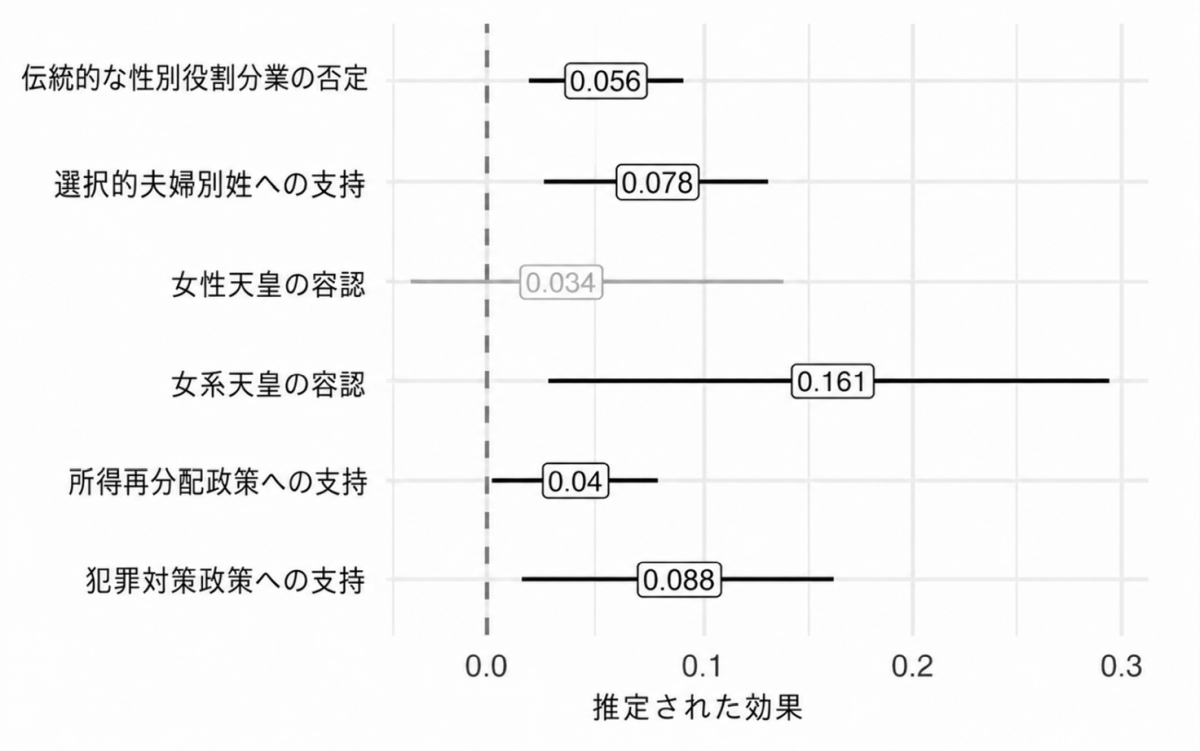
The analysis revealed that fathers whose first child is a girl are more opposed to traditional gender roles and tend to support optional separate surnames for married couples and female-line emperors than fathers whose first child is a boy.
Furthermore, a tendency to support strengthening income redistribution and increasing government spending on crime prevention was observed, but there was no significant difference in support for a female emperor.
The graph below shows the estimated effects of six items, with a dashed vertical line representing 'no difference' (0) and a horizontal line representing the 95% confidence interval. A higher number indicates that fathers whose first child is a girl tend to give more positive responses or supportive responses regarding gender equality and policies related to that item.
Furthermore, to determine whether fathers of firstborn daughters tend to be liberal in general politics, the study also compared 'general conservative/liberal tendencies,' 'support for the Liberal Democratic Party (a conservative party),' 'support for or opposition to an increase in foreigners in the region,' 'attitudes towards homosexuality,' and 'government spending on national security.' However, no significant differences were found in any of these five items. Ono et al. explained that the differences based on the gender of the firstborn were concentrated not on general political attitudes, but on items related to women's rights and opportunities.
Furthermore, Ono commented to the science media outlet PsyPost that 'these results are merely an average trend and do not apply to all fathers, nor is the estimated effect overwhelmingly large.'
Related Posts:








in Science, Posted by log1b_ok