Phea, an app co-founded by Bill Gates' daughter Phoebe Gates, is using fake clicks and 'cookie stuffing' to fraudulently claim affiliate commissions.
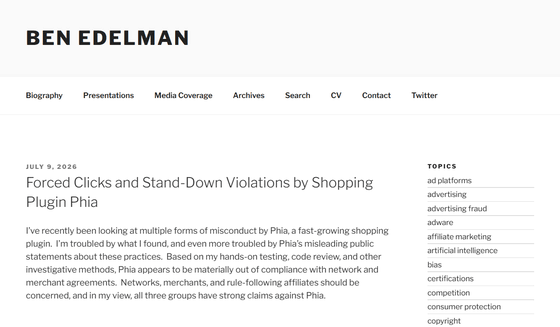
Forced Clicks and Stand-Down Violations by Shopping Plugin Phia – Ben Edelman
https://www.benedelman.org/phia-forced-clicks/
Gates Heir's Shopping App Took Credit for Sales It Didn't Drive - Bloomberg
https://www.bloomberg.com/news/articles/2026-07-09/gates-heir-s-shopping-app-took-credit-for-sales-it-didn-t-drive
Phia accused of 'cookie stuffing,' taking affiliate credit on purchases it didn't earn | TechCrunch
https://techcrunch.com/2026/07/10/phia-accused-of-cookie-stuffing-taking-affiliate-credit-on-purchases-it-didnt-earn/
Bill Gates' nepo-daughter Phoebe is accused of breaking platform policies with new shopping app that's said to have used 'FAKE' clicks to make money | Daily Mail Online
https://www.dailymail.com/lifestyle/article-15969007/bill-gates-daughter-phoebe-shopping-app-fake-clicks-money.html
Drama Over Phoebe Gates's Shopping Start-up Phia, Explained
https://www.thecut.com/article/phoebe-gates-shopping-startup-phia-controversy.html
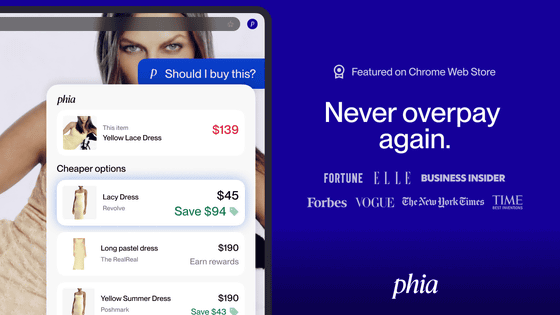
Phoebe Gates founded Phia in January 2023. Phia is a web browser extension that quickly finds discount codes that can be used for online shopping. It is known in industry jargon as an 'affiliate marketing program,' and Phia generates revenue by receiving a portion of the sales as a commission from retailers when products are sold through Phia.
However, investigations by Ben Edelman, an independent researcher and consultant specializing in affiliate marketing, and Capital One Shopping, which develops competing extensions for Phia, have revealed that Phia is claiming credit for online sales that it did not actually generate, violating the policies of many digital platforms.

Following this report, major media outlet Bloomberg also tested Phia on more than 50 websites. Their findings revealed that during the payment process for online shopping, a background tab would open without user intervention, and Phia would insert its own referral code, overwriting legitimate referral codes issued by other publishers. In other words, Phia was fraudulently claiming sales attributable to it, even for sales that it did not actually drive. This aligns with the results of independent code reviews conducted by Edelman and Capital One Shopping.
Edelman, who has exposed deceptive practices in digital advertising for decades, said, 'The most basic requirement in affiliate marketing is that you only get paid if a user clicks on the ad. The rules do not allow fake clicks, simulated clicks, fictitious clicks, or hypothetical clicks. Only real clicks are valid.'
Capital One Shopping also expressed concern that Phia is engaging in cookie stuffing, criticizing Phia by saying, 'Publishers like us are losing a large portion of our revenue to Phia, and advertisers like you are suffering losses due to fake clicks.'
A spokesperson for Capital One Shopping told Bloomberg, 'We believe it is our responsibility to disclose any technical anomalies or concerning practices we observe within the affiliate marketing ecosystem.'

In response to Bloomberg's report, a Phia spokesperson stated, 'Within the last 24 hours, we discovered that our codebase was causing incorrect attribution for some users in a recent release. Upon notification, our team worked around the clock to identify and mitigate the issue, and it has now been resolved.'
In fact, after Bloomberg notified Phia of the issue on July 7, they retested the company's extension and found that the problematic behavior had stopped in all cases where it had previously automatically recorded clicks via Phia.
According to a Phia spokesperson, the company undergoes regular audits by its network partners and 'always adheres to its terms of service.' The problematic 'code that enables automatic clicking' was added to the source code in December 2025.
Phia's practices violate industry rules prohibiting the use of cookies to claim credit for the success of other referrals. These industry rules are reportedly detailed in the terms of service of retailers such as eBay and Walmart, as well as major affiliate networks like
impact.com announced it has suspended Phia's account after finding that its extension 'conducted actions that violated our platform policies.' impact.com told Bloomberg that it will notify Phia of its findings, review any potentially affected transactions, and 'decide if any corrective actions are necessary.'

According to Appfigures estimates, Phia has been downloaded more than 1.2 million times in the past 12 months. Phia has attracted significant attention because its founder is Bill Gates' daughter, and it has successfully raised a total of $43.5 million (approximately 7 billion yen) from prominent venture capitalists and investors. As a result, Phia's co-founder, Phoebe Gates, has been named to Forbes' 30 Under 30 list .
This is not the first time Phia has been criticized. In 2025, security researchers pointed out that 'Phia is recording users' web browsing history.' This became a major problem because the information recorded by Phia included confidential information such as bank statements and personal email accounts.
Phia explained that it was recording web page content 'to determine whether a site was a shopping site.' According to Phia, this was an effort to identify and assist newly discovered retailers. However, after security researchers pointed out the problem, Phia stopped recording web page content and switched to recording URLs.
Regarding the report, Jeremy Stamper, who has known Phoebe Gates since she was a teenager, said, 'There is nothing in the Bloomberg report that suggests she was personally involved in any wrongdoing. The ability of Phia's browser extension to open tabs in the background and insert affiliate code is a technical implementation choice made by engineers, not by Phoebe herself. She is not a software developer, did not write the code for the extension, and there is no evidence that she instructed anyone to override other affiliates or manipulate commissions. What happened is a classic example of overly aggressive optimization, which is common in early-stage tech products, especially in the messy world of affiliate tracking, where scripts, libraries, and automation logic can behave in ways that the founders never intended. The report states that independent researchers discovered the problem, and Capital One It is clearly stated that Shopping pointed out similar behavior, and that Phia admitted the violation and corrected it. This sequence of events is consistent with a technical error, not a deliberate scheme. If Phoebe had intended to deceive, the company would not have immediately admitted the problem and not fixed the code. It is far more plausible that she became aware of the problem at the same time as the public and ensured that the team fixed it. Her broader actions support this interpretation. She runs Phia as a typical startup founder, negotiating frugally with influencers, refusing inflated fees, and not abusing the system. She is trying to build a sustainable business. Nothing in her behavior suggests that she is the person in charge of a covert affiliate fraud operation. The accusation is about the code, not her character, and the code was fixed by the time the issue surfaced. The fairest conclusion is that Phoebe Gates did nothing wrong. A technical misconfiguration occurred, it was fixed, and there is no evidence that she knew about it, intended it, or intentionally profited from it. If you wish, we can expand this into a stronger version or restructure it into a legal defense style,' he posted, defending Phoebe Gates.
I've known Phoebe Gates online since she was a teen, so I might be biased but nothing in the Bloomberg reporting shows she personally engaged in wrongdoing. Phia's browser extension opening background tabs and inserting affiliate codes comes from technical implementation choices… https://t.co/memzirqoMJ
— Jeremy Stamper 🇺🇸 🇺🇦 (@jeremymstamper) July 10, 2026
PayPal Honey, which was found to have been illegally stealing affiliate earnings using the same methods as Phia, lost as many as 4 million users after the fraud was discovered.
Popular browser extension 'PayPal Honey' found to be stealing influencer affiliate earnings and offering unfavorable deals to users - GIGAZINE
Related Posts:






in Software, Posted by logu_ii