Meta has announced 'Vistara,' a proprietary chip that reuses DDR4 memory from older servers in newer servers.
by
Meta's research team has announced 'Vistara,' a proprietary ASIC for reusing DDR4 memory salvaged from defunct servers in new DDR5-compatible servers. Vistara utilizes the high-speed interconnect standard CXL to connect older DDR4 memory as expansion memory for servers, and Meta explains that this allows for low-cost memory capacity expansion.
Vistara: Making CXL Real—Full Path from ASIC Design and OS Support to Hyperscale Deployment
(PDF file)https://aisystemcodesign.github.io/papers/isca26/vistara_camera_ready.pdf
At ISCA 2026, an international conference in the field of computer architecture held from June 27 to July 1, 2026, Meta presented a paper on Vistara. In the paper, Vistara is presented not merely as a prototype chip, but as a practical CXL system encompassing everything from ASIC design to OS-based memory management and deployment in large-scale data centers.
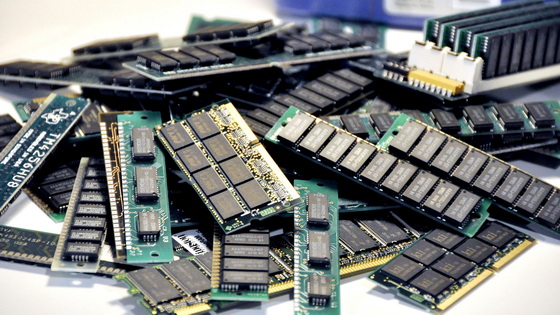
According to Meta, approximately 44% of their general-purpose CPU servers are bottlenecked by memory capacity, limiting their performance and scalability. On the other hand, while the operational lifespan of the server itself is about 3 to 5 years, DRAM can be used for 7 to 10 years, resulting in the problem of usable memory remaining even when servers are retired.
However, because DDR4 and DDR5 have different memory specifications and CPU connection methods, older DDR4 DIMMs cannot be directly installed into new servers designed for DDR5. Therefore, Meta has independently developed Vistara, which uses CXL 2.0/1.1 on the PCIe 5.0 physical interface to connect DDR4 memory to new servers as expansion memory.
The following is a diagram of the Vistara ASIC configuration. It features a subsystem that supports PCIe 5.0 and CXL, and two DDR4 memory controllers that connect the host CPU and DDR4 memory.
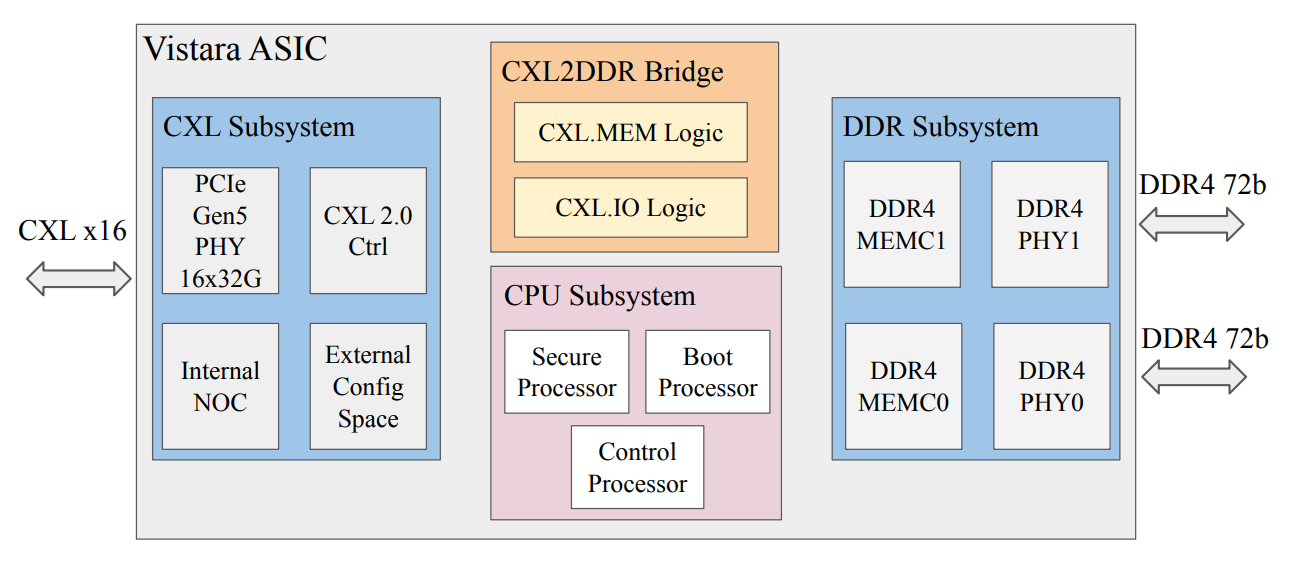
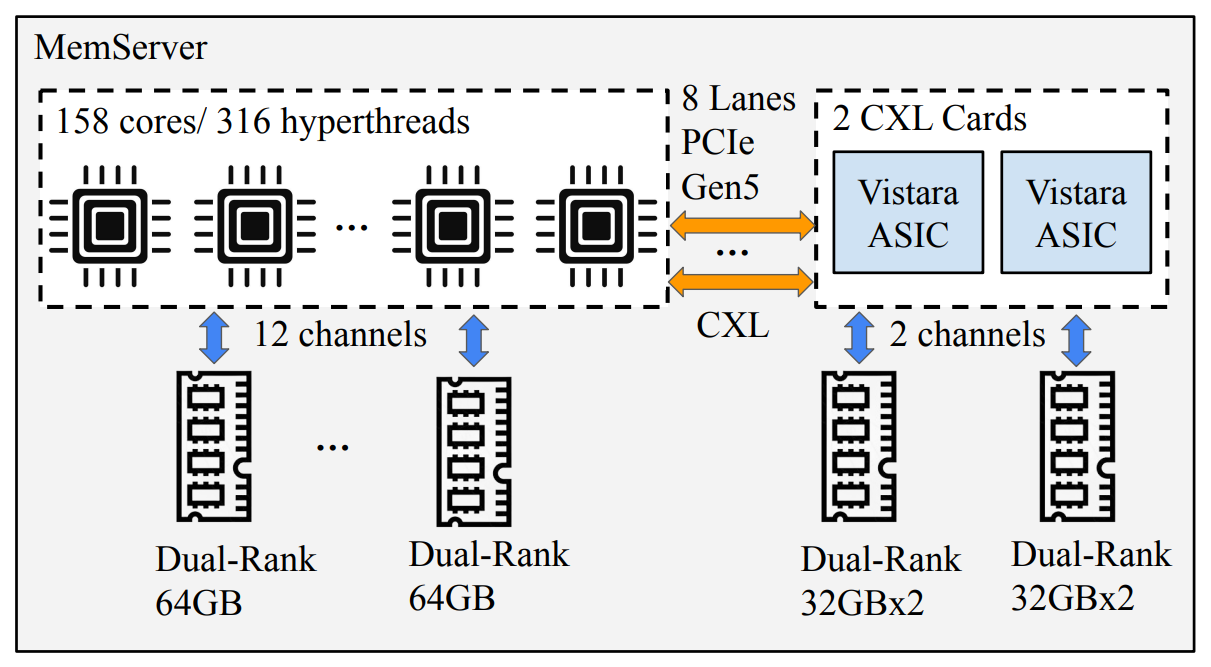
Vistara is a CXL 2.0/1.1 compliant Type-3 memory expansion ASIC with two independent 72-bit DDR4 memory channels. Theoretically, it can use four 64GB DIMMs, allowing for a maximum of 256GB per unit. However, in actual operation, the 'MemServer' uses two Vistara units, each connected with four 32GB DIMMs, for a total of 256GB of DDR4-2400 memory. This is combined with a 768GB DDR5-6400 module directly connected to the CPU, resulting in a total capacity of 1TB.
This is a diagram of the 'MemServer' configuration running Vistara. In addition to 768GB of DDR5 memory directly connected to the CPU, 256GB of DDR4 memory is connected via two Vistara ASICs, for a total of 1TB of memory.
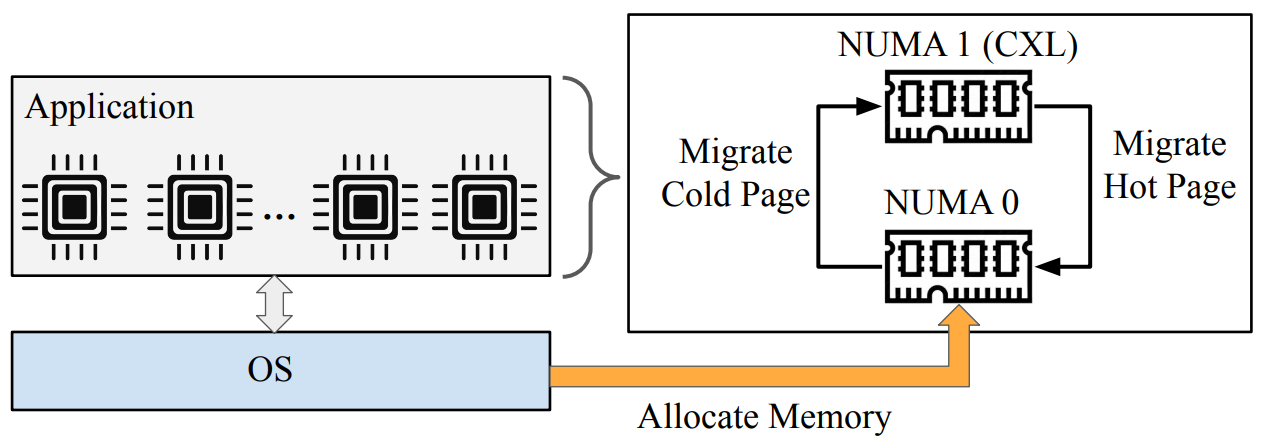
CXL-connected DDR4-2400 has lower bandwidth and higher access latency than DDR5-6400 directly connected to the CPU, so using them without distinguishing between them may result in performance degradation. Meta manages access frequency on a per-memory page basis at the OS level, promoting hot pages to DDR5 and demoting cold pages to CXL-connected DDR4, thereby minimizing the impact on performance.
Here's how memory tiering works in MemServer: The OS treats high-speed local DRAM and CXL-attached memory as separate NUMA nodes and automatically moves hot and cold pages based on their access frequency.
Meta uses Vistara-based CXL systems in production for isolated ML inference in recommendation systems, distributed caching, large-scale data processing, and databases. They reduced the number of required servers by up to 25% for the ML parameter server in their recommendation systems. They also reported a 29% reduction in average query processing time for a specific distributed caching workload, 'CacheB,' due to increased cache capacity.
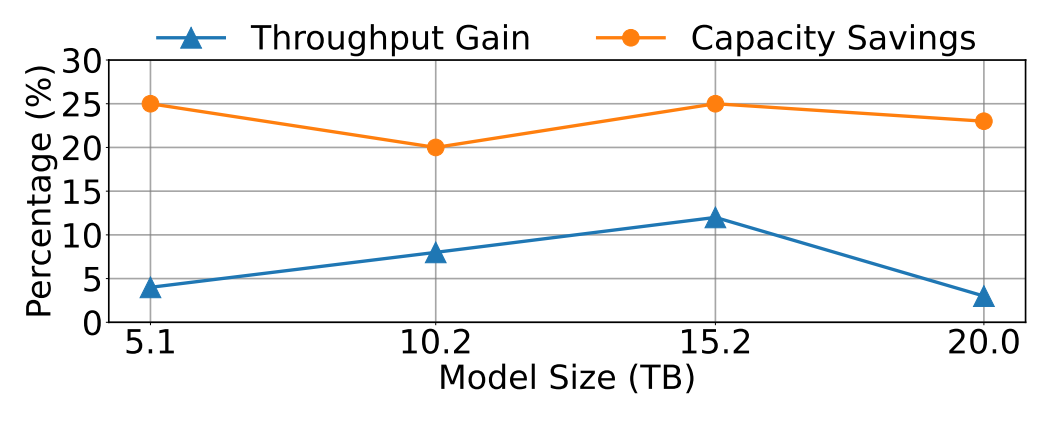
Vistara's aim is not just to connect older memory to new servers. Meta claims that by reusing existing DDR4 memory, it can alleviate memory capacity bottlenecks at a low cost, extend the lifespan of DRAM, reduce the amount of new memory needed, and lower the carbon footprint of the server cluster.
Related Posts: