American egg producers earned $3 billion through price manipulation, but were fined only $3 million, meaning their profits were 1,000 times greater.

In the United States, rising egg prices have become a problem, and on June 30, 2026, the Department of Justice's Antitrust Division filed a civil lawsuit against egg producers demanding that they cease systematic price manipulation aimed at raising egg prices.
Office of Public Affairs | Justice Department Requires Egg Producers to End Coordinated Benchmark Manipulation that Artificially Inflated Prices Across the Country | United States Department of Justice
Crime Pays: The Egg Bandits Made A Thousand Times the Fine They Just Paid for Price Fixing
https://www.thebignewsletter.com/p/crime-pays-the-egg-bandits-made-a
The following is a graph of the trend in wholesale prices per 12 eggs, compiled by Trading Economics. As of July 2, 2026, the price was $0.2677 (approximately 43 yen), but it had risen to $8.05 (approximately 1299 yen) by February 24, 2025.
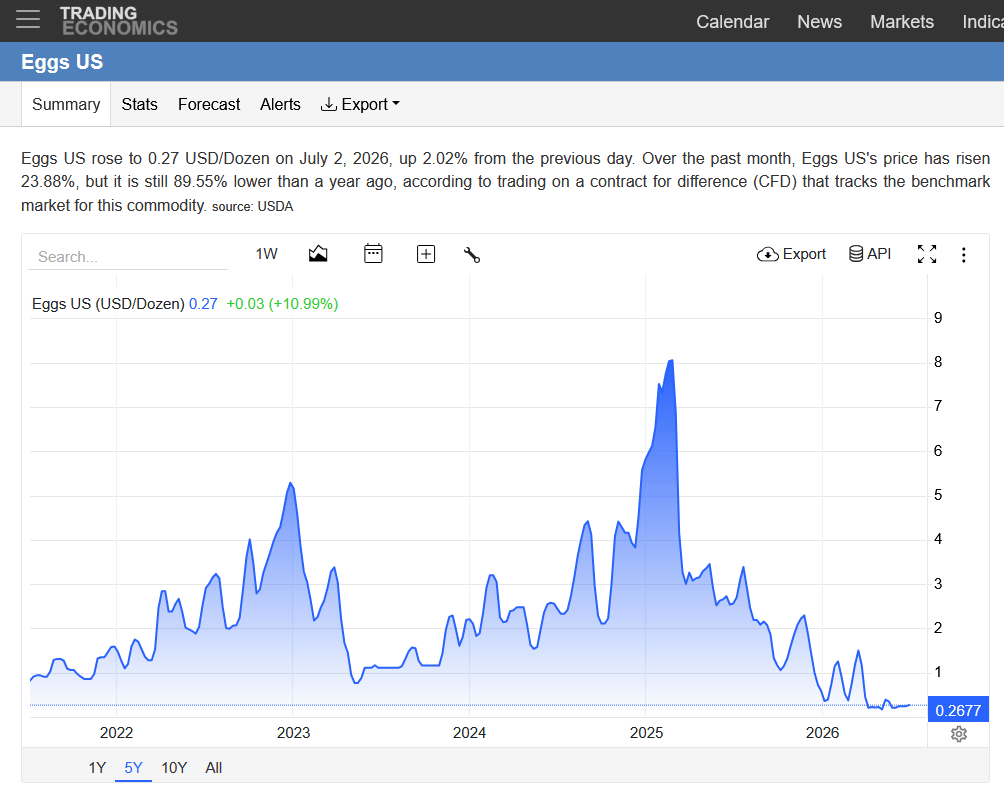
When egg producers explained the price increase in 2025 as being due to the mass death of chickens caused by avian influenza, consumers pointed out that the impact of avian influenza on egg production was minimal, and that the monopolization of the egg market by a few companies was causing the price surge.
The surge in egg prices in the US is not due to 'bird flu,' but rather to 'monopoly by a few companies,' according to GIGAZINE.
The Department of Justice has filed a lawsuit, in conjunction with the attorneys general of 17 states, alleging that three major egg producers, Cal-Maine, Hickman's, and Versova, manipulated egg prices.
In the U.S. wholesale market, transactions are conducted based on price estimates published by market analysis firm Urner Barry . According to the Department of Justice, the three companies being sued allegedly submitted a large number of 'high-value bids with a low probability of success' several hours before Urner Barry published its estimates, thereby inflating Urner Barry's estimates and driving up transaction prices.
The Department of Justice's proposed settlement includes demands such as a ban on communication with competitors regarding bidding prices, as well as the payment of a settlement fee and the donation of eggs to food banks.
In the Cal-Maine case, the Department of Justice is seeking a settlement of $1.5 million (approximately 240 million yen) and the donation of 30 million eggs to food banks. However, Matt Stoller, an expert on the antitrust movement, points out that 'if we estimate the cost of donating eggs to food banks at $1.5 million, the egg producers would have to pay $3 million (approximately 480 million yen). However, the producers have earned more than $3 billion (approximately 480 billion yen) through price manipulation. This is equivalent to a 1,000-fold return,' arguing that the profits from unfair price manipulation far outweigh the settlement amount.
Related Posts:







in Food, Posted by log1o_hf