What is 'developmental topographical orientation disorder,' a condition where a person gets lost even in their own home?

While it's understandable to panic when your smartphone's map app stops working, some people can even get lost in familiar places like their own homes. Isabel Cayco and her colleagues, who study neuropsychology at Leiden University in the Netherlands, explain the relationship between the inability to create a mental map of spatial connections and developmental topographical disorientation (DTD).
The condition that causes people to get lost in their own home
https://theconversation.com/the-condition-that-causes-people-to-get-lost-in-their-own-home-284617
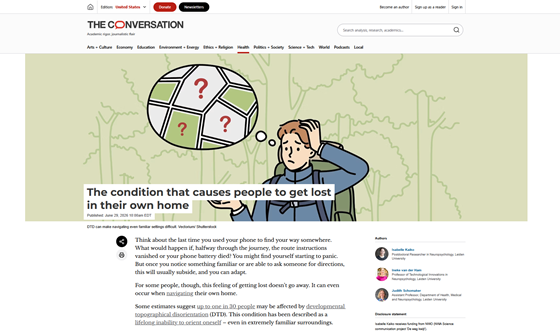
DTD is a disorder characterized by difficulty in understanding directions and spatial relationships from childhood, and getting lost even in familiar places. It is estimated that up to 1 in 30 people may be affected, and people with DTD report getting lost at least several times a week since childhood. Kaiko et al. explain that it is not something that develops later due to brain injury, neurological disease, or mental illness, but rather that the mechanism for understanding directions and places is inherently working that way in the person's body.
The degree of difficulty with DTD varies, and mild cases may be overlooked as simply being 'directionally challenged.' Therefore, Kaiko et al. point out that it is necessary to carefully distinguish the difficulties included in DTD.
Many people have a mental map of the relative positions of landmarks such as train stations, shops, houses, and street corners. This mental map is called a 'cognitive map,' and it is useful when taking shortcuts using unfamiliar roads or going to a destination via a different route than usual.
Kaiko et al. have proposed calling the type of DTD (Diagnostic and Temporomandibular Design) that cannot create cognitive maps ' atopia .' People with atopia do not necessarily have a low ability to recognize landmarks or remember prominent features, but they have difficulty coordinating 'the relative positions of different places' in their minds.
For example, a person with atopic dermatitis might know that 'my house is near the train station' or 'the shop is near my house.' However, this information remains isolated, and they cannot visualize how their house, the station, and the shop are arranged in their minds. Therefore, if a road is closed, they take a wrong turn, or approach a building from a different direction than usual, they may not know which way to go even if they see a landmark in front of them.

One of the research participants interviewed by Kaiko and his colleagues as part of the study was unable to visualize the relative positions of surrounding roads and buildings, describing it as 'always being in one place in my mind.'
When people with atopic dermatitis become overly worried about getting lost, they may start using only familiar routes, avoid going out altogether, or become completely reliant on GPS. While these behaviors may be misinterpreted by others as 'carelessness,' 'overthinking,' or 'poor comprehension,' Kaiko and her colleagues argue that such views are unfounded and may only further distress those affected.
Furthermore, people with atopic dermatitis or DTD may find it difficult to travel alone without appropriate support. In fact, one research participant needed her husband's help even when going to a place a short distance from her home, and never went to such a place alone.
However, atopia and DTD do not progress or worsen, and the ability to find one's way can potentially be improved with training. Kaiko et al. explain that navigation ability is like a muscle; it weakens if not used and strengthens with use. A study published in Scientific Reports showed that people who had fewer opportunities to find their way on their own and relied heavily on GPS performed worse on spatial memory when later performed on a task to find their way without GPS. Furthermore, when the same people were followed for three years, the results showed that those who used GPS more often experienced a greater decline in spatial memory.
A study published in Frontiers in Human Neuroscience suggests that virtual reality training may help improve spatial orientation. Cayko and colleagues have developed and are testing a six-week virtual program aimed at reducing navigation difficulties and making it easier for people with Atopia to move around independently.
Kaiko and his colleagues suggest that before reaching for a smartphone for directions, 'it's worth considering whether you can find your way on your own.' While the ability to find your own way and navigate is commonplace for many, consciously using this skill regularly can help maintain it.
Related Posts:




in Science, Posted by log1b_ok