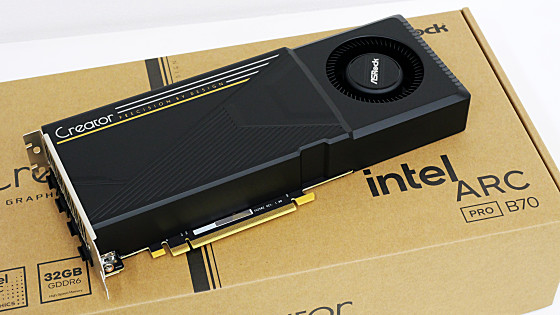
With 32GB of VRAM and significantly lower prices than other graphics cards, how well does the Intel Arc Pro B70 perform in terms of performance and token cost-effectiveness when actually running local AI?
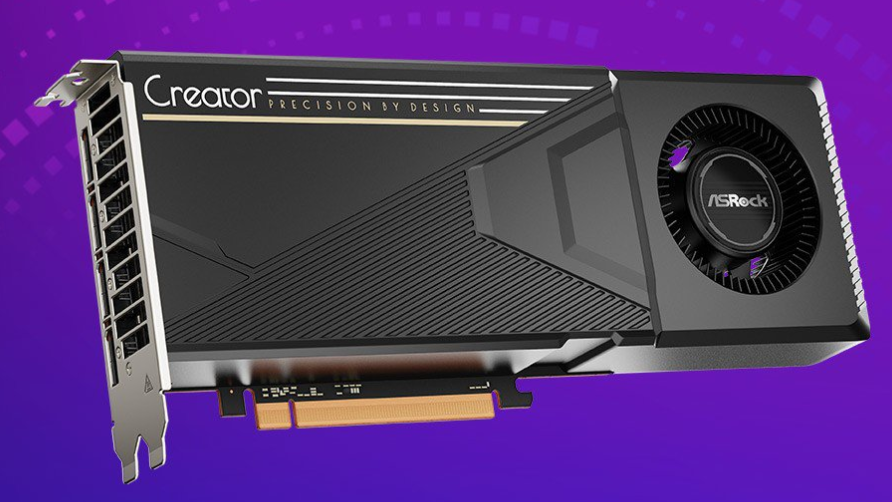
Puget Systems, a workstation manufacturer, has released real-world benchmark results for the 'Intel Arc Pro B70,' a workstation GPU equipped with 32GB of GDDR6 memory, in local LLM inference and image generation.
Intel Arc Pro B70: Multi-GPU AI Inference Performance | Puget Systems
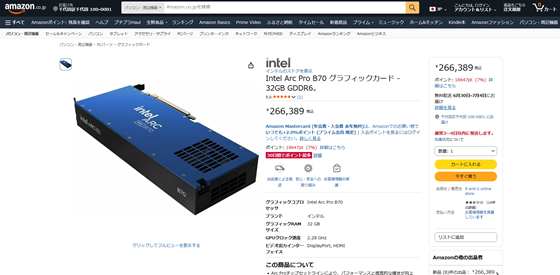
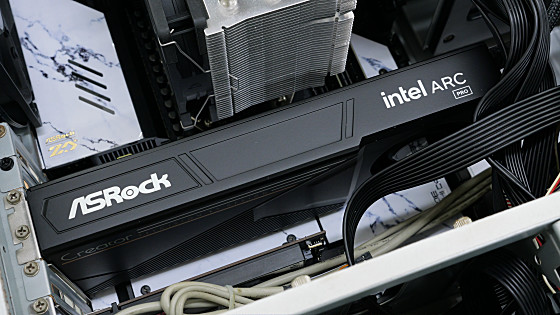
The Intel Arc Pro B70 is priced at $949 (approximately 151,840 yen) per card, significantly lower than the NVIDIA GeForce RTX 5090, which has a similar 32GB VRAM class and typically sells for 700,000 to 800,000 yen. In Japan, the ' ASRock Intel Arc Pro B70 Creator 32GB ' went on sale on June 19, 2026, with an estimated market price of 224,800 yen (including tax). At the time of writing, Intel graphics cards are available on Amazon.co.jp for 266,389 yen (including tax).
Amazon | Intel Arc Pro B70 Graphics Card - 32GB GDDR6 | Intel | Graphics Cards Online
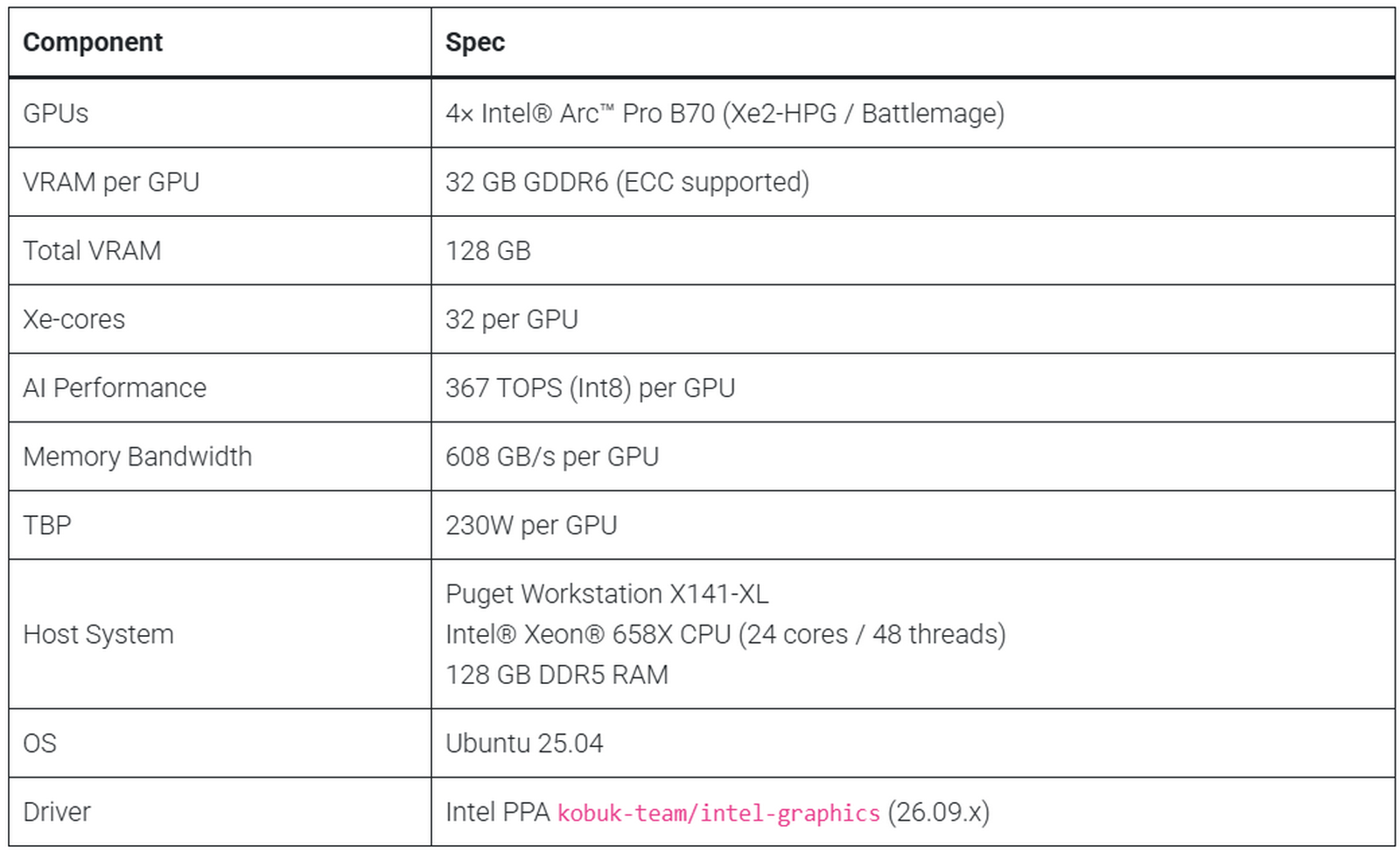
Puget Systems built a workstation equipped with four Intel Arc Pro B70 GPUs for testing, providing a total of 128GB of VRAM. The test environment consisted of Ubuntu 25.04, an Intel Xeon 658X processor, 128GB of DDR5 memory, and Intel's vLLM container for LLM Scaler . All LLM benchmarks were performed using the FP16 non-quantized model. Measurements were taken under conditions of 500 input tokens, 500 output tokens, and 1, 4, and 8 concurrent users. GPU power consumption was also recorded to calculate the execution cost per million output tokens.
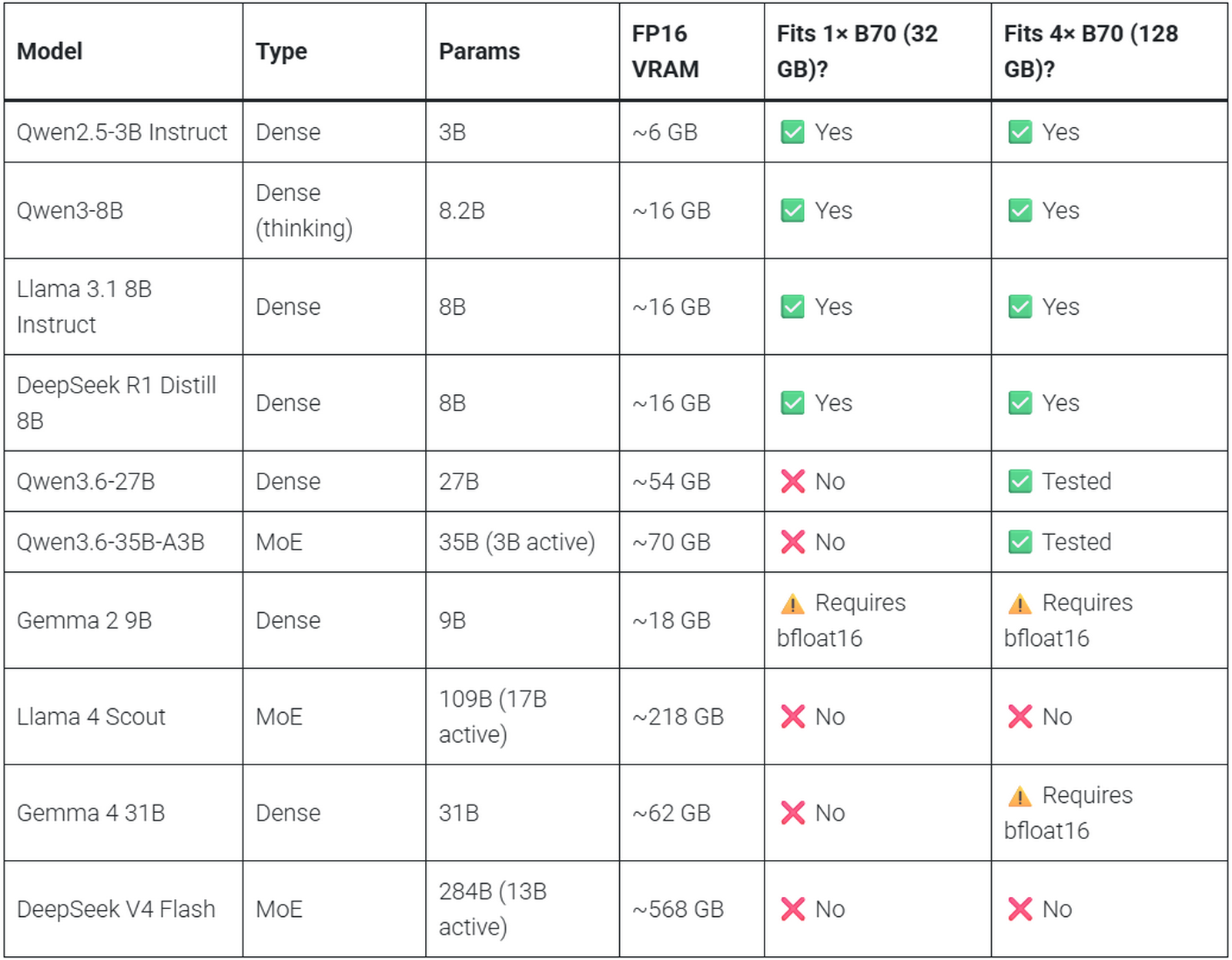
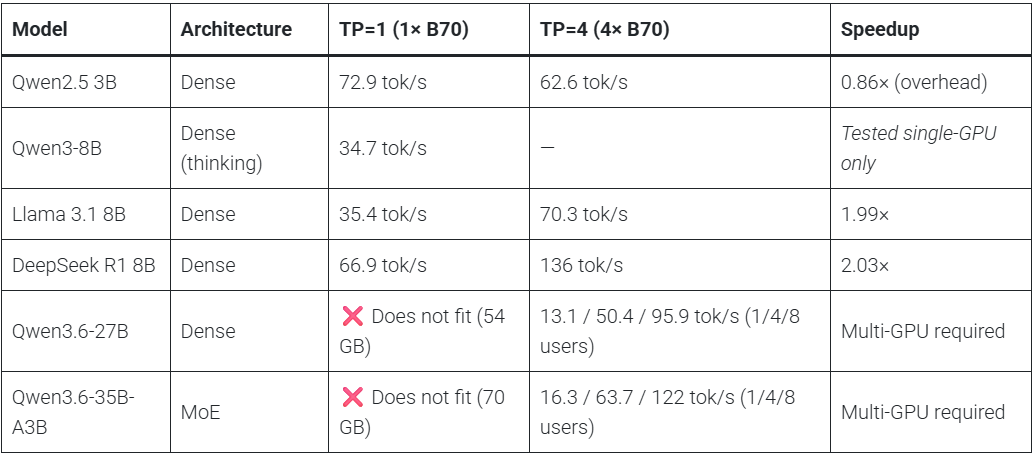
The table below shows the performance of local AI models when running on one or four Intel Arc Pro B70 cards. Qwen2.5-3B Instruct , Qwen3-8B , Llama 3.1 8B Instruct , and DeepSeek R1 Distill 8B can run on a single card, and Qwen3.6-27B and Qwen3.6-35B-A3B were confirmed to work with four cards. However, as of June 2026, the vLLM XPU backend cannot handle bfloat16 (16-bit floating-point arithmetic), so models that require bfloat16, such as Gemma 2 9B and Gemma 4 31B, could not be run directly on the Intel Arc Pro B70.
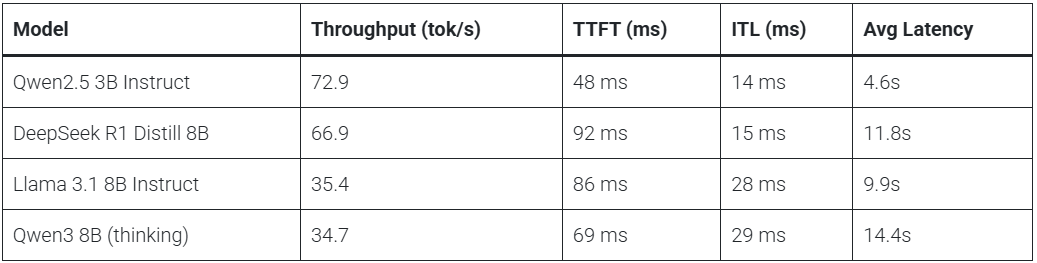
When run on a single Intel Arc Pro B70, Qwen2.5 3B Instruct recorded 72.9 tokens per second, DeepSeek R1 Distill Llama 8B recorded 66.9 tokens per second, Llama 3.1 8B Instruct recorded 35.4 tokens per second, and Qwen3 8B recorded 34.7 tokens per second. The 3B and 8B class models worked without problems even on a single Intel Arc Pro B70, and DeepSeek R1 Distill Llama 8B in particular showed high processing speed for an 8B class model. For Qwen3 8B, a 'thinking' process is involved before inference, so the performance could not be accurately measured with the usual 30-second measurement. The actual throughput was confirmed by extending the measurement time to 120 seconds.
Using tensor parallelism with a configuration of four Intel Arc Pro B70s, the processing speed of 8B-class models increases significantly compared to single-core models. Llama 3.1 8B Instruct increased from 35.4 tokens per second to 70.3 tokens per second with one user, and DeepSeek R1 Distill Llama 8B increased from 66.9 tokens per second to 136 tokens per second, both nearly doubling in speed. With eight users running simultaneously, Llama 3.1 8B Instruct reached 472 tokens per second, and DeepSeek R1 Distill Llama 8B reached 905 tokens per second, demonstrating significant effectiveness in applications such as local AI servers for internal use by multiple people.
Furthermore, the four-card configuration allows for the operation of medium-sized models that would not fit on a single 32GB VRAM card, while maintaining FP16. The Qwen3.6-27B Dense requires approximately 54GB of VRAM in FP16, and the Qwen3.6-35B-A3B MoE requires approximately 70GB, so they will not work on a single Intel Arc Pro B70. In the four-card configuration, the Qwen3.6-27B Dense operated at 13.1 tokens per second with one user and 95.9 tokens per second with eight users, while the Qwen3.6-35B-A3B MoE operated at 16.3 tokens per second with one user and 122 tokens per second with eight users.
On the other hand, if you only look at the speed of a single GPU, the NVIDIA GeForce RTX 5090 is considerably faster. Puget Systems says that the RTX 5090 can generally output 140 to 200 tokens per second with an 8B-class FP16 model, while the Intel Arc Pro B70 was only able to output about 35 to 67 tokens per second. However, the maximum model size that can be handled with FP16 on a single card is generally around 15B, and the Intel Arc Pro B70's strength lies in its ability to increase VRAM capacity at a lower cost rather than its speed per card.
Puget Systems calculates the cost per million output tokens using an electricity rate of $0.18 (approximately 29.0 yen)/kWh and a total system power consumption of 'average GPU power consumption + 300W on the host side'. Below is a table summarizing the processing speed of each local AI, the cost per million output tokens, and a cost comparison with Gemini 3.1 Pro, Claude Opus 4.8, and GPT-5.5.
| Model | GPU configuration | Processing speed | System power consumption | Cost per 1 million output tokens | Cost comparison with Gemini 3.1 Pro | Cost comparison with Claude Opus 4.8 | Cost comparison with GPT-5.5 |
|---|---|---|---|---|---|---|---|
| Qwen2.5 3B | 1 sheet | 72.9 tokens per second | 628W | $0.43 (approximately 69.2 yen) | 1/28 | 1/58 | 1/70 |
| DeepSeek R1 8B | 1 sheet | 66.9 tokens per second | 650W | $0.49 (approximately 78.9 yen) | 1/25 | 1/51 | 1/62 |
| Qwen3 8B | 1 sheet | 34.7 tokens per second | 593W | $0.85 (approximately 137 yen) | 1/14 | 1/29 | 1/35 |
| Llama 3.1 8B | 1 sheet | 35.4 tokens per second | 650W | $0.92 (approximately 148 yen) | 1/13 | 1/27 | 1/33 |
| Qwen3.6-35B-A3B | 4 sheets | 16.3 tokens per second | 720W | $2.21 (approximately 356 yen) | 1/5.4 | 1/11 | 1/14 |
| Qwen3.6-27B | 4 sheets | 13.1 tokens per second | 832W | $3.18 (approximately 512 yen) | 1/3.8 | 1/7.9 | 1/9.4 |
The cheapest Qwen2.5 3B in the table above operates at $0.43 (approximately 69.2 yen) per million output tokens. Even the 8B class models, such as the DeepSeek R1 8B at $0.49 (approximately 78.9 yen) and the Llama 3.1 8B at $0.92 (approximately 148 yen), are significantly cheaper compared to the cloud API prices of $12 (approximately 1930 yen) to $30 (approximately 4830 yen) per million output tokens. Even the Qwen3.6-27B, which requires a four-card configuration, costs only $3.18 (approximately 512 yen), which is 3.8 times cheaper than Gemini 3.1 Pro, 7.9 times cheaper than Claude Opus 4.8, and 9.4 times cheaper than GPT-5.5 in comparison with Puget Systems.
Furthermore, increasing the number of concurrent users further reduces the token price. Qwen2.5 3B fell from $0.43 (approximately 69.2 yen) with 1 user to $0.113 (approximately 18.2 yen) with 4 users, and to $0.060 (approximately 9.66 yen) with 8 users. DeepSeek R1 8B also fell to $0.068 (approximately 10.9 yen) with 8 users, and Llama 3.1 8B also fell to $0.128 (approximately 20.6 yen), demonstrating that the cost advantage of local execution becomes greater in environments where multiple people continuously use the system.
However, the local costs in the table only include electricity and do not include the purchase price of the workstation itself. Puget Systems' four-board test system is estimated to cost around $18,000 (approximately 2.9 million yen) as of June 2026, so the initial investment is quite large. Comparing running Qwen3.6-27B locally with the cloud AI Gemini 3.1 Pro, it is estimated that you can save $8.82 (approximately 1,420 yen) per 1 million tokens, and the system price can be recovered after processing approximately 2.041 billion tokens.
Beyond LLM, the Intel Arc Pro B70 has also delivered practical results in image generation. Puget Systems tested the generation of 1024x1024 pixel images using
The following images were generated on an Arc Pro B70 using Z-Image Turbo. In our ComfyUI + Z-Image Turbo tests, the entire 15.6GB pipeline fit within the Intel Arc Pro B70's 32GB VRAM and ran without any offloading.

The first run took 10.6 seconds due to model loading and on-the-fly optimization and compilation of necessary processes, but subsequent runs generated 1024x1024 pixel images in an average of 3.9 seconds. Ten consecutive generation tests were successful with zero failures, averaging 4.7 seconds, p50 3.96 seconds, throughput of 12.86 images per minute, and peak VRAM usage of 19.3GB.
Puget Systems argues that based on these results, it's more accurate to view the Intel Arc Pro B70 not as the 'fastest single GPU,' but rather as an 'AI-oriented GPU that can affordably accommodate 32GB of VRAM.' For applications where an 8B-class model is running alone, the Intel Arc Pro B70 is perfectly practical, and a four-card configuration allows for the local handling of 27B-35B-class models in FP16 mode. Furthermore, in environments with a growing number of simultaneous users, the electricity cost per million output tokens drops to tens of yen, demonstrating a significant advantage over cloud-driven AI in terms of token cost.
However, software limitations remain. Also, while Intel's LLM Scaler container supports INT4, FP8, and GPTQ, Puget Systems' benchmark did not test quantized inference, and all measurements were performed using FP16.
Puget Systems also explained that Intel's official vLLM containers conflicted with libraries not intended for the Arc Pro B70, requiring adjustments to container settings and environment variables to run multi-GPU inference. While the Intel Arc Pro B70 is attractive due to its low cost and large VRAM capacity, it is not a product that users familiar with CUDA environments can simply replace without much thought. Puget Systems assessed it as an option for users who can handle adjustments related to Linux environments and Intel XPUs.
Related Posts: