A study suggests that brain chemicals that increase when we feel disappointed may hold the key to breaking bad habits.
Even when we realize that our current methods are no longer working, we often find ourselves repeating the same actions. A research team at
Spatially heterogeneous acetylcholine dynamics in the striatum promote behavioral flexibility | Nature Communications
https://www.nature.com/articles/s41467-025-66826-1
Does 'disappointment' change the brain and behavior? | Okinawa Institute of Science and Technology Graduate University (OIST)
https://www.oist.jp/ja/news-center/news/2025/12/17/disappointment-alters-brain-chemistry-and-behavior
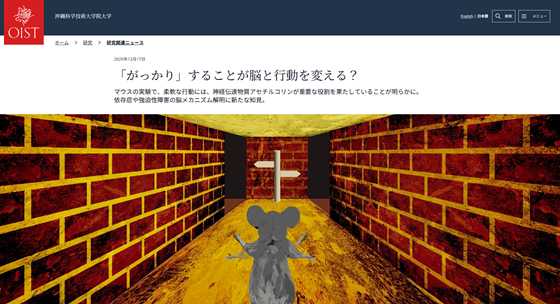
The ability to choose and switch to a new behavior when circumstances change and previous actions no longer work is called 'behavioral flexibility.' According to Jeff Wickens, who leads the Neurobiology Research Unit at OIST, switching to situational behavior is neuroscientifically very complex and requires the coordinated work of multiple areas of the brain, so the detailed mechanisms have not been fully understood.
A research team led by OIST researchers Gideon Sapong and Wickens focused on acetylcholine, which has been thought to be involved in switching between behaviors, and conducted an experiment in which mice were made to navigate a virtual maze.
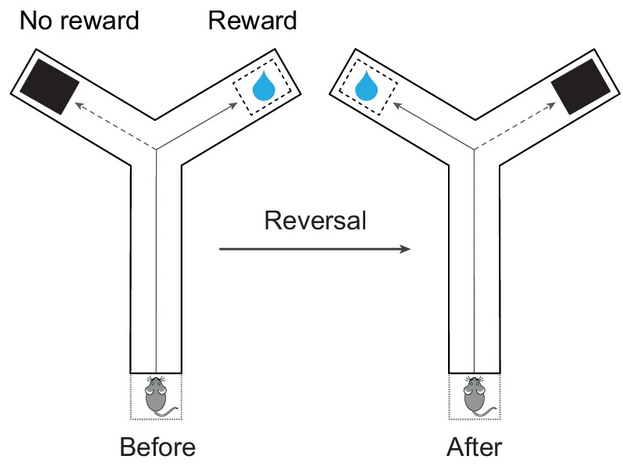
In the virtual maze used in the experiment, mice move around the maze by running on a rotating spherical device. The mice can choose either the left or right route, and if they take the route with a reward, they receive food, but there are no markers to indicate which is the correct route. Therefore, the mice have to learn the rewarding route through trial and error.
The research team trained the mice until they achieved an 80% accuracy rate in at least one session, and then reversed the route that yielded a reward. This put the mice in a situation where they would choose a route that was previously correct, but would not receive a reward.
In working on this problem, the research team observed changes in the striatum , a brain region involved in behavioral selection and learning, using a two-photon microscope . They found that when mice correctly selected a reward route, acetylcholine release in the dorsal striatum temporarily decreased. However, when the reward route was reversed and the mice were disappointed that they could not receive a reward even when selecting the previously correct route, acetylcholine release increased over a wide range of areas.
Furthermore, the increase in acetylcholine was linked to differences in subsequent behavior. According to Sapon, mice with significantly increased acetylcholine release were more likely to switch to an alternative choice after not receiving a reward. Regarding these results, Sapon stated, 'This shows that acetylcholine is important in breaking habits and enabling new choices.'
Furthermore, when the research team suppressed the activity of acetylcholine-releasing neurons in mice, the behavior of switching to an alternative choice after not receiving a reward decreased, and the number of trials required to adapt to the change in the reward route also increased. The research team reported that the average number of trials required to reach the 80% accuracy rate was 63 for mice without neuronal suppression, compared to an average of 115 for mice with suppressed neurons.
However, the increase in acetylcholine was not uniform throughout the dorsal striatum. When the research team divided the observation area into smaller regions and examined them, they found that while there were many areas where acetylcholine increased, there were also areas where it decreased or showed no significant change. The research team explained that 'it is possible that the mice did not completely forget past reward routes and retained memories in preparation for when the situation changed again.'
Wickens stated that 'understanding the function of this neurotransmitter is essential in treating many neuropsychiatric disorders, as acetylcholine levels often change in the treatment of such disorders as Parkinson's disease and schizophrenia.' He added that this could lead to a better understanding of disorders where breaking habits is difficult, such as addiction and obsessive-compulsive disorder, and could also contribute to the development of future treatments.
Related Posts:







in Science, Posted by log1b_ok