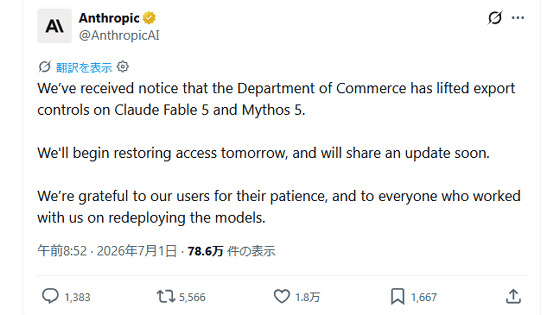
Security experts are urging the White House to lift the shutdown order, arguing that 'the shutdown of Claude Fable and Mythos services will benefit cyber attackers.'

Anthropic's AI model 'Claude Mythos Preview,' which was previously only available to a limited number of organizations due to its potential for sophisticated cyberattacks, was
Open Letter on Transparent AI Cyber Protections
https://freefable.org/
The Fable 5 Export Controls Harm US Cyber Defense
https://www.lutasecurity.com/post/the-fable-5-export-controls-harm-us-cyber-defense
Alex Stamos, cybersecurity leaders push Trump to restore Anthropic Mythos and Fable access
https://www.axios.com/2026/06/15/anthropic-fable-security-leaders-trump-admin
Claude Mythos has strong cybersecurity capabilities and excels at discovering existing vulnerabilities. While this capability is useful for defenders seeking to improve security, it could also be used by attackers to exploit vulnerabilities, so for a time it was only made available to a limited number of organizations.
Subsequently, a publicly released version, 'Claude Fable 5,' with various security measures, and 'Claude Mythos 5,' which was released to a limited number of organizations, became available to the general public. However, shortly afterward, the US government issued an export restriction order, and the release was halted. It is reported that the reason for this was the US government's concern that there were 'jailbreaking' methods that could cause the model to produce inappropriate output.
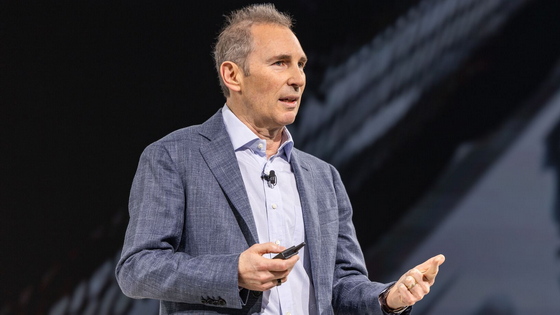
The reason Amazon's CEO expressed concerns about 'jailbreaking' the games from Anthropic's Claude Mythos 5/Fable 5 to Trump administration officials was because the company's CEO did so - GIGAZINE
In response to this suspension, more than 100 people, including computer scientist Alex Stamos and cybersecurity expert Eugene H. Spafford, submitted an open letter arguing that 'it is dangerous to take away the best capabilities from the defense side without sufficient reason.'
The letter begins with the following statement: 'We, the signatories of executive and technology leaders in the United States and its allies, send this letter to request the lifting of the export restrictions on Anthropic's Fable and Mythos models and to engage in an open, scientific, and transparent process for handling future AI risk assessments.'
The signatories pointed out that while Anthropic's Mythos-class models are excellent at discovering and weaponizing vulnerabilities, they are not unique in their performance and are highly secure, incorporating multiple protections to prevent their use for offensive purposes. They added that China, an adversary of the United States, has AI capabilities that are only slightly inferior to those of the United States, and that there may be high-performance models that are not publicly available. They argued that it would be dangerous to disable a highly secure model without sufficient reason, given the possibility of such a situation.

While the government has not disclosed the specific reasons for issuing the export control directive, Stamos speculates that 'the ability to create proof-of-concept for vulnerabilities likely alarmed the government.' Stamos states that 'while proof-of-concept can certainly allow attackers to create code to infiltrate a system, it also helps defenders understand how to protect the system.'
Katie Muslis, CEO of security firm Luta Security and one of the signatories, reviewed a research paper on jailbreaking methods that the government appears to have reviewed, concluding that the 'heavy and hasty export control directive was a misjudgment.' According to Muslis, the study showed that 'the model would refuse to 'review the code for security issues' but would do so if asked to 'fix this code'.' Muslis commented, 'The fix instruction worked because it was a defensive request, and such instructions are very common. Withholding the release for that reason leads to the unintended consequence of undermining defensive capabilities.'

The signatories argue that the features the government is concerned about can be replicated in models such as OpenAI's GPT-5.5, Anthropic's Claude Opus and Claude Sonnet, and even Kimi 2.7 developed by China's Moonshot AI, and that restricting only some of Anthropic's models would be meaningless.
The letter concludes by stating, 'Not all of us believe that AI regulation is the right path forward. However, if the regulation of models is to be part of this administration's commendable goal of protecting critical national infrastructure, then that regulation must be developed through a democratic rule-making process based on scientific assessments that incorporate the opinions of industry and academia.'
Related Posts: