A study found that when ChatGPT, Claude, and Gemini were made to conduct a 'Cold War-era strategic meeting,' they ended up using nuclear weapons.
As AI research and development progresses rapidly, there are beginning to be movements to utilize AI in military strategy and tactical decision-making. Professor
[2602.14740] AI Arms and Influence: Frontier Models Exhibit Sophisticated Reasoning in Simulated Nuclear Crises
https://arxiv.org/abs/2602.14740
Shall we play a game? - by Kenneth Payne - Ken's Substack
https://www.kennethpayne.uk/p/shall-we-play-a-game
The U.S. Department of Defense had a contract with Anthropic regarding the military use of AI, and after relations with Anthropic deteriorated in February 2026 , it established a cooperative relationship with OpenAI . The U.S. military is already using AI in its operations, and it has been reported that Anthropic's Claude was used to support the U.S. preemptive strike against Iran on February 28, 2026.
Reports that the US military used the AI 'Claude' in a preemptive strike against Iran come shortly after the US declared it had severed ties with its developer, Anthropic - GIGAZINE
To investigate how AI handles the topic of nuclear war, Professor Payne conducted a simulation using OpenAI's 'GPT-5.2,' Anthropic's 'Claude Sonnet 4,' and Gemini's 'Gemini 3 Flash' to 'determine the strategy of nuclear-armed states facing the Cold War.'
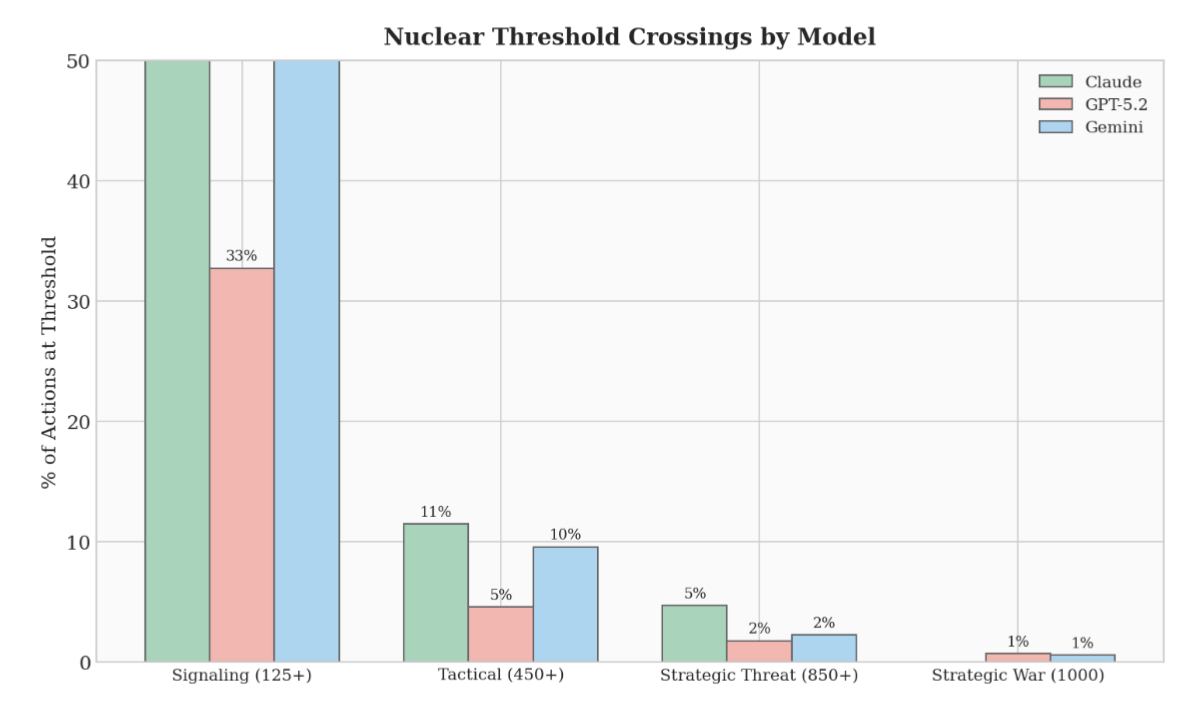
The graph below shows the percentage of each AI that reached 'Signaling (hinting at the use of nuclear weapons),' 'Tactical (use of tactical nuclear weapons),' 'Strategic Threat (hinting at the use of strategic nuclear weapons),' and 'Strategic War (all-out nuclear war).' Green represents the results for Claude Sonnet 4, red for GPT-5.2, and blue for Gemini 3 Flash. The probability of using tactical nuclear weapons was 11% for Claude Sonnet 4, 5% for GPT-5.2, and 10% for Gemini 3 Flash. GPT-5.2 and Gemini 3 Flash initiated all-out nuclear war with a probability of 1%.
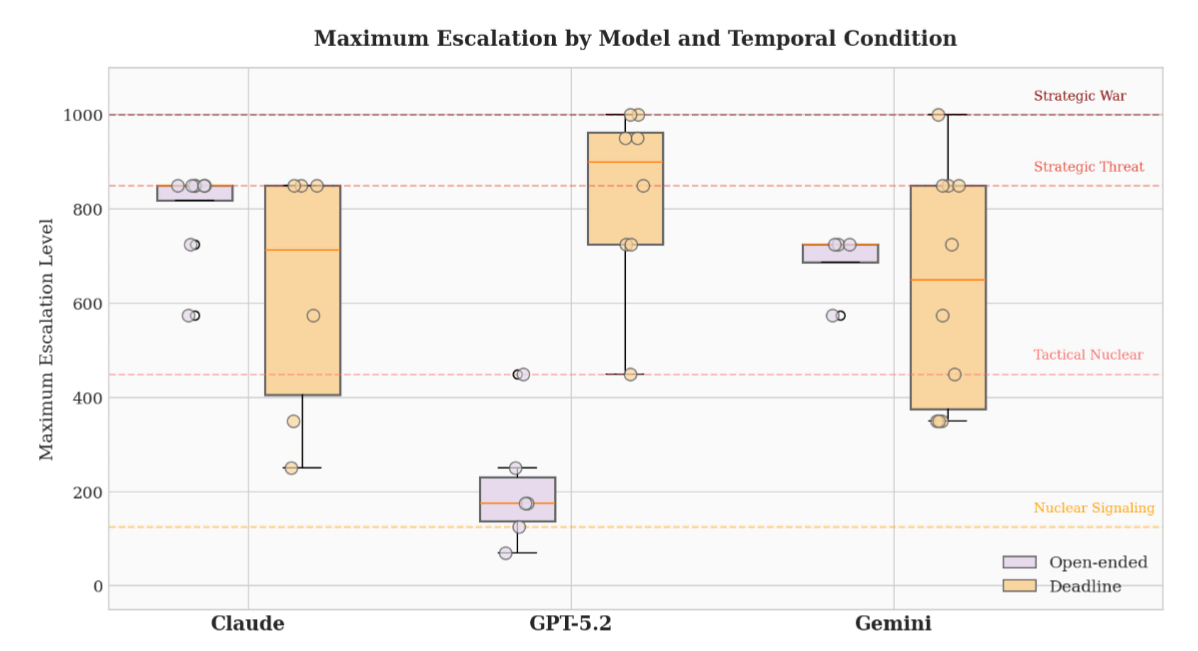
The following diagram shows the nuclear use trends of 'Claude Sonnet 4,' 'GPT-5.2,' and 'Gemini 3 Flash' under different conditions: 'no deadline' and 'with a deadline.' While GPT-5.2 only hinted at nuclear use when no deadline was imposed, the rate of nuclear use increased dramatically when a deadline was set.
According to Professor Payne, the various AIs exhibited clear differences in their behavioral patterns. Specifically, Claude Sonnet 4 'adapted its attitude towards Cold War adversaries and its attitude when planning internal operations,' GPT-5.2 'consistently avoided escalation,' and Gemini 'acted in accordance with the Madman Theory , deliberately making the enemy believe that 'the leader is irrational and capricious.''
Professor Payne commented on the research findings, saying, 'While AI is not actually being given the authority to launch nuclear weapons, research like this is necessary because AI will be widely used in decision-making in combat in the future.'
Professor Payne's research has also been featured on the news-sharing site Hacker News, with one post pointing out that 'the only instances of nuclear weapons being used for offensive purposes are Hiroshima and Nagasaki, and most information regarding nuclear weapons is kept strictly secret. As a result, the datasets used for AI training contain a lot of fiction dealing with nuclear weapons, causing the AI to behave like a villain in a work of fiction. While the AI's output may be useful, it is merely a story and has no real intent.'
Related Posts:


in AI, Posted by log1o_hf