Anthropic has released policy recommendations on how to address the catastrophic risks posed by advanced AI systems and how to respond to disruptions in the labor market.

Anthropic, the developer of the AI model Claude, has released proposals on how governments should address the catastrophic risks posed by the most powerful AI models.
Policy on the AI Exponential \ Anthropic
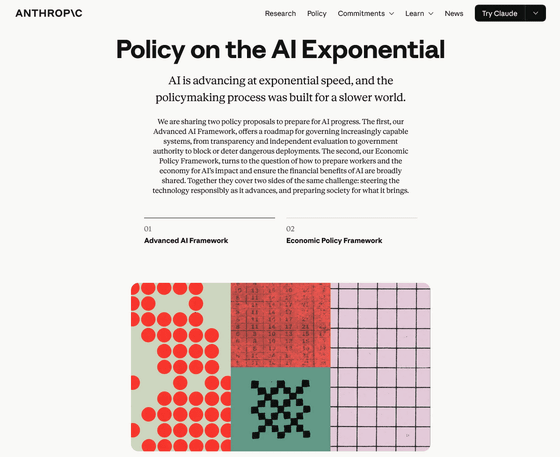
Policy on the AI Exponential \ Anthropic
https://www.anthropic.com/policy-on-the-ai-exponential/epf
Adv-AI-Framework_060926_a.pdf
(PDF file) https://www-cdn.anthropic.com/files/4zrzovbb/website/0a58d567024a8b448ff15158ebc3625328dfcc1f.pdf
Anthropic released 'Claude Mythos 5' and 'Claude Fable 5' on June 9, 2026, updates to its high-performance AI model ' Claude Mythos Preview, ' which is capable of sophisticated cyberattacks. Anthropic claims that Claude Mythos Preview is an advanced AI model that ' will change the way we think about cybersecurity, ' and it has been reported to have discovered thousands of serious potential vulnerabilities, including those in major operating systems and browsers.
The official version of 'Claude Mythos' has finally been released, and 'Claude Fable,' a version with no user restrictions, has also been released, making it available to everyone - GIGAZINE
Anthropic points out that as AI develops powerfully, 'the risk of catastrophic damage will also increase.' Four types of 'catastrophic risks' are listed: 'biological risks,' where technologies that accelerate new drug development could facilitate the development of biological weapons; 'cyber risks,' where critical infrastructure could be threatened by the discovery of critical vulnerabilities in software; 'uncontrollable risks,' where it may become far more difficult for developers to control AI systems as their performance improves; and 'automated development risks,' where these risks are amplified as AI systems automate the research and development of AI itself.
Anthropic has addressed the 'risks of automated development,' where AI designs the next generation of AI, creating even more powerful AI, by discussing the issues, future possibilities, and necessary countermeasures.
Anthropic warns of the risks of a self-improvement loop where 'AI creates AI,' and discusses the possibility of AI itself accelerating AI development - GIGAZINE

According to Anthropic, several state laws enacted in recent years have required businesses to explain and publicly disclose their safety measures, and Anthropic has supported these laws. However, Anthropic states that transparency alone is no longer enough, and the government needs to play a more substantive role.
Regarding transparency, Anthropic suggested going beyond traditional approaches such as safety frameworks explaining how catastrophic risks are assessed and evaluating the capabilities and risks of cutting-edge models. They proposed mandating the regular publication of risk reports explaining the overall risk situation for developers, as well as regular evaluations by 'independent evaluators.' Independent evaluators are individuals or organizations that independently evaluate AI models, and Anthropic argued that governments and the industry need to set standards for independent evaluators and ensure funding and sufficient access to cutting-edge models.
Furthermore, developers of cutting-edge AI models need to protect their entire development environment from internal and external threats, including publishing program outlines, sharing details with designated agencies upon request, establishing channels for reporting 'distillation attacks' that attempt to learn and mimic the model's behavior, and regularly testing their own defenses. In addition, Anthropic argues that governments should have the power to block or restrict the deployment of models that could cause catastrophic damage, but should not be given overly broad regulatory powers.
Furthermore, there are concerns that AI could disrupt the labor market. In response, Anthropic has announced a total investment of $350 million (approximately 56 billion yen), including investments in the 'Economic Futures Research Fund,' which will fund large-scale research trials and program evaluations of promising public policies, and the provision of fellowship programs to support early-career individuals in spreading the benefits of AI to communities across the United States. Anthropic also pointed out that labor organizations and governments should deepen their understanding of AI and the changes in employment, and focus on stabilizing the employment economy.
Anthropic stated, 'These challenges are complex and novel, and we expect there to be lively discussions about the recommendations we offer. However, we strongly urge policymakers to address these challenges proactively now. AI capabilities will improve rapidly in the coming months, and governance needs to keep pace.' Anthropic warned that the improvement in AI capabilities could outpace the pace of policymaking, and that the next few years will be critical.
Related Posts:






in AI, Posted by log1e_dh