OpenAI has established 'OpenAI Economic Research Exchange,' a platform for research into the impact of AI on the economy.
AI is said to have had a tremendous impact on people's lives and transformed the way businesses operate. However, to truly understand just how much change has occurred, solid evidence and rigorous empirical research by researchers are necessary. To address this, OpenAI has established the ' OpenAI Economic Research Exchange ,' a platform for integrating these findings.
Introducing the OpenAI Economic Research Exchange | OpenAI
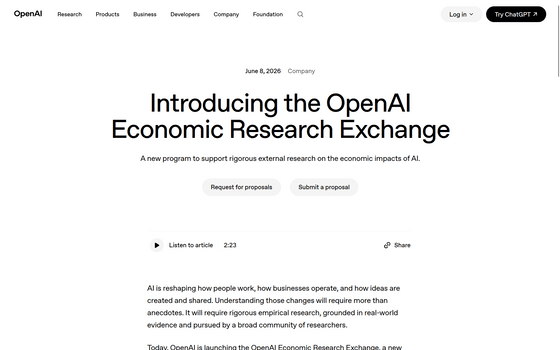
OpenAI Economic Research Exchange | OpenAI
Economic Research Exchange Application | OpenAI
https://openai.com/form/economic-research-exchange/
The 'OpenAI Economic Research Exchange' is a platform established by OpenAI's economic research team to formalize and expand collaboration with external researchers. Through this platform, external researchers can work with OpenAI's economic research team to study how AI is impacting the economy, including workers, businesses, and institutions.
OpenAI explained the background to the establishment of the OpenAI Economic Research Exchange, stating, 'AI is changing the way people work, how companies operate, and how ideas are created and shared. To understand these changes, anecdotes alone are insufficient. We need rigorous empirical research based on real-world evidence and conducted by a broad community of researchers.'
In setting up the organization, OpenAI stated that 'applicants who submit proposals that align with OpenAI's current economic research priorities may be invited to follow-up interviews regarding their work methods and to participate in technical selections for personnel responsible for practical analysis.'
The main research topics that OpenAI is seeking are as follows:
• Impact on the labor market: Beyond exposure to AI, how can we measure which occupations are more likely, or already are, to experience workforce increases, layoffs, job creation, or job growth as the capabilities of AI models improve?
• Employer behavior and job design: How will AI change employer behavior, including hiring needs, job descriptions, selection processes, compensation, team structures, and whether companies will redesign jobs to accommodate AI?
• Household Well-being: What impact will AI have on household well-being outside of formal work? This includes its effects on decision-making, time management, caregiving, financial planning, health management, and daily economic well-being.
AI and Education: How are teachers using AI tools? How is the role of teachers changing or expanding with the introduction of AI? How will exposure to AI change students' choices regarding learning and career preparation?
• Unequal access and benefits: Who is not benefiting from AI, and why? What are the biggest barriers, and how can they be overcome?
• Small and medium-sized enterprises (SMEs) and sole proprietors: How will AI impact SMEs, freelancers, sole proprietors, creators, and other independent or informal economic activities?
• Public Sector and Civil Society: What are the economic impacts of AI in the public sector and civil society? What are the economic impacts of AI in the public sector and civil society, including on public sector productivity, access to benefits, education administration, staffing agencies, licensing, tax administration, and the provision of public services?
• Knowledge Production and Innovation: How will AI transform knowledge production and innovation, including science, research and development, research workflows, expert productivity, patents, and the dissemination of cutting-edge knowledge?
• Market structure: What impact will the introduction of AI have on the market structure? For example, corporate competitiveness, dependence on platforms, bargaining power, relationships with suppliers, barriers to entry, etc.
• Value Measurement: How should the economic value of AI be measured? Specifically, how should willingness to pay, tangible value, task-level time savings, avoidance costs, results after quality adjustments, and sustainable productivity improvements be measured?

External researchers who propose these projects will receive several months of research support from OpenAI, a $25,000 (approximately 4 million yen) research grant for the principal investigator, other compensation, and access to data.
OpenAI stated, 'We welcome proposals from researchers with outstanding empirical research capabilities and expertise in applied causal inference, measurement methods, labor economics, productivity, firms, education, entrepreneurship, public finance, regional economics, development, inequality, or related fields.'
Related Posts:







in AI, Posted by log1p_kr