NASA has announced the first phase of its lunar base program, aiming for sustained astronaut stays in the third phase, starting in 2032.

At an event held on May 26, 2026, the National Aeronautics and Space Administration (NASA) announced an outline of the first phase of its Moon Base program. NASA plans to send lunar rovers and drones to the moon by 2026 and revealed that it has signed multi-million dollar contracts with several private space development companies.
Moon Base - NASA
NASA Provides Update on Moon Base Rovers, Landers, Missions - NASA
https://www.nasa.gov/news-release/nasa-provides-update-on-moon-base-rovers-landers-missions/
NASA Begins Phase 1 of Building Its Moon Base. Here's The Full Plan. : ScienceAlert
https://www.sciencealert.com/nasa-begins-phase-1-of-building-its-moon-base-heres-the-full-plan
NASA administrator hails 'Golden Age' of lunar exploration as Moon Base plans unveiled | Live Science
https://www.livescience.com/space/space-exploration/nasa-administrator-hails-golden-age-of-lunar-exploration-as-moon-base-plans-unveiled
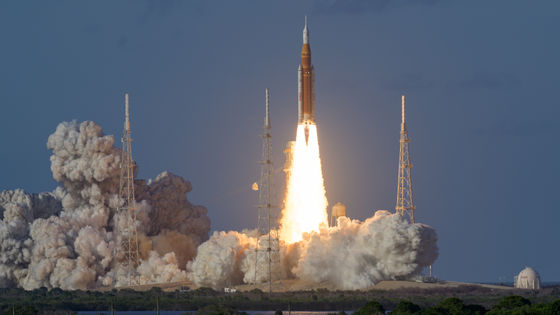
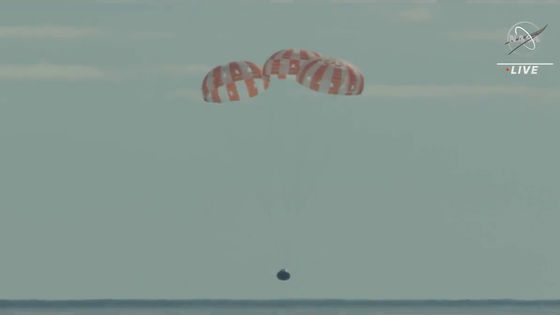
In April 2026, NASA successfully launched the Artemis II mission, placing a spacecraft carrying four astronauts into lunar orbit, sending humans to the farthest point from Earth in history . Less than two months later, NASA announced an outline of the first phase of its lunar base program.
The following images illustrate the first (PHASE 01), second (PHASE 02), and third (PHASE 03) phases of NASA's planned lunar base program.
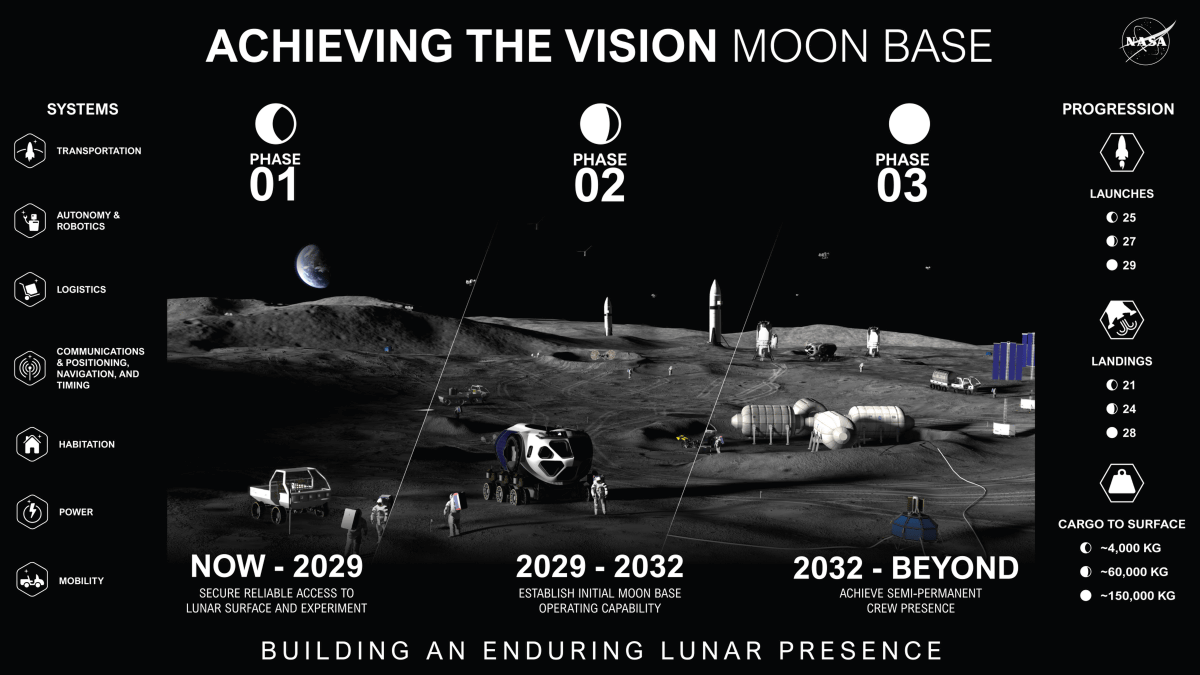
The first phase will take place from 2026 to 2029 and will include exploration of the lunar south pole region, a potential site for a lunar base, technology testing, and robotic exploration missions on the lunar surface in preparation for future manned spaceflights. In addition to manned and autonomous rovers for demonstrating mobility and surface preparation, four drones called
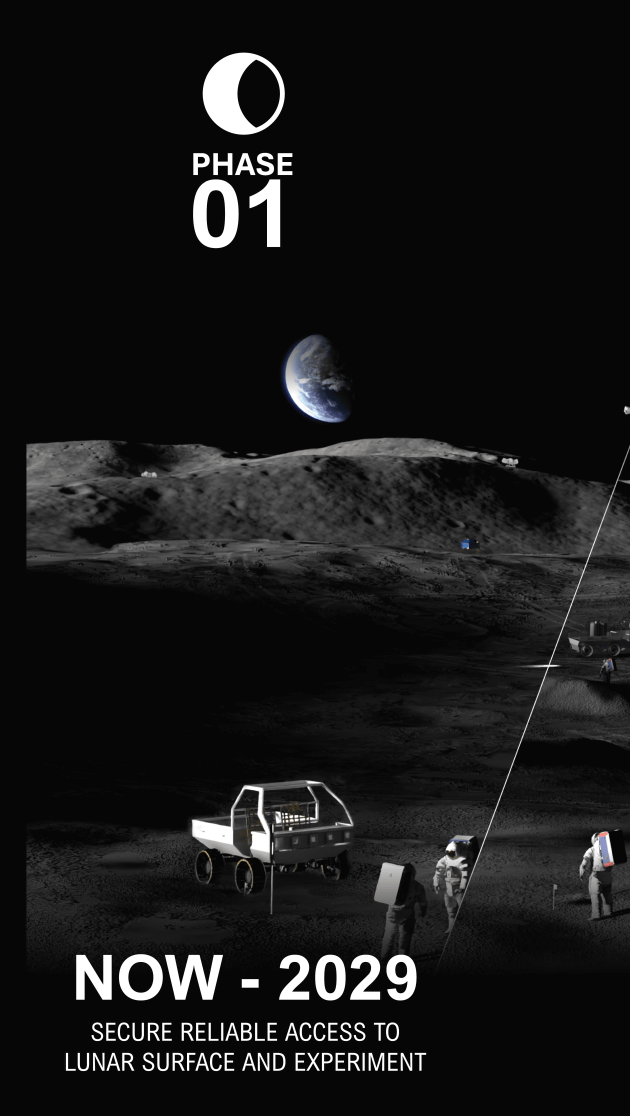
The second phase, scheduled for 2029-2032, will involve the construction of semi-permanent infrastructure and the commencement of initial settlement and logistics operations. Plans include expanding the solar power system necessary for lunar stays, introducing initial nuclear power capacity, improved rovers, construction of initial living spaces, and strengthening the communication network between the surface and orbit.
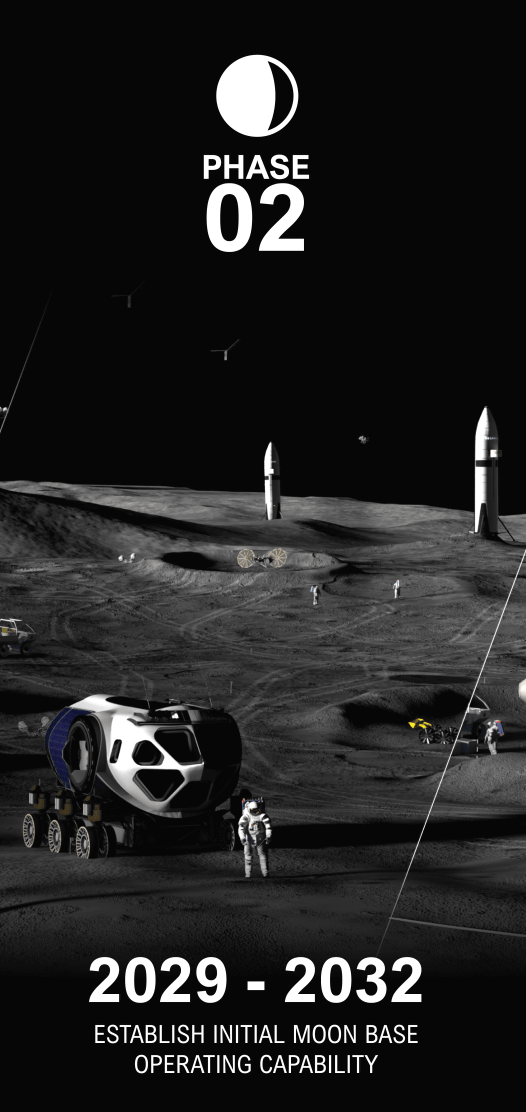
In the third phase, starting in 2032, sustained lunar stays will be achieved through regular personnel rotations and continuous lunar activities. This phase will include the establishment of semi-permanent habitation modules with spacious interiors for astronauts to live and work in, nuclear fission power systems that can reliably supply energy using local resources, and advanced logistics networks using manned and autonomous vehicles.
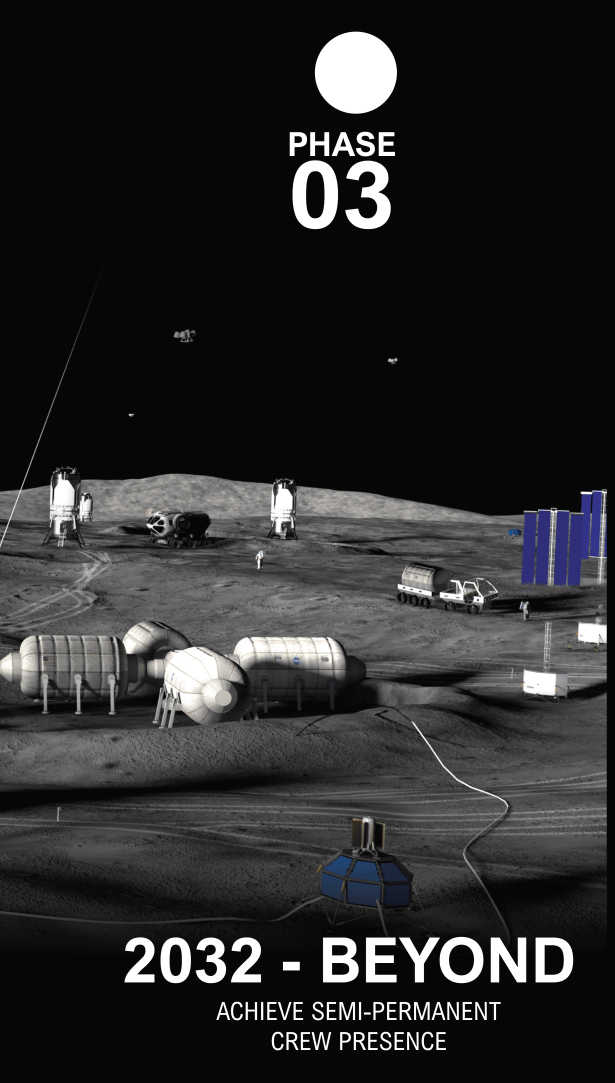
At an event on May 26, NASA announced that the first phase of its lunar base program will begin in 2026, with three missions planned: 'Moonbase I,' 'Moonbase II,' and 'Moonbase III.' The outlines of each mission are as follows:
Moonbase I:
This mission, scheduled for the fall of 2026 or later, will use Blue Moon Mark 1 Endurance , a lander from Blue Origin led by Jeff Bezos, to carry payloads such as a stereo camera to study the interaction between the spacecraft's thrusters and the lunar surface, and a laser reflection array to help pinpoint the orbiting spacecraft's location.
Moonbase II:
This mission, scheduled for sometime in 2026, will use the Astrobotic Griffin lander to transport 1,100 pounds (approximately 500 kg) of cargo, including an Astrolab FLIP rover (lunar exploration vehicle) . The mission aims to mature a mobility system that will be useful for future lunar vehicle operations.
Moonbase III:
This mission, scheduled for sometime in 2026, will send the first payload selected through NASA's 'Lunar Payloads and Lunar Research' initiative aboard Intuitive Machines ' Nova-C 'Trinity' lander. The payload will include instruments for studying bright spots on the lunar surface, as well as payloads from the European Space Agency (ESA) and the Korea Astronomy and Space Science & Technology Research Institute.
For this series of missions, Blue Origin secured a contract totaling $468 million (approximately 77 billion yen), while Astrolab secured a contract of $219 million (approximately 35 billion yen), and Lunar Outpost , which is developing a lunar rover, secured a contract of $220 million (approximately 35 billion yen).
Carlos Garcia-Galan, head of the lunar base project, stated at a press conference that NASA's lunar base could eventually resemble a vast city. 'We envision the lunar base being hundreds of square miles (hundreds of square kilometers) in size, equipped with various facilities, and ultimately leading to the achievement of our goal of a permanent presence on the moon,' he said.
NASA Administrator Jared Isaacman said in a statement, 'The lunar base will be America's and humanity's first base on another celestial body.' In a post on X, he commented, 'The golden age of lunar exploration has begun.'
The near impossible is becoming possible.
— NASA Administrator Jared Isaacman (@NASAAdmin) May 26, 2026
We are building toward a sustained human presence at the lunar South Pole. It begins with Phase 1: CLPS landers and LTV rovers testing the “science of survival” on the lunar surface before heavy HLS cargo landers deliver the mass and… pic.twitter.com/EhqmXAPQzA
Related Posts:
in Free Member, Science, Posted by log1h_ik