A marketing company was fined for advertising a feature that supposedly eavesdropped on users' cell phones, even though there was no evidence that it actually did so.

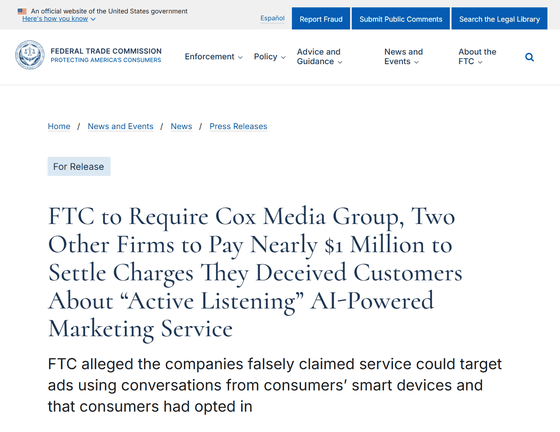
FTC to Require Cox Media Group, Two Other Firms to Pay Nearly $1 Million to Settle Charges They Deceived Customers About “Active Listening” AI-Powered Marketing Service | Federal Trade Commission
https://www.ftc.gov/news-events/news/press-releases/2026/05/ftc-require-cox-media-group-two-other-firms-pay-nearly-1-million-settle-charges-they-deceived
Marketing Company Claims That It Actually Is Listening to Your Phone and Smart Speakers to Target Ads
https://www.404media.co/cmg-cox-media-actually-listening-to-phones-smartspeakers-for-ads-marketing/
Cox Media found after bragging it spied on users through their phones | The Verge
https://www.theverge.com/policy/937027/cox-media-marketing-ai-powered-phone-spying-ads-ftc-fine
Cox Media Group, based in Georgia, USA, and its partner marketing companies MindSift and 1010 Digital Works, have been offering a marketing service called 'active listening,' which uses a special algorithm to eavesdrop on and detect relevant conversations from smart devices and deliver advertisements to consumers in specific areas. It has been pointed out that Cox Media Group, MindSift, and 1010 Digital Works have been boasting that active listening 'eavesdrops on consumer conversations intercepted by smart devices in real time.'
However, Active Listening was sued on the grounds that it was not based on audio data and that consumers had not opted in to the service. The complaint alleges that Active Listening never actually eavesdropped on consumers' conversations or used audio data, nor did it accurately place advertisements in locations requested by customers.
The FTC also pointed out that 'Cox Media Group, MindSift, and 1010 Digital Works deceived potential customers by claiming that consumers had opted in to active listening.' The three companies argued that consumers opted in by agreeing to the terms of service that they had to agree to when downloading and using the app, but the FTC countered that 'in the case of an intrusive service like active listening, simply clicking on mandatory terms of service does not constitute opting in to the use of a consumer's audio data within their home,' and determined that the three companies' claim that consent had been obtained was invalid.
In addition, the FTC pointed out that if active listening works as advertised, it would violate Section 5 of the Federal Trade Commission Act by collecting and using consumers' voice data without proper consent.

In addition, MindSift and 1010 Digital Works are alleged to have provided Cox Media Group with the means and tools to deceive customers through marketing materials, sales pitches, and answers to customer questions, thereby misleading small and medium-sized businesses about the capabilities of active listening.
The proposed order to resolve the FTC's claims would order Cox Media Group to pay $880,000 (approximately 140 million yen) in settlement payments, and MindSift and 1010 Digital Works to pay $25,000 (approximately 4 million yen) each. These settlement payments will be used to compensate users who suffered damages due to false representations regarding active listening.
Christopher Mufaridge, head of the FTC's Consumer Protection Division, stated, 'Not only did the products these companies sell fail to deliver the promised results, but they also deceived potential customers by claiming they had subscribed to the service, when it was clear they had not. Being honest with customers is a fundamental principle of business, and these companies failed to do so.'
Related Posts:







in Software, Web Service, Smartphone, Posted by logu_ii