We have confirmed instances where heat from data centers causes downwind residential areas to become hotter.

Data centers are crucial infrastructure supporting the expansion of AI use in addition to cloud and web services, but the impact of the heat generated by their operation on surrounding areas is also attracting attention. A research team at Arizona State University used vehicle-mounted sensors to measure temperatures around four data centers in the Phoenix metropolitan area and confirmed instances where residential areas downwind were warmer than those upwind.
Data Center Waste Heat as an Emerging Urban Thermal Hazard: First Field Measurements of Neighborhood-Scale Air Temperature Impacts | Journal of Engineering for Sustainable Buildings and Cities | ASME Digital Collection
Turning down the heat from data centers | ASU News
https://news.asu.edu/20260518-environment-and-sustainability-turning-down-heat-data-centers
Heat released into the environment by human activities such as automobiles, factories, and building heating and cooling systems is called 'artificial waste heat,' and it is a factor that exacerbates the urban heat island effect .
A research team led by David J. Thaler, who studies geographical science and urban planning at Arizona State University, has identified data centers as a rapidly growing source of concentrated artificial heat in urban environments. While the heat flux from data centers can reach 2 to 6 times the peak solar radiation, their impact on the temperature of nearby residential areas has not been directly measured in previous studies.
The research team measured the temperature on both the upwind and downwind sides around four data centers in the Phoenix metropolitan area of Arizona using vehicle-mounted sensors. The data centers targeted were CyrusOne , Aligned , and Digital Realty in Chandler, and NTT PH1 in Mesa. High-precision temperature sensors and GPS were attached to multiple vehicles, which were driven on public roads and nearby residential areas around the data centers. The temperature sensors were installed at a height of 1.6 to 2.2 meters above the ground and recorded the temperature at 2-second intervals.
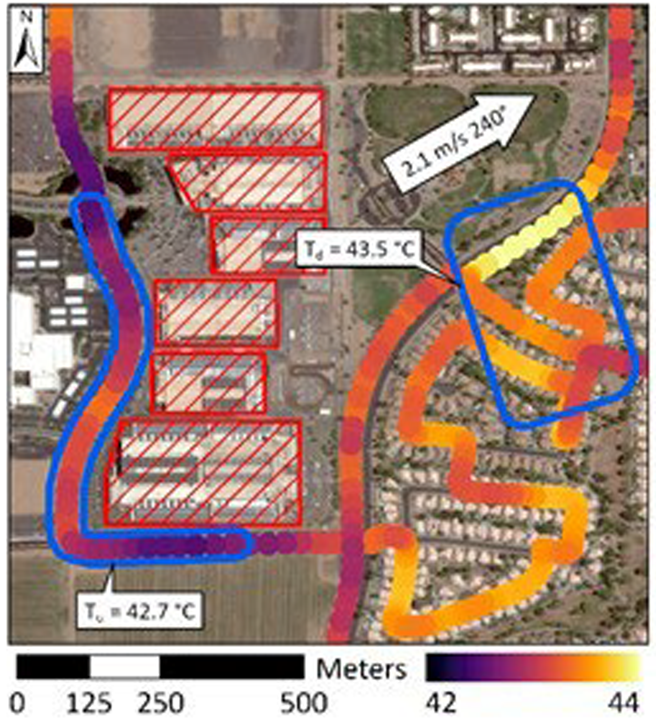
Measurements were taken around the CyrusOne data center between 2:25 PM and 2:45 PM on June 18, 2025. At that time, a wind of 2.1 meters per second was blowing from the west-southwest, and the hot air emanating from the data center was flowing towards the residential areas to the east and northeast of the CyrusOne site. The average temperature upwind was 42.7°C, while the temperature in the residential area downwind near the east side of the data center rose to 43.5°C, and this difference of approximately 0.8°C extended for about 500 meters downwind.
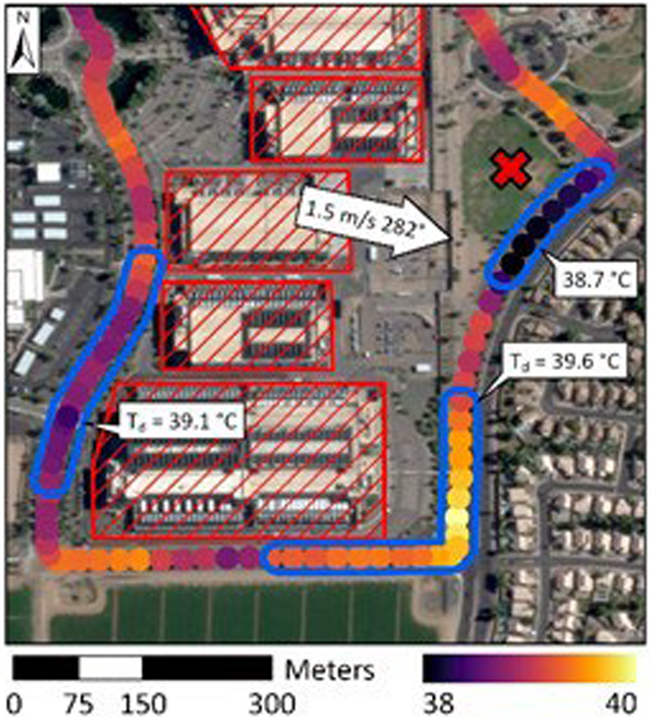
Furthermore, measurements were also taken around the CyrusOne data center on the morning of August 8, 2025. At that time, a wind of 1.5 meters per second was blowing from the west-northwest, and the average temperature upwind was 39.1°C, while the downwind residential area to the southeast was 39.6°C, a temperature difference of 0.5°C. On the other hand, some areas downwind were cooler than the surrounding area, and the research team found that these were near
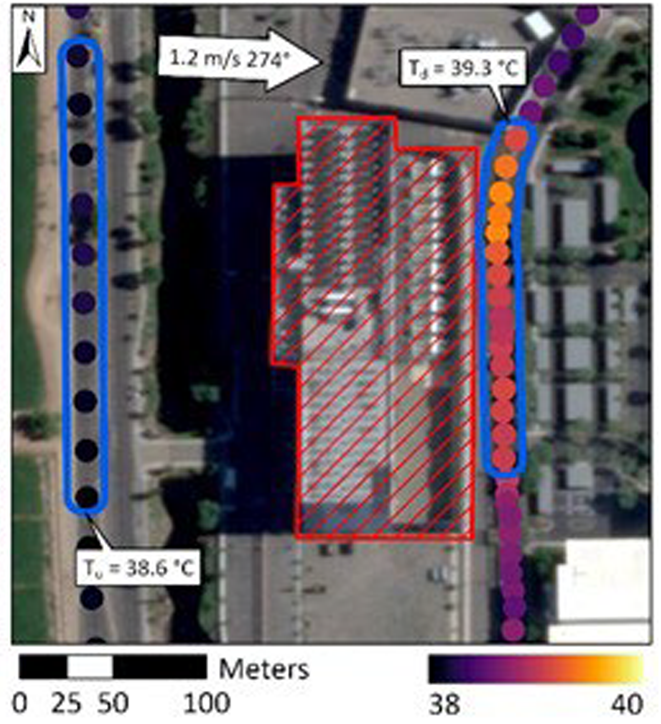
Measurements taken around Aligned's data center also confirmed a temperature difference between the windward and leeward sides. The average temperature on the east side of the data center, where exhaust from the condensers is emitted, was 39.3°C, while the average temperature on the west side (windward) was 38.6°C, a difference of approximately 0.7°C.
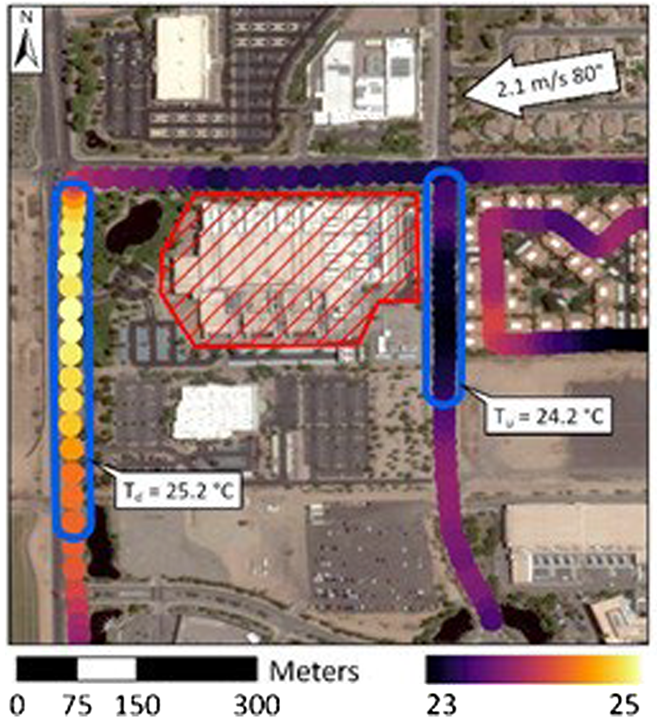
Measurements taken around Digital Realty's data center showed that the average temperature on the windward side was 24.2°C, while on the leeward side it was 25.2°C, resulting in an average temperature difference of 1.0°C and a maximum difference of approximately 2°C.
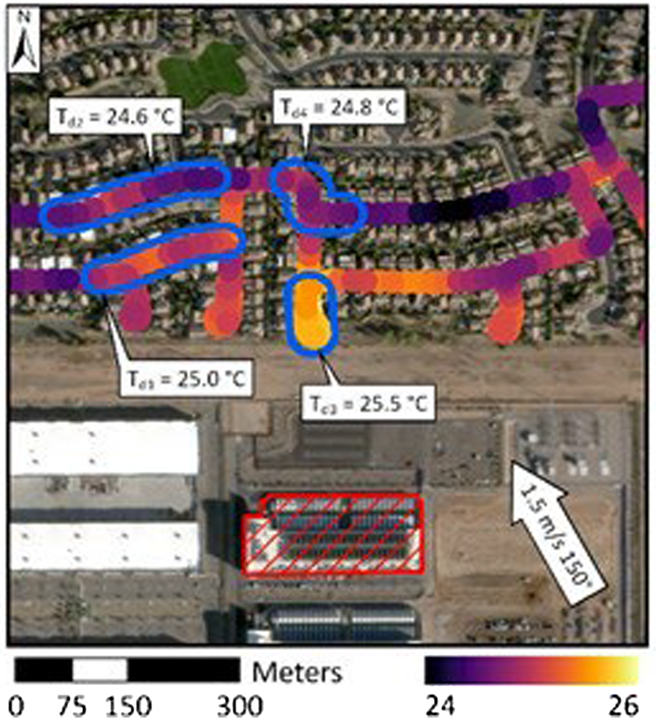
Measurements were taken at NTT PH1 between 10:30 AM and 10:40 AM on October 25, 2025. A wind of 1.5 meters per second was blowing from the south-southeast, and the residential area was downwind of the data center. Near the boundary of the data center, temperatures of 25.5°C and 25.0°C were recorded depending on the location, and dropped to 24.8°C and 24.6°C when moving 80 to 100 meters north towards the residential area. The research team explained that these results 'are consistent with the behavior of hot air released from the condenser being diluted downwind and mixing vertically.'
Combining the measurements from all four data centers, the maximum temperature increase on the downwind side was 2.2°C. Furthermore, temperatures on the downwind side were, on average, 0.7–0.9°C higher than the corresponding upwind side, and the temperature increase was detected within a range of 100–500 meters from the perimeter of the data centers. The research team cites the consistent correlation between high-temperature areas and wind direction across multiple data centers, multiple dates, and different weather conditions as evidence that this temperature increase is due to heat exhaust from the data centers.
The research team attributes these temperature differences to the widespread use of air cooling in data centers within the Phoenix metropolitan area. Almost all of the power consumed by IT equipment is ultimately converted into heat, and air-cooled condensers expel air that is 8 to 14°C hotter than the surrounding air at a speed of 2 to 4 meters per second. In the Phoenix metropolitan area during the summer, exhaust temperatures can exceed 50°C, and this hot air is carried downwind by the wind.
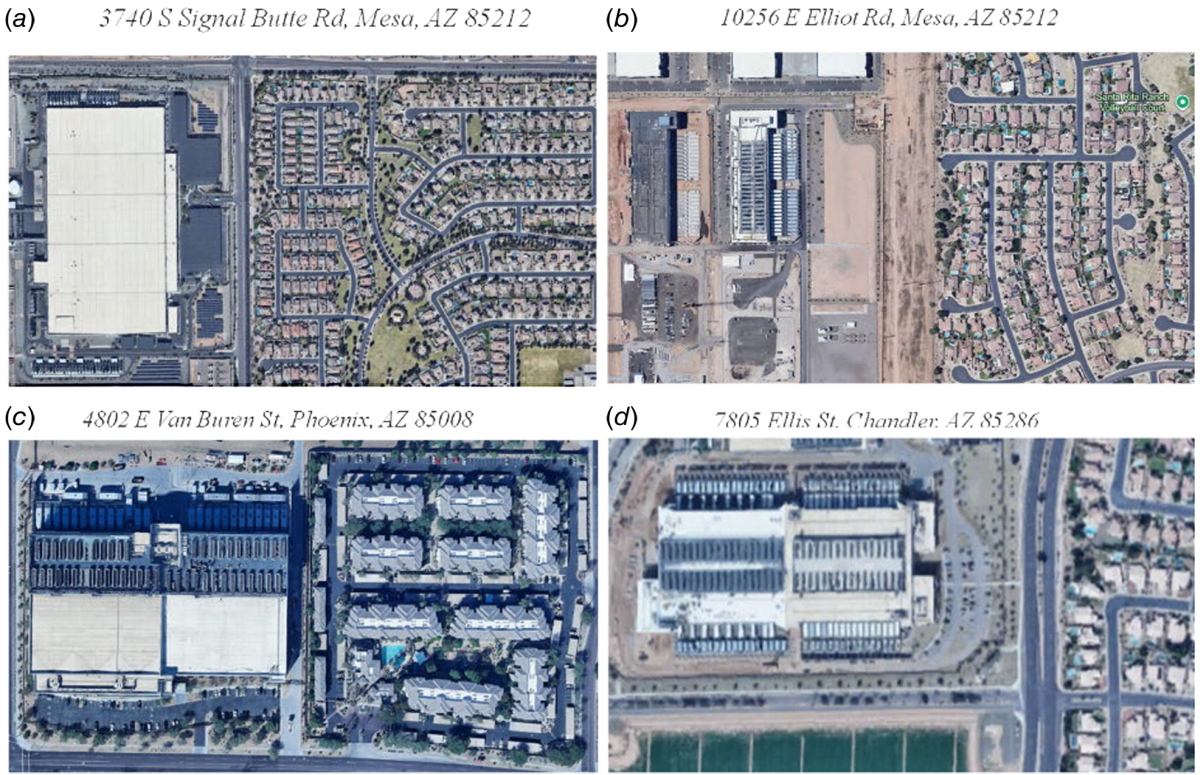
The research team also focused on the proximity of data centers to residential areas. Below are examples of data centers adjacent to residential areas, including NTT PH1 and CyrusOne, which were the subjects of this study, as well as Apple Data Center and
The scale of heat dissipation is quite large; NTT PH1 is estimated to emit heat equivalent to that of approximately 40,000 households. Furthermore, CyrusOne's data center complex in Chandler is said to emit heat equivalent to that of over 180,000 households from its 34-hectare site. In the Phoenix metropolitan area, more than 50% of household electricity consumption is used for air conditioning, so even a 1-2°C rise in outside temperature could increase air conditioning demand in downwind homes.
The research team states that these results are initial observations based on four data centers and several measurements, and that further measurements over a wider range of time periods and weather conditions are needed. Thaler, the lead author of the research paper, said that 'data centers are inherently important to society and will only become more necessary in the future,' and explained that it is important to work with data center operators and policymakers to create knowledge to reduce the impact of waste heat flowing into residential areas.
Related Posts:





in Science, Posted by log1b_ok