Three out of five short story award-winning works have been suggested to be 'highly likely to have been written using AI.'
Major publishers
AI scandal engulfs prestigious short story prize after multiple entrants accused of fabricating work | The Independent
https://www.independent.co.uk/arts-entertainment/books/news/commonwealth-short-story-winner-ai-generated-jamir-nazir-granta-b2980039.html
'Obvious markers of AI': doubts raised over winner of short story prize | Books | The Guardian
https://www.theguardian.com/books/2026/may/19/commonwealth-short-story-prize-winner-doubts-ai-artificial-intelligence
The Commonwealth Short Story Prize is a literary award established in 2012 by the Commonwealth Foundation, an intergovernmental organization in the UK, and is open to writers residing in member states of the Commonwealth of Nations , which consists of 56 member states.
The competition will judge unpublished short stories of 2,000 to 5,000 words, with winners selected from five regions: Africa, Asia, Canada & Europe, the Caribbean, and the Pacific, and one overall winner chosen from among these. The winner will be announced on June 30th each year, with prize money of £2,500 (approximately 530,000 yen) for each region and £5,000 (approximately 1,070,000 yen) for the overall winner.
The 2026 Commonwealth Short Story Award received a record-breaking 7,806 submissions, and the winners for each region were announced in May . Among these, suspicions have arisen that 'The Serpent in the Grove,' the winning entry from the Caribbean region by Trinidad and Tobago-born author Jamil Nazir, may have been generated using AI.
Nazir is a writer from Trinidad and Tobago with East Indian ancestry, and his works explore the cultural interplay between the Caribbean region and Indian immigrants. He is also a poet and has already published many books, as mentioned on the award winner announcement page.

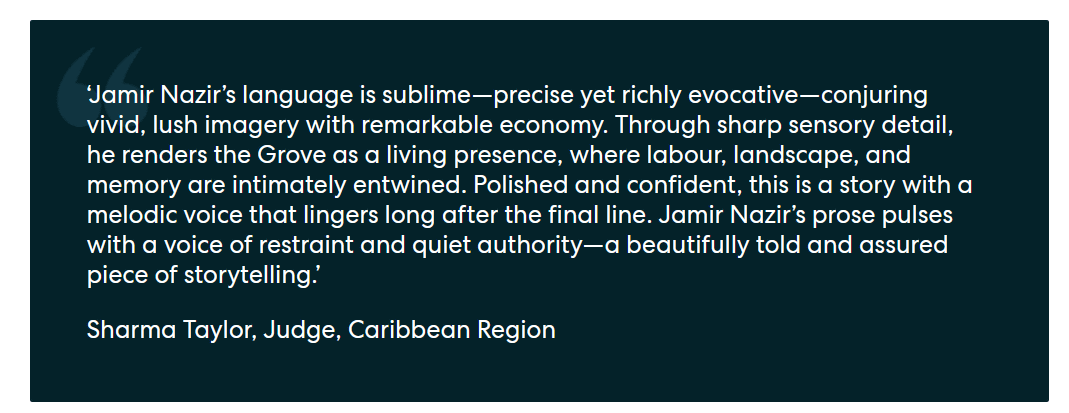
'The Serpent in the Grove' is a story set in the countryside of Trinidad and Tobago, and is said to be about 'a struggling farmer, a silent wife, and a forest that seems to remember what humans try to bury.' The judges commented that 'Jameel Nazir's words are sublime, precise yet evoke rich emotion, and paint vivid and rich images with surprising conciseness,' and that 'this refined and confident story has a melodic resonance that lingers long after you finish reading the last line.'
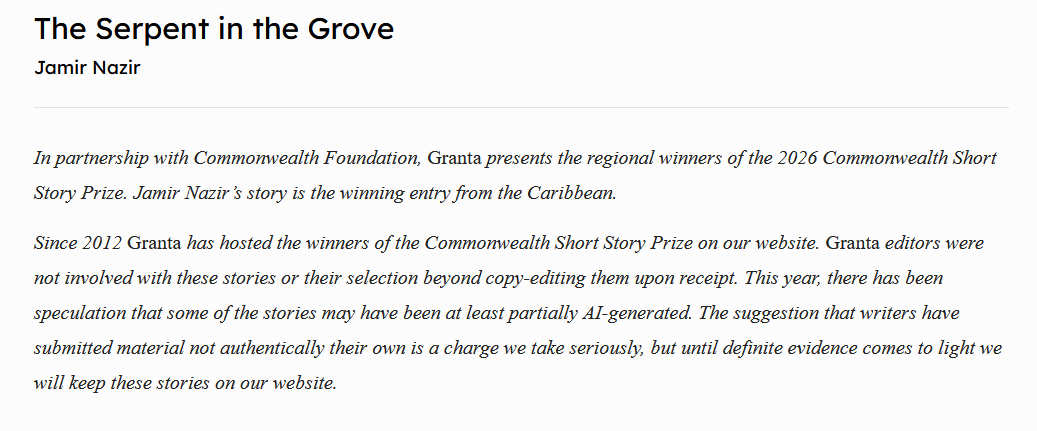
The full text of 'The Serpent in the Grove' is available on the official website of the British literary magazine Granta, and can be read by accessing the following link.
The Serpent in the Grove | Jamir Nazir | Granta
When 'The Serpent in the Grove' was released, online readers began pointing out that it had stylistic characteristics often seen in AI-generated text. AI researcher Nabil Qureshi said, 'This is the first time a story generated by ChatGPT has won a prestigious literary award (the Commonwealth Short Story Prize). The phrase 'Neither X nor Y, but Z' appears here and there, and the expression 'hums' is used frequently. There are many other clear characteristics that indicate it is AI-generated. In any case, this is a major milestone for AI.'
Well, this is a first: a ChatGPT-generated story won a prestigious literary prize (The Commonwealth Prize).
— Nabeel S. Qureshi (@nabeelqu) May 18, 2026
'Not X, not Y, but Z' sentences everywhere, the 'hums' trope, and plenty of other obvious markers of AI writing.
A major milestone for AI, at any rate... @GrantaMag https://t.co/BWGBpRasNz pic.twitter.com/U6jWejprFv
Professor Ethan Morick, an AI researcher at the University of Pennsylvania, said, 'This is a kind of Turing test, but it appears that a 100% AI-generated story has won the Commonwealth Short Story Award for the Caribbean region. The story was praised for its 'lyrical precision, memorable atmosphere, and confident and restrained narrative style.''
In a Turing Test of sorts, it looks like a 100% AI generated story just won the Commonwealth Prize for the Caribbean region 'for its lyrical precision and haunting atmosphere, the story stood out for the confidence and restraint of its voice.'
— Ethan Mollick ( @emollick.bsky.social ) May 19, 2026 2:50
Published in Granta: granta.com/the-serpent-...
[image or embed]
When people who became interested in Mr. Nazir looked into him, they reported that the only published work he seems to have had so far was a self-published collection of love poems from 2018, and that all they could find were posts on Facebook and LinkedIn. It was also reported that Mr. Nazir talks about how wonderful AI is on LinkedIn, suggesting that he is obsessed with AI.
you look this guy up and all you get is stuff about this story, a book of 'love poems' self-published in 2018 with a blurry stock photo on the cover, and a bunch of random facebook and linkedin posts. incredible indictment of the whole writing prize industry that this got through https://t.co/jalmgdD2RT
— david c. porter (read NTTN) (@toomuchistrue) May 18, 2026
Some people suspected that Mr. Nazir's photo might have been generated by AI, but it has been discovered that when he self-published a collection of poems in 2018, Mr. Nazir was featured in a newspaper in Trinidad and Tobago.
Everyone keeps saying that Jamir Nazir is a totally AI-generated person, but he appears to really exist and live in Trinidad and Tobago, even if he did use apparently AI for his award winning poetry and used AI to create a headshot. https://t.co/mzISA3rtXc pic.twitter.com/rAnTeH7kTd
— Jacqueline Sweet (@JSweetLI) May 19, 2026
The Independent, an overseas media outlet, checked the text using the AI detection platform Pangram and determined that 'The Serpent in the Grove' was 100% AI-generated. According to Pangram, the combination of three adjectives—'damp soil, wood smoke, and the sour taste of fermented cocoa'—is a common rhetorical pattern of AI, and the frequent use of words and phrases such as 'stubborn' and 'as if it had' is also frequently seen in AI-generated text.
Furthermore, one X user pointed out that the winning entries for Canada and Europe, ' The Bastion's Shadow, ' and for Asia, ' Mehendi Nights,' also appear to have been generated by AI.
doesn't seem like an one off. of the 5 stories that won, 3 appear to be primarily ai written according to pangram.... 🙄🙄 https://t.co/VCrcBisS10 pic.twitter.com/Zds7TwKZ1Q
— qt cache🪷 (@frontier_foid) May 18, 2026
In response to this accusation, Indian author Sharon Alparail, the author of 'Mehendi Nights,' told The Independent that he did not use AI at any stage of writing or editing. He stated that he submitted documents such as Google Drive timestamps to the Commonwealth Foundation to demonstrate the writing process of 'Mehendi Nights,' and said, 'Only human hands and eyes were involved in this story, and I refuse to use AI in its writing.'
In response to the controversy, Granta, the literary magazine that publishes the winners of the Commonwealth Short Story Prize online, displayed a statement at the top of its page listing all the winning works: 'Granta editors have no involvement in these works or the selection process other than proofreading after submission. This year, there has been speculation that some of the works were generated, at least partially, by AI. Granta takes the allegations that authors submitted works that were not their own seriously, but will continue to publish these works online until concrete evidence emerges.'
Related Posts: