An American researcher who visited major AI labs in China explains: What makes the 'Chinese AI ecosystem' different from AI research in the West?
Nathan Lambert, an American AI researcher and operator of the cutting-edge AI newsletter '
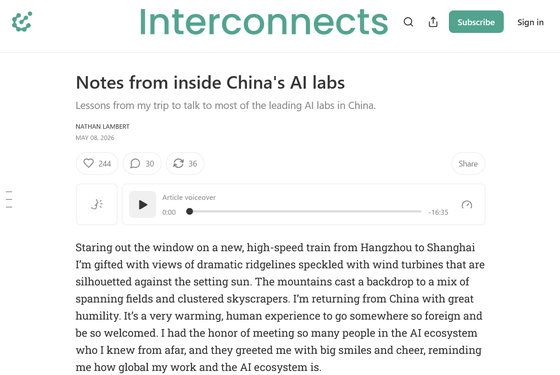
Notes from inside China's AI labs - by Nathan Lambert
https://www.interconnects.ai/p/notes-from-inside-chinas-ai-labs
According to Lambert, while Chinese and American research institutes are similar in that they possess high levels of the latest and largest models enabling agent-based workflows, excellent scientists, massive data, and high-speed computing, the crucial difference lies in how these elements are organized and nurtured in the environment in which they are cultivated. Lambert had long believed that 'Chinese research institutions are able to keep up with cutting-edge technology and maintain that level because of their cultural traditions,' but his opinion was solidified after actually speaking with scientists belonging to top Chinese research institutions.
Building advanced large-scale language models (LLMs) requires extensive coordination and complex processes. Therefore, Lambert points out that it is more important to improve multiple elements such as the overall performance, cost, and stability of the model in a balanced way, rather than focusing on the outstanding achievements of individual researchers.
In the United States, there is a strong culture of asserting one's opinion, and speaking out about one's research makes it easier to succeed as a 'leading expert in the field of AI.' However, this culture also creates conflict within companies and research organizations. For example, there are rumors that the organization of Meta's LLM 'Llama ' has 'collapsed due to the weight of internal politics, as the interests of researchers have become entrenched in the hierarchical structure.' In fact, it has been reported that Meta has lost most of its original Llama development team to competitors, indicating a high turnover rate among its personnel.
Meta has lost 11 of its original Llama development team members to competitors - GIGAZINE

On the other hand, Lambert points out that Chinese researchers tend to prioritize improving the overall performance of the model over 'high-profile research results,' and are also proactive in mundane, less glamorous work. Lambert analyzes that China's 'total war' research culture is well-suited to the inconspicuous work required to improve the final model, the willingness of even those unfamiliar with AI development to quickly adapt to new technologies, and the accumulation of countless small improvements such as architectural adjustments.
Another notable feature of major AI labs in China is the deep involvement of students as core members in development. Companies like OpenAI, Anthropic, and Cursor do not offer internships, and even companies like Google, which have Gemini-related internships, raise concerns that interns may be separated from core research. On the other hand, in China, student researchers are directly integrated into actual model development teams, and Lambert praises that students are able to adapt to new technologies without preconceived notions and are also adept at absorbing large amounts of papers and technical information in a short period of time.
Furthermore, Lambert says that the relationships between companies in the Chinese AI industry are significantly different from those in the United States. He describes the Chinese LLM industry as 'more like an ecosystem than a group of fiercely competing tribes.' While giant IT companies like Alibaba and ByteDance wield considerable influence, DeepSeek is highly regarded for its technological capabilities. Each company is keenly aware of its peers, yet there is a sense of respect for each other, and there is a relatively open culture of sharing technology and knowledge. On the other hand, in the United States, everyone seems to be engrossed in various industry trends, from data vendors to computing and fundraising, and Lambert says that 'when researchers meet, a competitive atmosphere quickly develops.'

Lambert has compiled 'six of the most important insights at the industry level' gained from conversations with Chinese researchers.
1: While some believe that spending on AI services in China will not grow significantly due to the previously small enterprise software (SaaS) market, there is actually a very large cloud market, and there is discussion within Chinese research institutes about the possibility that AI demand will expand in a similar way to cloud computing.
2: Chinese AI developers highly value Anthropic's 'Claude' and use it in their software development, even though it is not officially available in China.
3. Chinese companies strongly believe that 'critical technologies should be owned in-house,' and many companies, not just giant IT companies like Alibaba and ByteDance, are working on developing their own AI models.
4. Lambert states that while it was confirmed within each research organization that the Chinese government was supporting LLM development, the scale of that support was unclear. However, there was no indication that the government was directly influencing the technical decisions regarding the AI models.
5. The quality of data in China is lower compared to the United States. Chinese companies have a strong 'build-not-buy' culture, and it seems that it is often better to build environments and data in-house, with researchers spending considerable time building reinforcement learning training environments themselves.
6: The US government's export restrictions on high-performance NVIDIA chips have had a major impact, and there is a constant craving for high-performance chips.
Lambert summarized his findings by stating that 'China possesses numerous characteristics and instincts that are extremely difficult to model using Western decision-making methods,' and analyzed that the frequent emphasis on open source in Chinese research institutes stems from this culture, making it difficult to explain in detail. As an American AI researcher, Lambert said that while he hopes the United States will take the lead in AI research, he believes that a Chinese-style open ecosystem will produce safer, more accessible, and more useful AI.
Related Posts:







in AI, Posted by log1e_dh