Google DeepMind CEO says China's AI is catching up with the West but has yet to show breakthroughs
Demis Hassabis, CEO of Google DeepMind, the company behind the AI assistant Gemini, shared his views on China's AI technology in a podcast, saying that China may only be 'a few months behind' Western technological capabilities.
The Man Behind Google's AI Machine | Demis Hassabis Interview - YouTube
China just 'months' behind US AI models, Google DeepMind CEO says
https://www.cnbc.com/2026/01/16/google-deepmind-china-ai-demis-hassabis.html
DeepMind CEO: “China is closing the AI gap” - TechCentral.ie
https://www.techcentral.ie/deepmind-ceo-china-is-closing-the-ai-gap/
In an interview with CEO Hassabis, CNBC asked, 'The West has tended to underestimate China's potential to create powerful AI, but the emergence of DeepSeek has been shocking. Big companies like Alibaba are creating highly competitive open-source AI models, but does this mean that China is ultimately falling behind in the AI race?'
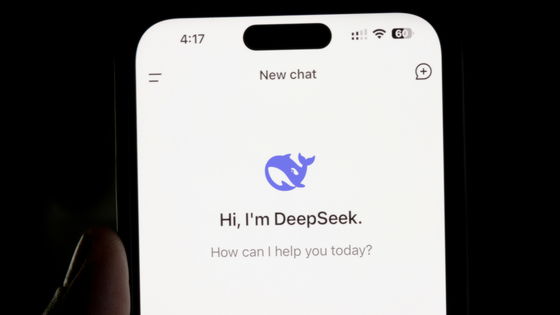
The DeepSeek referred to by CNBC is the 'DeepSeek-R1' model, released by the Chinese company DeepSeek in January 2025. It boasted capabilities comparable to OpenAI's latest model at the time, but was developed using a chip with only 3% of the cost and inferior performance. Furthermore, its open-source nature meant it was widely available to users, which was highly praised. It not only breathed fresh air into the AI industry, but also had a major impact on the stock prices of competitors.
The emergence of DeepSeek-R1 is more like the emergence of Google than the 'Sputnik shock' - GIGAZINE

In response to this question, Hassabis, CEO of Gemini at Google DeepMind, pointed out that 'Japan is not falling behind at all,' and added, 'In fact, it is progressing more than expected, and is probably only a few months behind Europe and the United States at this point.'
However, he added that he doubts whether China, despite its talented developers, can actually bring about technological innovation, saying, 'They have shown that they can catch up with the West very quickly, but they have not yet shown the ability to invent something that pushes the frontier like Transformer .' Transformer is a scientific breakthrough achieved by Google in 2017, and is the foundational technology for AI such as OpenAI's ChatGPT and Google's Gemini.
It has been pointed out that China is subject to US government restrictions, preventing it from obtaining the high-performance chips used by OpenAI, making it difficult for it to compete on the same level as Europe and the United States. When asked, 'Do you think that limited access to technology makes innovation difficult?', Hassabis replied, 'No. It's more of a mentality issue. Google DeepMind is an organization that encourages exploratory innovation rather than the expansion of known technologies, and to achieve this requires world-class engineering, which China undoubtedly has. However, there is an innovation problem: inventing something is 100 times more difficult than copying something, and that's where it becomes difficult to break through.'
DeepSeek has continued to release new models since the DeepSeek-R1, but the impact of its early days is fading. However, China is not only DeepSeek, but also Chinese tech giants such as Alibaba and startups such as Moonshot AI and Zhipu have released highly powerful models, demonstrating their significant influence in the AI race.
China's number of generative AI patent applications is over 38,000, making it the world's number one by far, nearly six times that of the second-placed United States.

Other top tech leaders have also acknowledged China's progress, with NVIDIA CEO Jensen Huang stating, 'America is not far ahead in the AI race. We have a big lead in chips, and China has a big lead in energy. We're even in infrastructure, and we're even in AI models.' Meanwhile, some Chinese are pessimistic, with Alibaba's technology director, Qwen, pointing out, 'There's less than a 20% chance that Chinese companies will surpass American tech giants in AI within the next three to five years, and America's computing infrastructure is one to two orders of magnitude larger than China's.'
China continues to develop its own high-performance semiconductors, driven by regulations, and when the Donald Trump administration tried to relax regulations and export NVIDIA's high-performance semiconductors, it effectively designated them as embargoed goods.
China government tells tech companies not to import NVIDIA's H200 because it is a prohibited item - GIGAZINE
Speaking at the World Economic Forum, Hassabis said that entry-level jobs and internships could take a hit in 2026, adding that they're already seeing signs of this with Google DeepMind. While new, more meaningful jobs may emerge in the short term, the arrival of AGI (artificial general intelligence) will mean we'll be entering uncharted territory. He criticized governments and economists for failing to grasp the scale of the changes that are coming.
Related Posts: