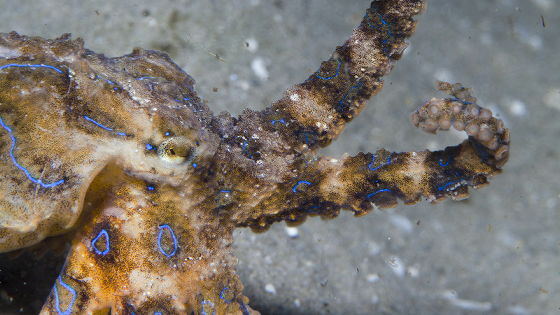
It has been discovered that male octopuses desperately protect the one arm they need for mating.
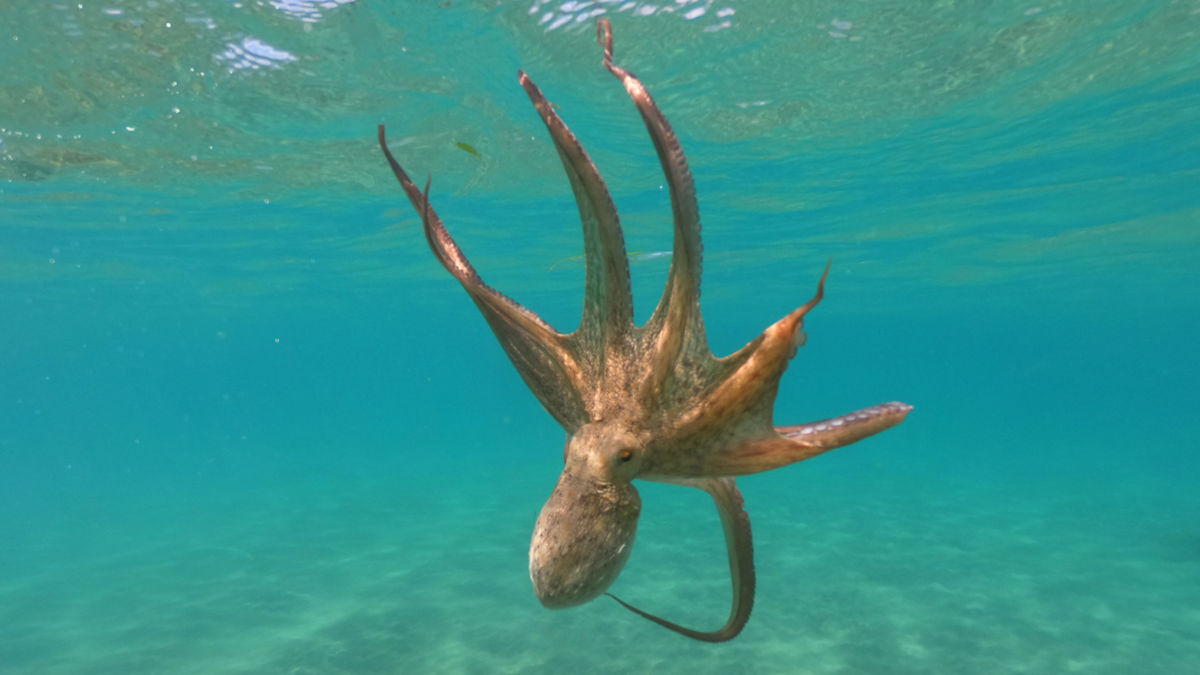
Mature male octopuses have a specialized 'hectocotylus' for transferring spermatophores containing sperm. Research by Keijiro Haruki and colleagues at Nagasaki University has revealed that a small octopus called the dwarf octopus avoids the risk of losing its hectocotylus.
Male Octopus Avoid Using Hectocotylized Arm Under Situations With Unpredictable Risks - Haruki - Ethology - Wiley Online Library
Do male dwarf octopuses truly protect their hectopod arms, which are essential for reproduction? —Experiments reveal 'selective protective behavior'— | Nagasaki University
https://www.nagasaki-u.ac.jp/ja/science/science447.html
The lengths male octopuses go to protect the arm they need to mate
https://phys.org/news/2026-04-lengths-male-octopuses-arm.html
Cephalopods often lose arms, but previous studies have shown that the rate of hectocotyledonous arm loss is lower compared to other arms.
When Haruki and his colleagues collected and studied dwarf octopuses along the coast of Nagasaki Prefecture, they found that 78% of octopuses in their natural environment lose at least one arm. However, while males lost their hectopod at a remarkably low rate, females lost the arm in the same position as the other arms (right third arm) if they were males.
Since the hectocotylus arm cannot be replaced by other arms, and its loss almost always prevents the octopus from reproducing before death, it was speculated that octopuses take actions to protect their hectocotylus arm. However, it was not clear how they actually protect it.
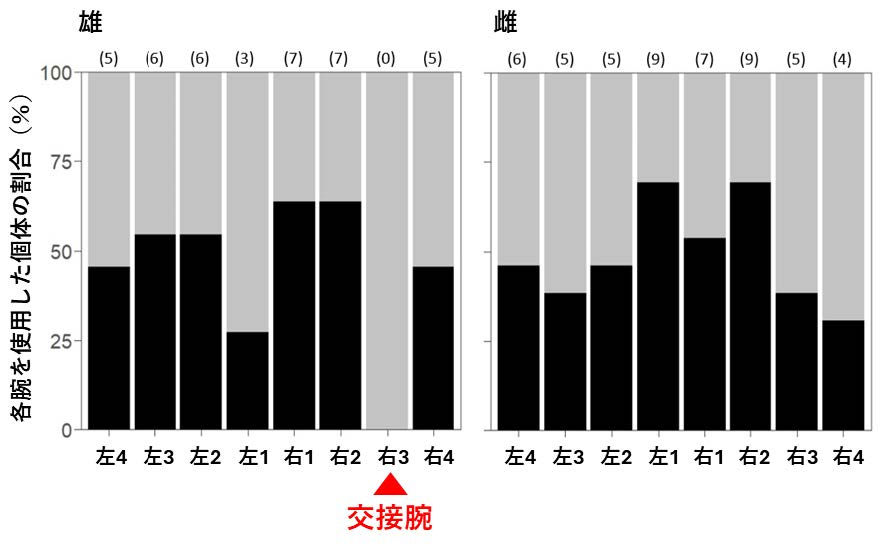
Therefore, Haruki and his colleagues conducted two experiments using dwarf octopuses.
In the first experiment, an octopus and a fishing weight were placed in a tank, and it was observed which arm the octopus used to touch the weight. This experiment revealed that females touched the weight evenly with all their arms, while males did not use their hectocotyledonous arm at all.
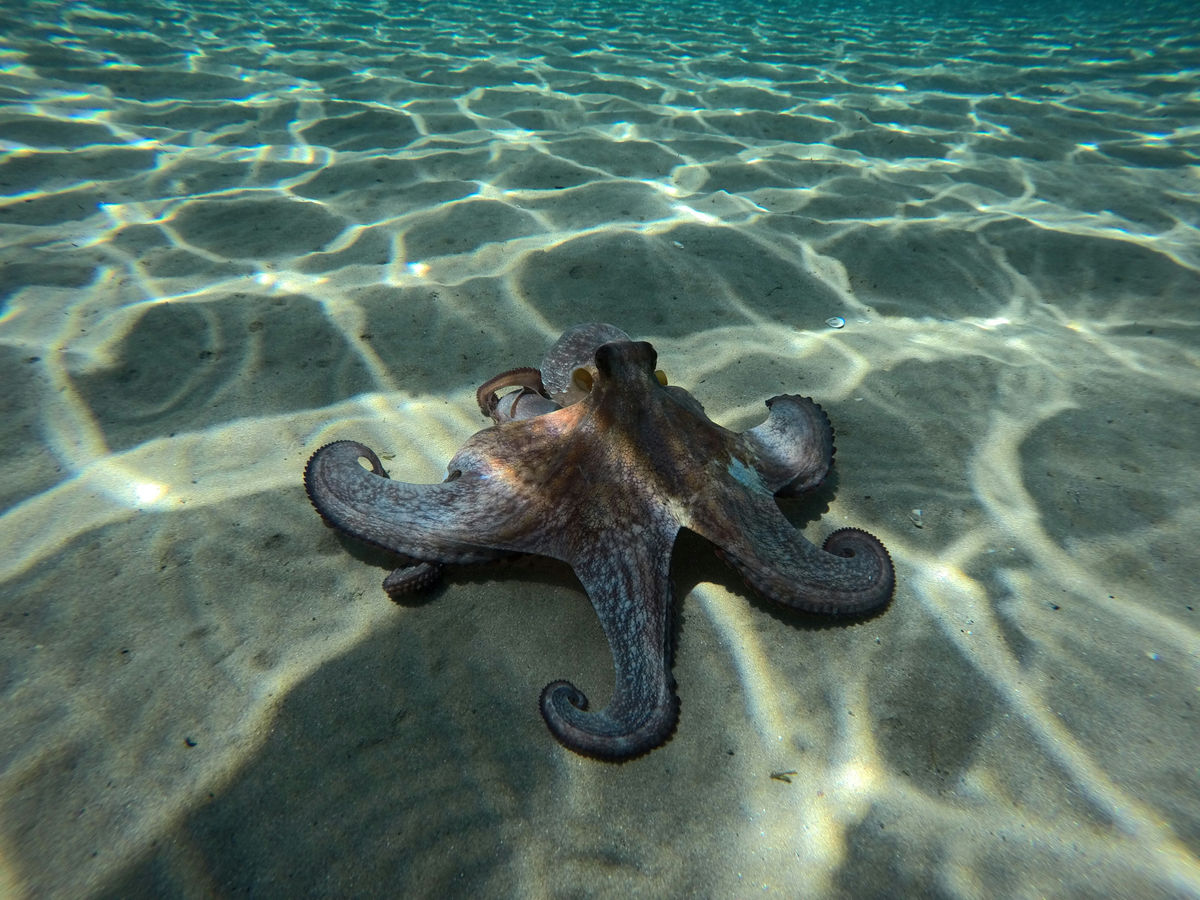
In the second experiment, pieces of shrimp were placed in a dark hole where the contents could not be seen, and it was observed which arm the octopus would insert into the hole. This simulated the natural environment where the octopus did not know whether there was food in the hole or a predator that might bite off its arm. In this experiment, there was no significant difference in the frequency with which males inserted their hectopod arm compared to females inserting their right third arm, but males spent significantly longer inserting other arms before inserting their hectopod arm for the first time.
Based on these experiments, Haruki et al. pointed out that 'these strongly suggest that in situations with unpredictable risks, male pygmy octopuses protect their hectopods more than their other arms.' They added, 'The significance of this study lies in demonstrating that male pygmy octopuses not only escape predation (i.e., death), but also selectively protect parts of their body essential for reproduction to ensure future reproductive success.'
Related Posts: