Elon Musk accused CEO Sam Altman of breaking his commitment to keeping OpenAI a non-profit organization and is seeking $134 billion in damages.
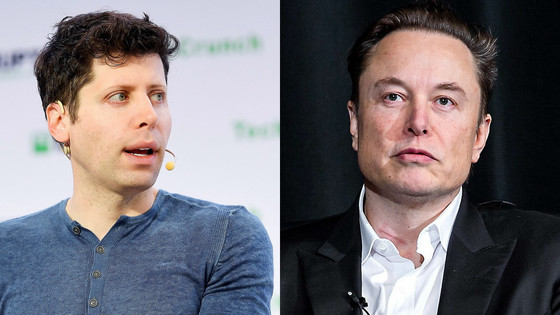
TechCrunch and US Air Force / Trevor Cokley
The legal battle between Elon Musk and OpenAI CEO Sam Altman is set to intensify in a federal court in Oakland, California. Musk is seeking $134 billion (approximately 21.34 trillion yen) in damages, alleging that OpenAI, CEO Altman, and President Greg Brockmann broke their commitment to 'maintain the AI research organization as a permanent non-profit.'
US judge dismisses Musk's fraud claims in OpenAI case at his request, plans to proceed to trial | Reuters
https://www.reuters.com/world/us-judge-dismisses-musks-fraud-claims-openai-case-plans-proceed-trial-2026-04-24/
Musk v. Altman heads to court next week. Here's what's at stake
https://www.cnbc.com/2026/04/24/musk-v-altman-trial-openai-lawsuit-xai.html
OpenAI was founded in 2015 by Elon Musk and Altman, among others. The initial concept was to compete with giant tech companies like Google and to develop powerful AI in a way that would benefit all of humanity, rather than letting it become the monopoly of a single company. According to the New York Times, in May 2015, Altman proposed the 'Manhattan Project for AI' to Musk, outlining a plan to share a research lab for creating powerful AI with the world through 'some kind of non-profit organization.'
The story behind the founding of DeepMind, OpenAI, and Anthropic: How those who feared the risks of AI the most decided they should be the leaders and built the company - GIGAZINE
However, within OpenAI, since around 2017, there had been a growing concern that releasing cutting-edge AI as open source might be dangerous. At the same time, there were growing concerns that remaining a non-profit organization would not be able to raise the necessary funds to develop artificial general intelligence (AGI) that could rival human intelligence.
The conflict between Musk and OpenAI became decisive in 2018. Musk proposed linking OpenAI with Tesla and using Tesla's supercomputers to build AI, but Altman and others refused to hand over management control to Musk. As a result, Musk left OpenAI and cut off funding.
Subsequently, Altman proceeded with fundraising for OpenAI by linking a for-profit subsidiary under a non-profit organization. OpenAI raised $13 billion (approximately 2 trillion yen) from Microsoft and began to limit the open-sourcing of its technology.
OpenAI decides to abandon its for-profit venture and maintain its management as a non-profit organization - GIGAZINE
In his lawsuit, Musk alleges that Altman and Brockmann deliberately manipulated and deceived him by promising to 'pursue a safer and more open path to AI development than that of for-profit giants.' Musk's side argues that his donation to OpenAI was based on these promises and that the profits that were unjustly seized should be returned to OpenAI's non-profit division.
On the other hand, OpenAI completely denies Musk's claims. OpenAI counters that 'Musk himself was trying to transform OpenAI into a commercial organization in 2018,' and claims that a 2017 document included in the court records shows that Musk's side had registered a company that appears to be a for-profit version of OpenAI.
It has been revealed that Elon Musk was planning to acquire OpenAI, the developer of ChatGPT, in 2018 - GIGAZINE
According to economic media outlet CNBC, OpenAI had considered a plan to transition to a fully for-profit company in 2024, separating its control from its non-profit status. However, under pressure from civil society groups, former employees, and Elon Musk, the company changed its course and completed a recapitalization in October, solidifying a structure in which the non-profit organization retains a controlling stake in the for-profit business.
In the trial, in addition to Musk, Altman, and Brockmann, Microsoft CEO Satya Nadella has also been named as a witness. The trial is divided into two stages: one to determine liability and the other to decide on damages and remedies. Nine jurors will give their opinions on liability, but their verdict is advisory, and the final decision will be made by the judge.
This trial is seen not only as a personal dispute between OpenAI and Elon Musk, but also as something that could impact the future of the AI development race. OpenAI is aiming for an IPO and has listed the lawsuit as a business risk in its investor materials. Meanwhile, Musk has launched xAI, a competitor of OpenAI, and has further integrated it with SpaceX, meaning that the struggle for dominance in the AI market, fundraising, and corporate governance will be put to the test in court.
Related Posts:

in AI, Posted by log1i_yk