As SpaceX prepares for a 280 trillion yen initial public offering, a series of anomalies have been reported with its Starlink satellites. A tracking company suggests that 'a satellite exploded, scattering dozens of fragments.'
Several reports have emerged in a short period of time regarding anomalies in satellites and the resulting fragmentation of satellites at Starlink, the satellite internet business of SpaceX, the space company founded by Elon Musk. Concerns about safety are growing as SpaceX prepares for one of the largest initial public offerings in history, worth approximately $1.75 trillion (approximately 280 trillion yen), and is embarking on further business expansion.
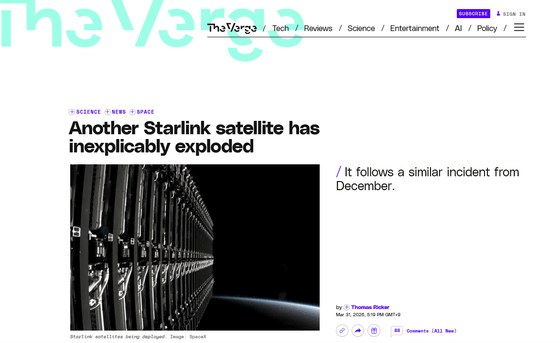
Another Starlink satellite has inexplicably exploded | The Verge
https://www.theverge.com/science/903906/another-starlink-satellite-has-inexplicably-exploded
SpaceX finally files for IPO, targets $1.75 trillion valuation
https://arstechnica.com/space/2026/04/spacex-finally-files-for-ipo-targets-1-75-trillion-valuation/
On March 29, 2026, Starlink's X account reported that a sudden 'anomaly' occurred with a Starlink satellite, causing communication with the satellite to be lost at an altitude of approximately 560 km above Earth. The post stated that 'the latest analysis indicates that this event does not pose any new risks to the space station, its crew, or launches related to NASA's Artemis program,' and added that 'SpaceX and the Starlink team are actively working to identify the root cause and will take prompt corrective action as needed.'
On Sunday, March 29, Starlink satellite 34343 experienced an anomaly on-orbit, resulting in loss of communications with the satellite at ~560 km above Earth.
— Starlink (@Starlink) March 30, 2026
Latest analysis shows the event poses no new risk to the @Space_Station , its crew, or to the upcoming launch of NASA's…
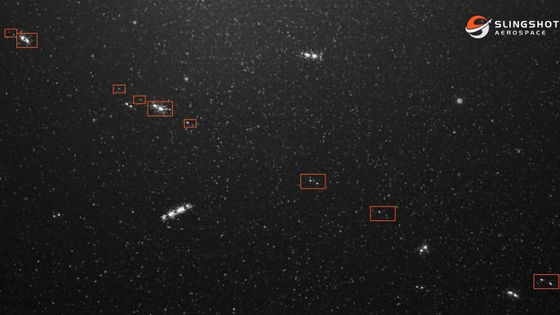
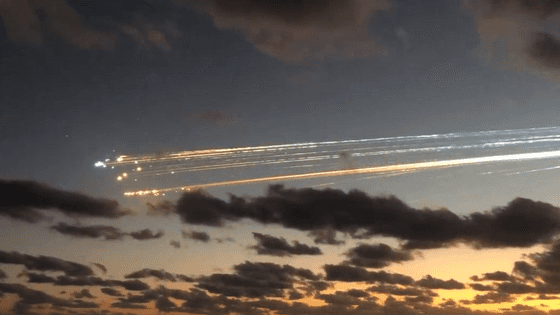
SpaceX has not disclosed the specific details of the Starlink satellite in question. Leo Labs , a space tracking company specializing in tracking satellites and space debris in low Earth orbit (LEO), said it 'immediately detected dozens of objects' near 'Starlink 34343' after the incident, suggesting that an 'explosive disintegration' resulting in multiple fragments may have occurred.
A similar incident was reported in December 2025. On December 17, an anomaly occurred with 'Starlink 35956,' and communication was lost at an altitude of approximately 418 km above Earth. SpaceX reported that 'this anomaly caused a gas release from the propulsion tank, ejecting a small number of traceable objects at low relative velocity,' suggesting that some kind of explosion was the cause. Leo Labs pointed out that 'it is highly likely that the cause was internal energy rather than a collision with other satellites or debris.'
On December 17, Starlink experienced an anomaly on satellite 35956, resulting in loss of communications with the vehicle at 418 km. The anomaly led to venting of the propulsion tank, a rapid decay in semi-major axis by about 4 km, and the release of a small number of trackable…
— Starlink (@Starlink) December 18, 2025
The debris from the disintegration of a Starlink satellite in LEO is expected to re-enter the atmosphere within a few weeks and is not expected to have any direct impact on the International Space Station (ISS) or other spacecraft. However, the recurrence of satellite explosions in such a short period of time has further heightened concerns about the safety of the rapidly growing low-Earth orbit satellite network. In particular, LEO is a 'crowded region' where more than 24,000 objects, including space debris and approximately 10,000 Starlink satellites, are being tracked, raising concerns about the risk of collisions between satellites or fragments of disintegrated satellites, as well as the ' Kessler Syndrome ,' where debris causes a chain reaction of collisions.
Meanwhile, in January 2026, the U.S. Federal Communications Commission (FCC) approved an additional 7,500 satellites from SpaceX, bringing the total to 15,000 operational by 2031. Furthermore, in February 2026, SpaceX submitted an application to the FCC requesting permission to launch one million solar-powered satellite data centers into low Earth orbit.
Elon Musk's SpaceX plans to launch 1 million solar-powered satellite data centers - GIGAZINE
As part of its further business expansion, SpaceX has reportedly filed documents with the Securities and Exchange Commission for an initial public offering (IPO) in April 2026. According to reports, SpaceX's valuation could reach up to $1.75 trillion (approximately 280 trillion yen) through its initial public offering (IPO), and it is expected to raise up to $75 billion (approximately 12 trillion yen). Ars Technica reported that the IPO could take place around June 28, 2026, which is Musk's 55th birthday.
Starlink is the core of SpaceX's revenue, accounting for 50-80% of its sales. Therefore, the series of satellite malfunctions that occurred in a short period of time, just as the company was on the verge of a major expansion including significant fundraising, has raised concerns about risks to SpaceX's revenue base itself and its growth strategy.
Related Posts:


in Web Service, Posted by log1e_dh