Google researchers warn that quantum computers could crack the cryptocurrency encryption used to protect it with far fewer resources than previously thought.

[2603.28846] Securing Elliptic Curve Cryptocurrencies against Quantum Vulnerabilities: Resource Estimates and Mitigations
https://arxiv.org/abs/2603.28846
Safeguarding cryptocurrency by disclosing quantum vulnerabilities responsibly
https://research.google/blog/safeguarding-cryptocurrency-by-disclosing-quantum-vulnerabilities-responsibly/
Google Paper Warns Crypto on Quantum Risk Ahead of 2029 Timeline - Bloomberg
https://www.bloomberg.com/news/articles/2026-03-31/google-paper-warns-crypto-on-quantum-risk-ahead-of-2029-timeline
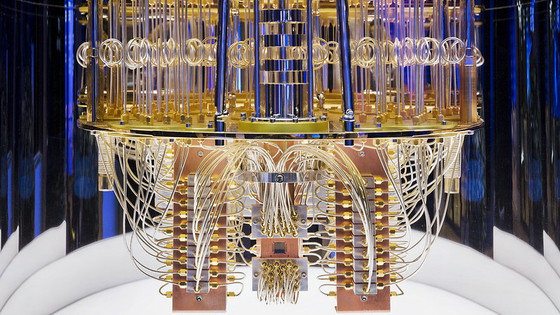
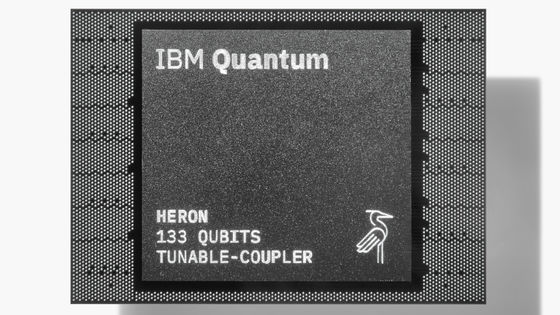
Quantum computers are computers that perform calculations using qubits , the smallest unit of quantum information. They are expected to solve problems that cannot be solved by conventional classical computers, bringing about significant advancements in fields such as chemistry, drug discovery, and energy.
On the other hand, there are concerns that quantum computers could break encryption methods that were previously unbreakable, threatening existing cryptographic systems. Shor's algorithm , a quantum algorithm for rapidly performing prime factorization, is widely known as theoretical evidence that quantum computing could break existing cryptographic schemes.
Most blockchain technologies and cryptocurrencies, including Bitcoin, rely on elliptic curve cryptography, which is based on the discrete logarithm problem on an elliptic curve, known as 'ECDLP-256,' for a crucial aspect of security.

Google's research team has designed two quantum circuits that implement Shor's algorithm for ECDLP-256. The number of physical qubits required to run the newly designed circuits is estimated to be less than 500,000, a reduction to just one-twentieth of the conventional number.
In a blog post, the research team stated, 'Our new paper shows that future quantum computers may be able to break elliptic curve cryptography, which protects cryptocurrencies and other systems, with fewer qubits and quantum gates than previously thought. We want to raise awareness of this issue and provide the cryptocurrency community with recommendations to improve security and stability before it becomes possible to break it, including a transition of blockchain to post-quantum cryptography that is resistant to quantum attacks.'
Google has already announced plans to transition to post-quantum cryptography by 2029, anticipating a future where conventional encryption methods can be easily broken by quantum computers.
Reports that the cryptography underlying cryptocurrencies and blockchains is threatened by quantum computers have become a hot topic in the cryptocurrency community. Hassev Qureshi, managing partner at Dragonfly , a venture capital firm specializing in the cryptocurrency sector, commented, 'Google is now more confident about the transition to post-quantum cryptography in 2029. All blockchains need to develop transition plans urgently. The transition to post-quantum cryptography is no longer a drill.'
This is wild. Google Research demonstrates a ~20x more efficient implementation of Shor's algorithm that could break ECDSA keys within minutes with ~500K physical qubits.
— Haseeb ]|[ (@hosseeb) March 31, 2026
Google is now more confident on a 2029 post-quantum transition. We are no longer looking at mid 2030s,… https://t.co/jGzFk5uLc0 pic.twitter.com/O4V1VbiXkf
Related Posts:





in Security, Posted by log1h_ik