It has been pointed out that a widely cited paper contained false claims, but the authors admitted the errors but refused to correct them, and the research institution ignored the facts and left the matter unaddressed.

Andrew Gellman, a professor of statistics and political science at Columbia University, points out that a paper that has been cited more than 6,000 times and has been mentioned by government officials and even a former US Vice President, contains fatally false claims, yet has not been corrected or punished.
False claims in a widely-cited paper. No corrections. No consequences. Welcome to the Business School. | Statistical Modeling, Causal Inference, and Social Science
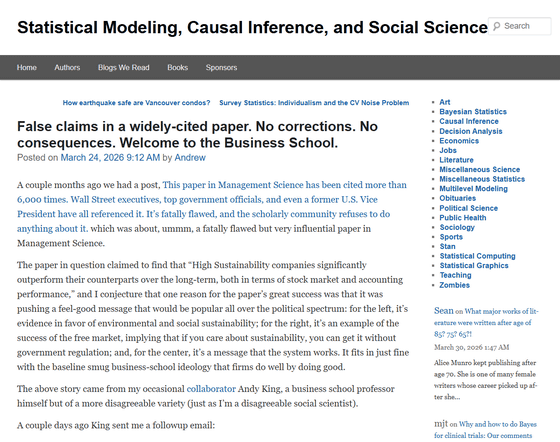
The paper in question is titled ' The Impact of Corporate Sustainability on Organizational Processes and Performance, ' published in 2014 in the management science journal Management Science . This paper argues that 'highly sustainable companies significantly outperform their competitors in the long term, both in terms of stock market performance and accounting performance.'
German points out that one reason this paper has been cited more than 6,000 times and cited by prominent figures in the business world, government officials, and former vice presidents is that 'it conveyed a pleasant message that was widely accepted regardless of political stance.'
For the left, it serves as evidence supporting environmental and social sustainability; for the right, it's a successful example of a free market, demonstrating that sustainability can be achieved without government regulation. It also sends a message to the centrists that the system is functioning.
'The argument in this paper is precisely in line with the basic and self-serving ideology of business schools that companies succeed by doing good,' Gelman pointed out.

Andy King, a professor at Boston University's Questrom School of Business, has long resisted the claim that the institutions for fostering trustworthy science are dysfunctional. King has believed that editors, reviewers, and research ethics officers—the very people who are problematic in academia—are quietly carrying out their duties.
However, when King attempted to reproduce the paper in question, he discovered that it contained serious flaws and inaccuracies. Initially, King believed that correcting the paper's content would be easy, given that it was published in the prestigious academic journal Management Science and its authors belonged to renowned institutions.
However, the authors ignored King's complaints, Management Science refused to take action, and the academic community turned a blind eye. Although their names were not revealed, two universities reportedly admitted that the authors of the paper published a misleading report, but King claims they ignored the evidence of research misconduct.
Furthermore, King pointed out that the paper is cited approximately 2,000 times a year, has a significant impact on investment practices and public policy, and is the most cited paper in Management Science since 2006.

According to King, the method described in the paper differed from the method actually used by the authors. King had pointed out this issue to the authors for many years, but the authors only acknowledged it after two years of back-and-forth. However, the authors continue to refuse to correct the paper.
Management Science reportedly responded that, according to its rules, only the authors can request corrections to a paper, and therefore, they cannot correct a paper if they determine that the authors will not comply. King has also contacted the Office of Research Ethics because the authors admitted the errors but refused to make corrections.
London Business School, the business school to which the paper's authors belong, claims there was no violation as they did not conduct the analysis themselves. Harvard Business School has refused to disclose whether or not an internal investigation was conducted or what its results were. Oxford University has argued that since the paper was published while Mr. Eccles (one of the authors) was enrolled at Harvard Business School, Harvard University is responsible for the actions.

Gelman cited 'the fact that a University of California professor blatantly falsified data but received no punishment' and 'the fact that a Cornell University professor committed widespread research misconduct and was eventually forced to resign, yet this took a long time and the university failed to address external concerns,' stating that he has lost much faith in research ethics offices and similar organizations. In fact, a political science professor at Rutgers University received an award from the American Political Science Association for a book that contained plagiarized material. Furthermore, even after being informed of the plagiarism, the American Political Science Association refused to revoke the award or share it with the author of the plagiarized work.
King also mentioned that there are cases where those who cheat attack those who expose the problem, which he described as extremely troublesome. Regarding this, King said, 'It's as if all the important people are in the same country club and have to deal with a cocky caddy who points out every single mistake. They might get even more frustrated with people like us who are club members but side with the caddies.'
Gellman wrote, 'The ultimate solution would be to admit these people to a newly established 'Second Chance University.' This university would include researchers who have committed misconduct, mathematicians who plagiarized material from online sources without citing them to write chess books , disgraced primatologists like Anil Petty , Lawrence Tribe , Lawrence Summers , and unfortunate individuals who, through no fault of their own, ended up co-authoring papers using false data. It would be a truly wonderful place for such people. And this university would be the only one that fully encourages students to use chat AI to write their end-of-semester reports!'
German also wrote, 'To be honest, I don't know how to deal with this problem. I keep shouting about it here, but it doesn't seem to be very effective.'
Related Posts:








in Note, Posted by logu_ii