For the first time in the world, the neural network of the female genitalia has been completely mapped, revealing the anatomical structure of the clitoris, which is expected to greatly improve treatment outcomes for women undergoing pelvic surgery.

A research team at the University Medical Center Amsterdam in the Netherlands has successfully created a complete 3D map of the neural network in the clitoris, a female genital organ whose details were previously unknown, using synchrotron radiation with high-energy X-rays. This research reveals the anatomical structure of the clitoris, one of the least studied organs in the human body due to social taboos and technological limitations, with micrometer-level resolution.
Neuroanatomy of the clitoris | bioRxiv
Full network of clitoral nerves mapped out for first time | Women's health | The Guardian
https://www.theguardian.com/society/2026/mar/29/full-network-clitoral-nerves-mapped-out-first-time-women-pelvic-surgery
The research team used a state-of-the-art X-ray technique called HiP-CT (High-Intensity Phase-Contrast Tomography) at the European Synchrotron Radiation Facility (ESRF) in France. This technique allowed them to scan pelvic samples from two women, aged 59 and 69, at voxel sizes of 20 μm and 2 μm.
The powerful X-rays from synchrotron radiation made it possible to visualize fine nerve bundles within soft tissues, which was impossible with conventional magnetic resonance imaging (MRI). Open-source software was used for image reconstruction, and machine learning algorithms were employed for nerve segmentation.
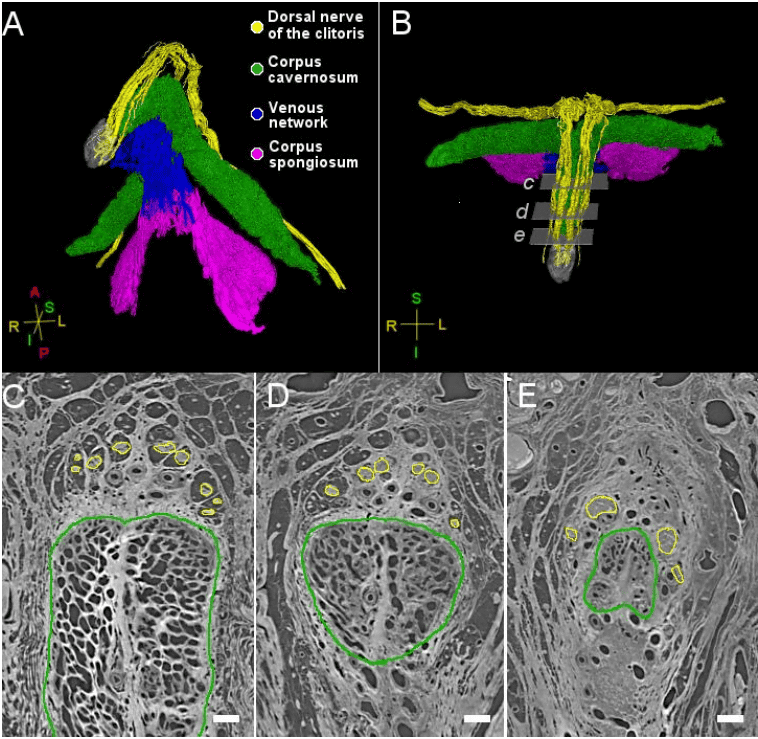
One of the most important findings in this study is the identification of the complete 3D pathway of the dorsal clitoral nerve (DNC), the main sensory nerve of the clitoris. The dorsal clitoral nerve runs from the clitoral crura through the clitoral body to the clitoral glans.
The following image shows an overall view of the clitoris and the course of the dorsal clitoral nerve (DNC), the main sensory nerve. In the 3D reconstructed image, the DNC is colored yellow, the corpus cavernosum is green, the venous network is blue, and the corpus spongiosum is magenta, allowing you to see the specific location of the nerve bundles in the cross-sectional view.
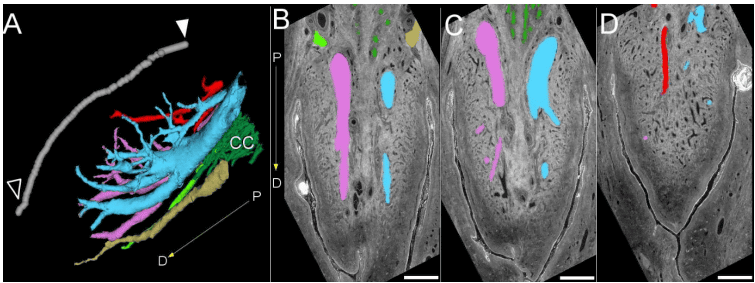
Upon examining the microstructure of the DNC within the clitoral glans, five thick nerve trunks with a maximum diameter of 0.2 mm to 0.7 mm (average 423 μm³ ) were identified, revealing that these branch out in a tree-like manner toward the surface of the glans.
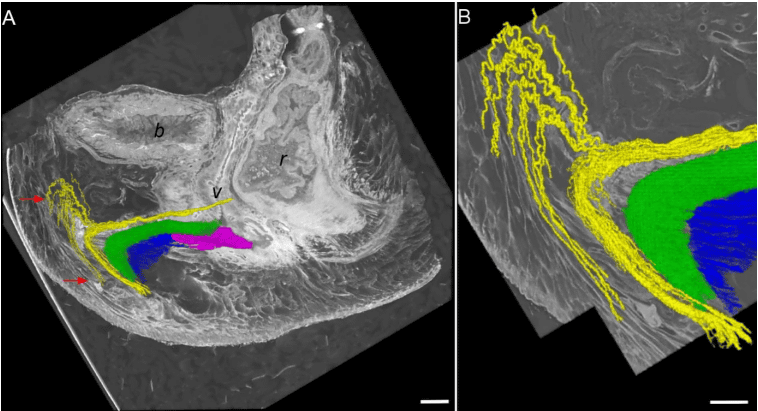
Furthermore, the study revealed for the first time that several branches of the dorsal clitoral nerve extend and distribute to the clitoral hood and pubic mound.
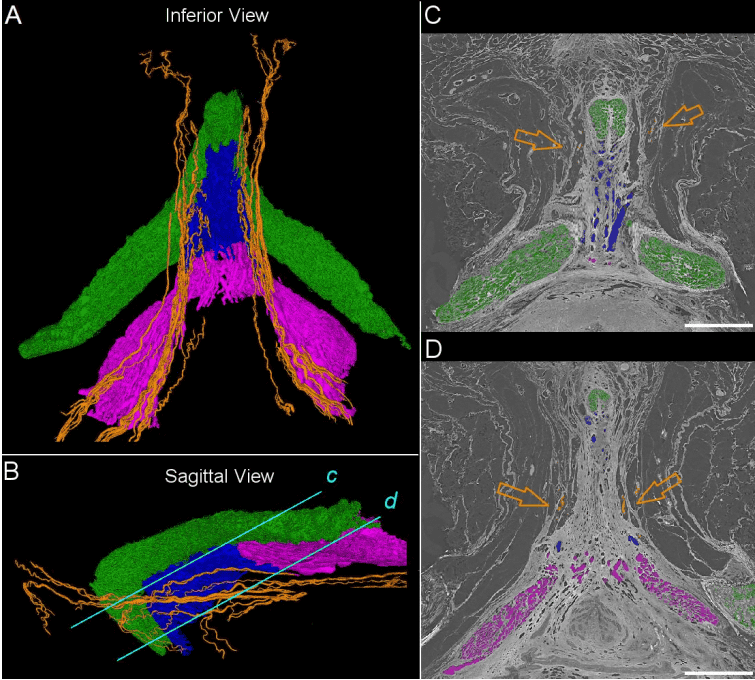
Furthermore, it was confirmed that the posterior labial nerve (PLN), a branch of the perineal nerve, innervates not only the labia but also the area surrounding the clitoral body. These detailed nerve distributions suggest that the definition of areas to be avoided during surgery needs to be re-evaluated.
The research team cites the clinical significance of their findings as contributing to reconstructive surgery after female genital mutilation (FGM), which is estimated to affect 230 million women worldwide. Data shows that approximately 22% of women who undergo reconstructive surgery experience a decrease in orgasmic sensation afterward, but a precise understanding of nerve pathways will allow for improvements in surgical techniques. Furthermore, it will lead to the provision of guidelines to prevent unintended nerve damage in cosmetic surgery procedures such as labiaplasty, which are said to have increased in number by 70% between 2015 and 2020.
The research team points out that research on the clitoris has long been considered a cultural taboo, and that it has historically been ignored in standard anatomy textbooks or incorrectly described as a 'smaller version of the penis.' Although this study has limitations, such as being limited to postmenopausal samples, they hope that it will lay the foundation for future large-scale surveys including younger women and research using molecular markers to distinguish between sensory and autonomic nerves.
Related Posts:





in Science, Posted by log1i_yk