Corruption damages social trust more severely in democratic nations than in dictatorships.

While political corruption is a factor that undermines public trust, research has shown that the magnitude of its social impact may vary depending on the political system.
Frontiers | The price of accountability: corruption erodes social trust more in democracies than in autocracies
In a study published in the peer-reviewed journal Frontiers, Kimo Eriksson of the Department of Mathematics and Economics at Märdalen University in Sweden, and Irina Valtanova of the Swedish Institute for Future Studies , which conducts policy-related research, compared and analyzed the impact of corruption on 'social trust' between democratic and authoritarian regimes (dictatorships). Social trust refers to the degree to which people feel they can 'trust' others and institutions, and is considered an important element that enables collective action necessary for social stability and economic activity, such as promoting citizen cooperation and reducing transaction costs.
When citizens become aware of corruption among public officials, it creates a sense of injustice that those in power who disregard the rules benefit, undermining the foundation of general trust. Past research has shown a negative correlation, creating a vicious cycle that encourages further corruption. Other studies have revealed that political corruption and social trust are not merely correlated, but involve a direct causal relationship.

Therefore, Erikson et al. investigated whether the type of political system is related to the decline in social trust due to corruption. The study uses data from 62 countries, including complete data on “perceived corruption,” “general trust,” and “indicators of the quality of democracy,” and employs a multistage analysis combining individual-level survey responses with national-level indicators of the quality of democracy.
The research has shown that corruption tends to undermine social trust in almost all political systems. Furthermore, it concludes that the impact of this decline in trust at the individual level is significantly stronger in democracies than in authoritarian states, and that the exposure of corruption tends to severely damage social trust.
The following graph illustrates the negative correlation between the degree to which citizens perceive corruption and social trust, broken down by political system. Blue represents democracies, yellow represents authoritarian states, with the horizontal axis representing corruption perception and the vertical axis representing social trust. Democracies show a steeper distribution, indicating a stronger negative correlation between the degree of government corruption and social trust.
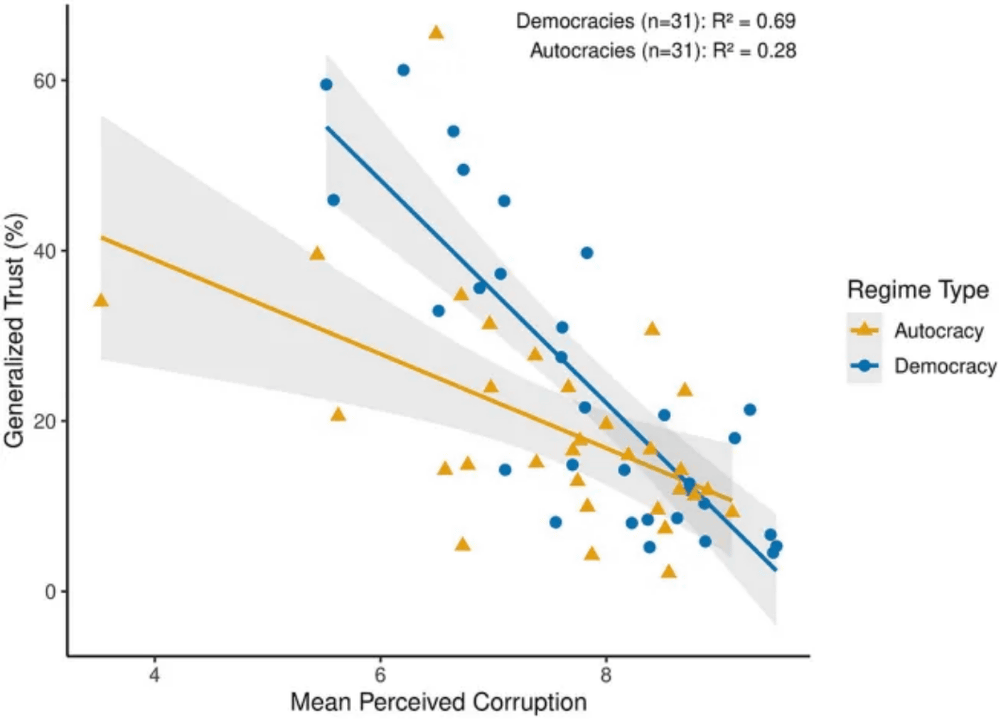
Researchers point out that this is due to the 'high expectations' in a democracy. Democracy is based on the principles of equality under the law and fair treatment of citizens, and when public officials engage in bribery or collusion, they are betraying not only administrative rules but also the core promises of democratic governance. As a result, trust in society as a whole is severely shaken. On the other hand, under a dictatorship, the level of expectations and trust in the government is relatively low, so even if corruption is discovered, the decline in social trust may remain relatively limited.
Furthermore, researchers point out that in democracies, public officials are elected by popular vote, giving them a strong sense of 'representing the people,' and that if corruption is discovered, trust in the citizens who elected those officials may be shaken. On the other hand, in dictatorial states, public officials are often from an elite class, and it is thought that corruption would not affect relations among citizens.
Based on the research findings, the paper concludes that 'corruption scandals in established democracies should be viewed not merely as criminal justice issues or administrative failures, but as a potential threat to social cohesion.' Furthermore, while conventional anti-corruption measures focus on strengthening oversight bodies and improving the transparency of political funding, the researchers argue that efforts are needed not only to strengthen oversight bodies and improve the transparency of political finance, but also to rebuild and maintain the social trust that has been damaged by past corruption.
Related Posts:






in Science, Posted by log1e_dh