What is 'Ageless Linux,' which deliberately violates the law requiring age verification during OS setup?

In California, USA, the Digital Age Assurance Act (AB 1043), which requires users to verify their age during OS account setup to protect minors online, is scheduled to go into effect in January 2027. However, an operating system called 'Ageless Linux' has emerged that deliberately violates this law by not verifying users' ages.
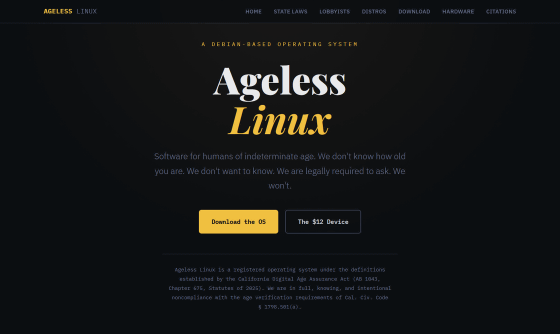
Ageless Linux — Software for Humans of Indeterminate Age
https://agelesslinux.org/
GitHub - agelesslinux/agelesslinux.org: public static site content · GitHub
https://github.com/agelesslinux/agelesslinux.org
California's Digital Age Assurance Act requires companies that provide online services and products that children may access to make reasonable determinations as to whether a user is a child, and to apply a high level of privacy protection based on child standards to all consumers.
This includes an obligation for OS providers to collect user age information and classify it into four categories: 'under 13,' '13 to under 16,' '16 to under 18,' and '18 and over,' and to inform app developers of the user's category when an app is downloaded or launched on the OS.
California introduces law requiring user age verification during OS setup, including Linux and SteamOS - GIGAZINE

Ageless Linux is an operating system that deliberately violates the Digital Age Protection Act by not collecting users' age information. Ageless Linux is an OS based on the Linux distribution Debian , and it seems that to install it, you first need to install Debian and then run a specific script to convert it to Ageless Linux.
The only real difference between Debian and Ageless Linux is that the ' /etc/os-release ' file, which identifies the type of Linux distribution, is named 'Ageless Linux' instead of 'Debian'. In other words, developer John McCardle admits that Ageless Linux is essentially just a script that changes the name of the OS.
Because Ageless Linux is almost indistinguishable from Debian, questions may arise such as, 'Is Ageless Linux a real operating system?' or 'Isn't this just Debian with a different name?' In response, McArdle argues that the Digital Age Protection Act does not define minimum technical requirements, and that in the Linux distribution ecosystem, modifying and redistributing an existing system creates a new distribution which is then recognized as an independent OS under the Digital Age Protection Act.
The purpose of Ageless Linux is to raise questions about the Digital Age Protection Act itself by intentionally distributing an operating system that does not comply with it. McArdle points out that only large corporations have the resources to implement age verification systems in their operating systems, and that the Digital Age Protection Act is a blow to small-scale developers. He also notes that many Linux distributions, such as Debian, which are run by volunteers or hobbyists, do not have the funds to implement age verification systems.
The Digital Age Protection Act stipulates that intentionally violating it can result in a fine of up to $7,500 (approximately 1.2 million yen) per affected child. However, McArdle argues that Ageless Linux does not collect users' ages in the first place, making it impossible to precisely determine whether or not a user is a child. 'We are not claiming a loophole. We are interpreting the law in the proper order,' he said.
Ageless Linux has also been a hot topic on social media platforms like Hacker News. One user commented that the fact that the debate surrounding age verification emerged almost simultaneously in the US, UK, and EU suggests the involvement of cross-border lobbying groups and their vested interests.
Ageless Linux – Software for humans of indeterminate age | Hacker News
https://news.ycombinator.com/item?id=47381791
Furthermore, there have been reports of concerns that online age verification tools intended to protect children are also being used to monitor adults , and that laws mandating age verification are ineffective and only increase unnecessary burdens.
An analysis suggests that the law mandating age verification is ineffective and only increases unnecessary burdens - GIGAZINE

Related Posts:







in Software, Posted by log1h_ik