By measuring neuronal activity in the brain, researchers were able to recreate the images a mouse saw.

A study has been published that shows how a mouse's brain activity can be reproduced based on the image it sees, improving on previous models by approximately 1.9 times. This research is expected to provide clues to understanding how the brain processes visual information.
Movie reconstruction from mouse visual cortex activity | eLife
Scientists 'Re-Watch' Videos Seen by Mice by Studying Their Brains : ScienceAlert
https://www.sciencealert.com/scientists-rewatch-videos-seen-by-mice-by-studying-their-brains
The research team, led by Joel Bauer of University College London (UCL), started by improving a previously developed ' dynamic neural encoding model ' that takes into account a mouse's behavior while watching a video, such as running speed and pupil position and size, to predict which neurons will fire when viewing a particular video.
The dynamic neural encoding model uses two-photon calcium imaging, which measures neuronal activity from intracellular calcium ion concentrations, to record approximately 8,000 neurons in real time. Analyzing which neurons are active when a mouse views a video allows the model to reconstruct the overall representation of the original video. However, previous studies have only achieved a correlation of 0.301 between predicted and actual neural activity. To improve the accuracy of the reconstruction, the UCL team calculated the difference between predicted and actual neuronal activity and gradually adjusted and optimized the video pixels to match the observed neural activity. This improved the model's ability to reconstruct the 'video viewed by the mouse.'
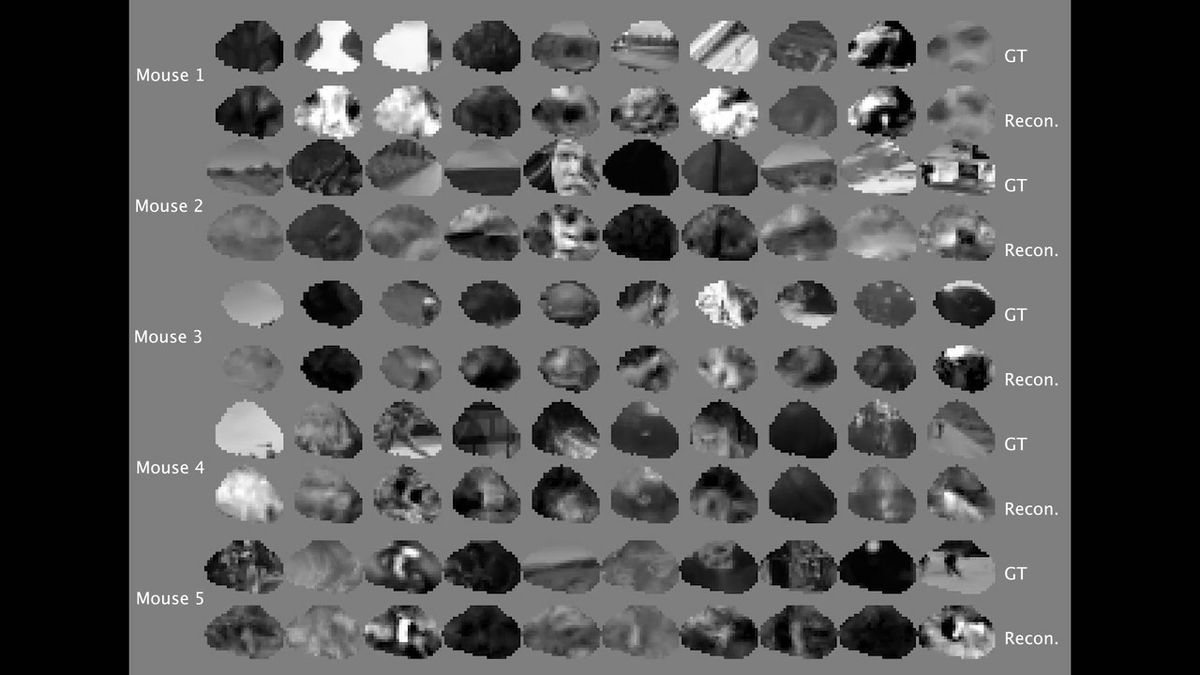
After training the model, the researchers showed five mice an entirely new 10-second video that had not been included in the model's training, and then created a 10-second video based solely on the neuronal activity data.
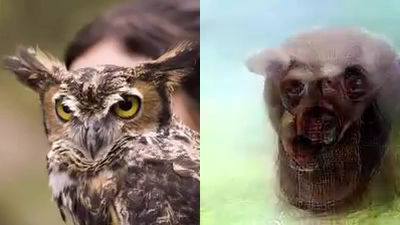
The first row shows the video presented to the mouse, and the second row shows a video reconstructed from the activity of approximately 8,000 V1 (primary visual cortex) neurons. The correlation between the reconstructed video and the original video was a maximum of 0.569, a significant improvement over previous models.
Below, for each 'Spatial
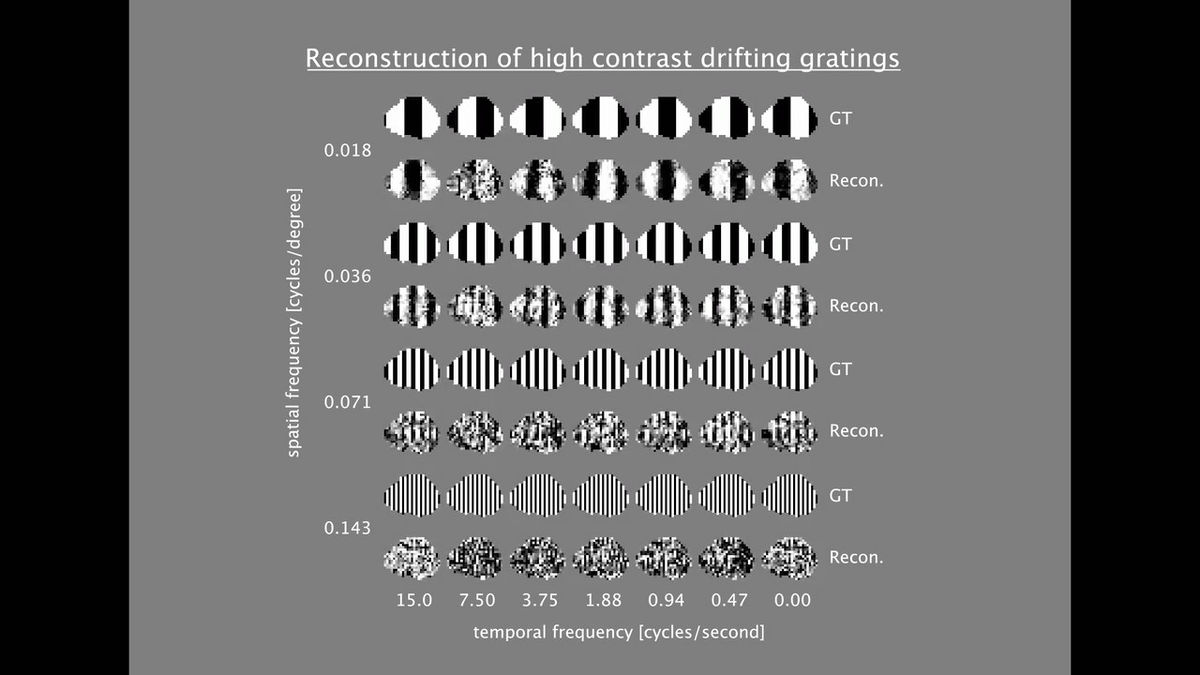
Although the reconstructed video is low-resolution, it is possible to distinguish the movement and general shape of objects, confirming that it captures the characteristics of the video the mouse was viewing.
According to the researchers, this technique will help us understand 'how the brain processes information from the outside world and how it differs from what actually exists.' Lead author Bauer said, 'We don't perfectly recreate the world in our heads. Visual processing processes distort our representations, altering information. This discrepancy between reality and our mental representations is not necessarily an error, but rather a feature that reflects how our minds interpret and enhance sensory information. We want to understand how this happens in the brain.'
Related Posts:






in Science, Posted by log1e_dh