Meta announces its proprietary AI chips 'MTIA 300', 'MTIA 400', 'MTIA 450', and 'MTIA 500' simultaneously, with all types expected to be operational within two years
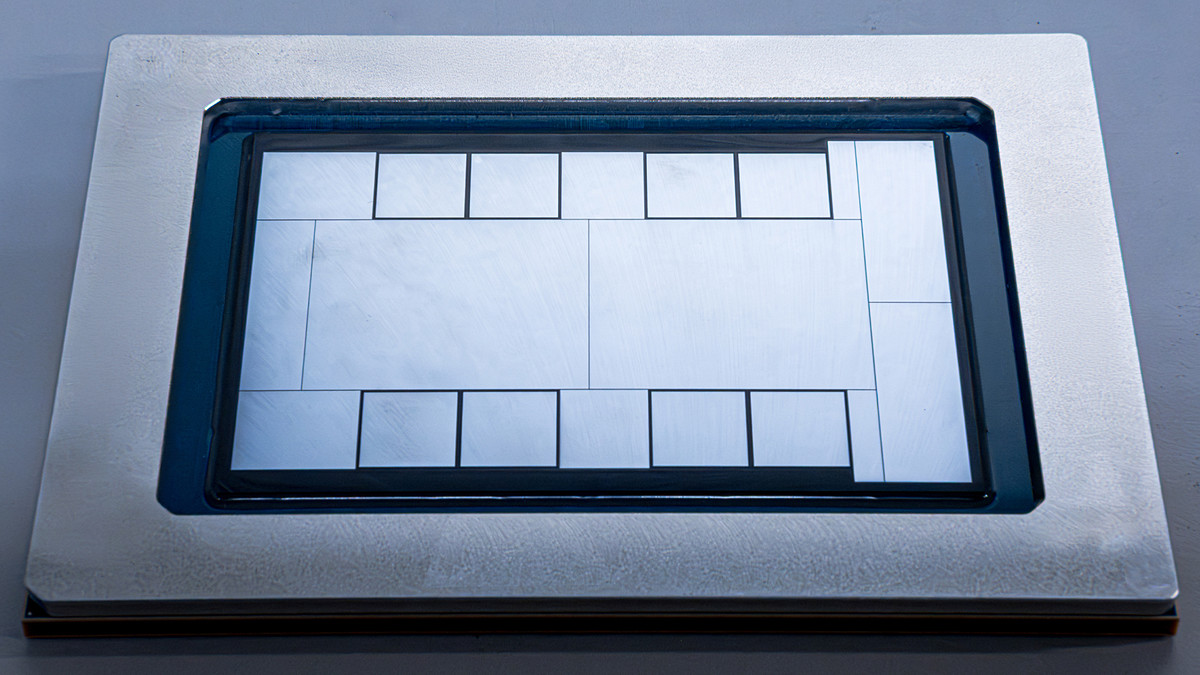
Meta is collaborating with Broadcom to develop the Meta Training and Inference Accelerator (MTIA) AI chip. On March 11, 2026, four MITA series chips were announced: the MTIA 300 , MTIA 400 , MTIA 450 , and MTIA 500. Of these, the MTIA 300 is already in mass production, and the other chips are scheduled to be mass-produced by 2027.
Four MTIA Chips in Two Years: Scaling AI Experiences for Billions
Expanding Meta's Custom Silicon to Power Our AI Workloads
https://about.fb.com/news/2026/03/expanding-metas-custom-silicon-to-power-our-ai-workloads/
Typically, it takes about two years from the start of chip design to mass production. Therefore, Meta points out that a certain amount of 'gambling' is necessary to keep up with the rapid advances in AI. Meta has adopted a strategy of 'deploying modular chiplets in short cycles' to reduce the uncertainties in chip design, and it seems that it will be able to mass-produce four types of AI chips: 'MTIA 300,' 'MTIA 400,' 'MTIA 450,' and 'MTIA 500' in the two years until 2027. An overview of each chip is as follows.
◆MTIA 300
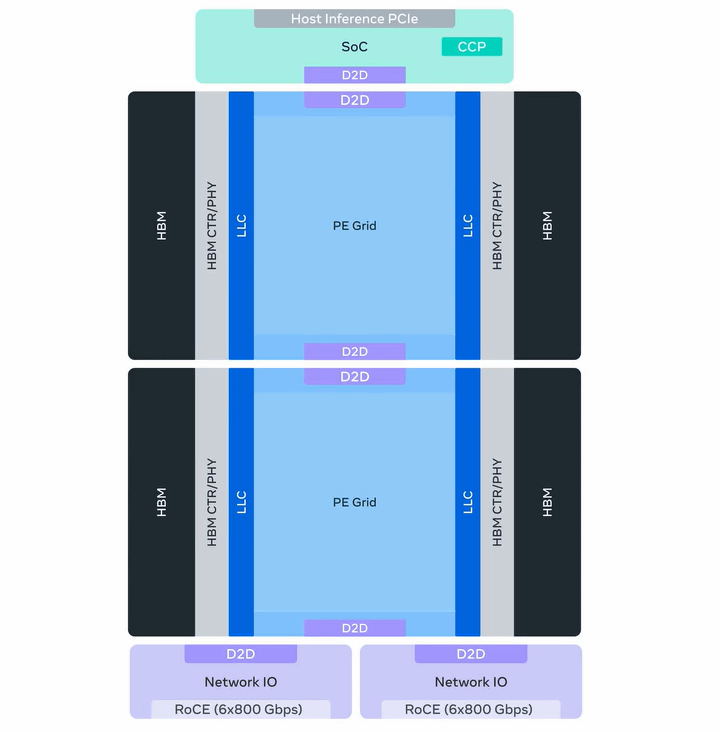
The MTIA 300 is a chip optimized for AI training using a technique called 'ranking and recommendation (R&R),' with a performance of 1.2 PFLOPs at FP8 precision. While R&R is considered an older generation workload than generative AI, the MTIA 300 design is said to have served as the foundation for other chips. The MTIA 300 is already in mass production.
◆MTIA 400
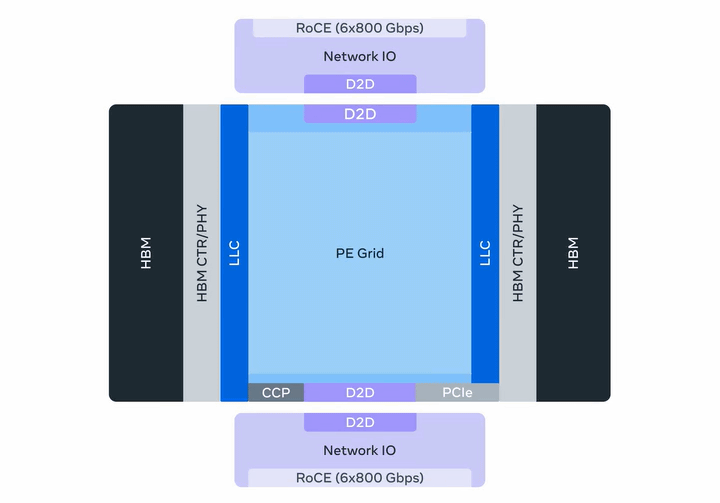
The MTIA 400 is an improved version of the MTIA 300, a general-purpose chip designed to handle not only R&R but also generative AI. While the MTIA 300 focused on efficiency, the MTIA 400 was designed to achieve computational performance comparable to major commercial products, with FP8 precision performance increased to 6 PFLOPs.
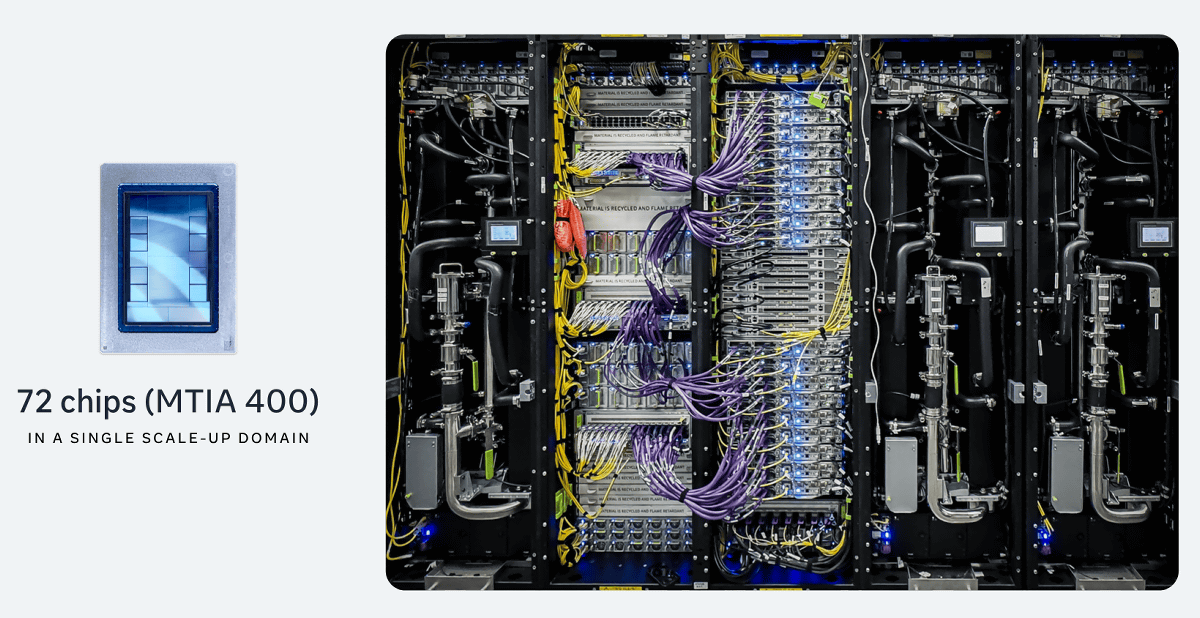
The MTIA 400 has completed lab testing and is being prepared for deployment in data centers. Meta has also published images of a rack containing 72 MTIA 400s.
◆MTIA 450
The MTIA 450 is a chip based on the MTIA 400, optimized specifically for generative AI. Its HBM bandwidth has doubled from 9.2TB/s of the MTIA 400 to 18.4TB/s, and its FP8 precision performance has reached 7PFLOPs. The MTIA 450 is scheduled to enter mass production in early 2027.
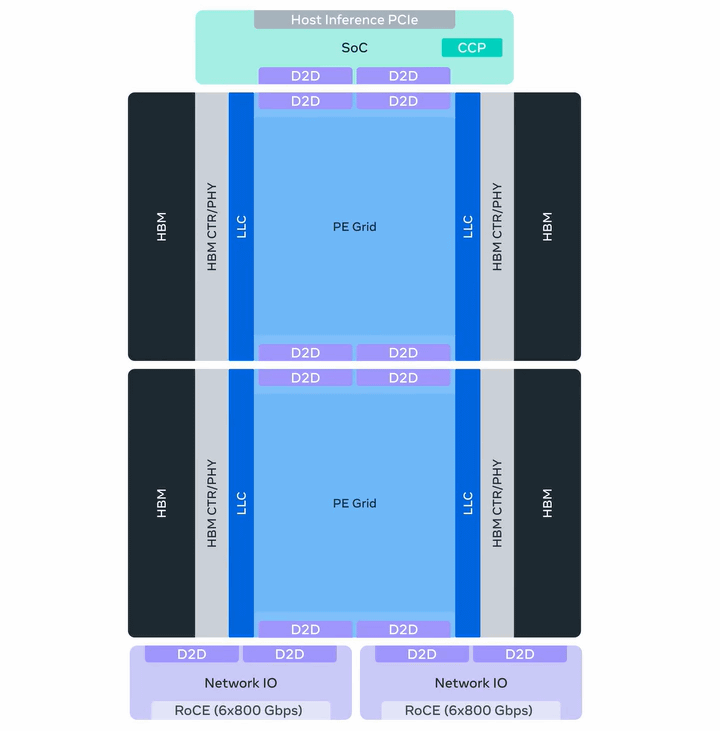
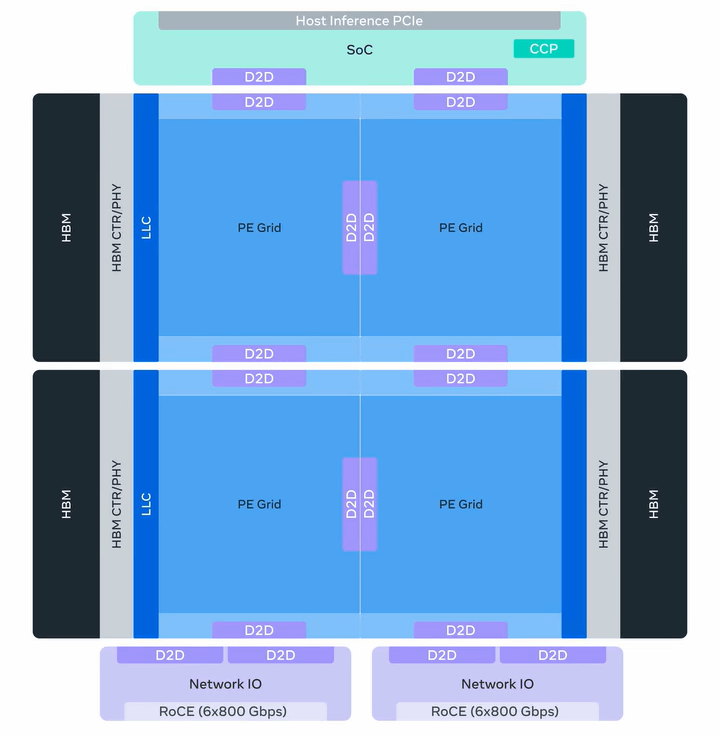
◆MTIA 500
The MTIA 500 is a chip that improves HBM bandwidth to 27.6MB/s and is scheduled to begin mass production in 2027. Its computational performance is 10 PFLOPs at FP8 precision and 30 PFLOPs at MX4 precision.
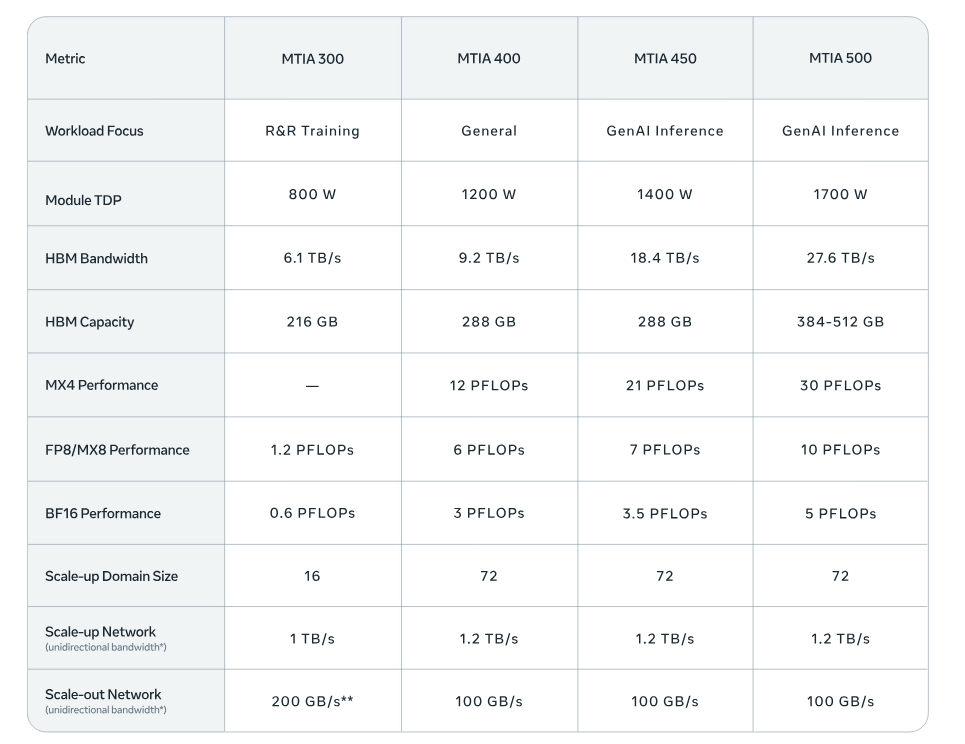
Below is a table summarizing the specifications of 'MTIA 300', 'MTIA 400', 'MTIA 450', and 'MTIA 500'. It can be seen that the performance of Meta chips will increase dramatically in the two years leading up to 2027.
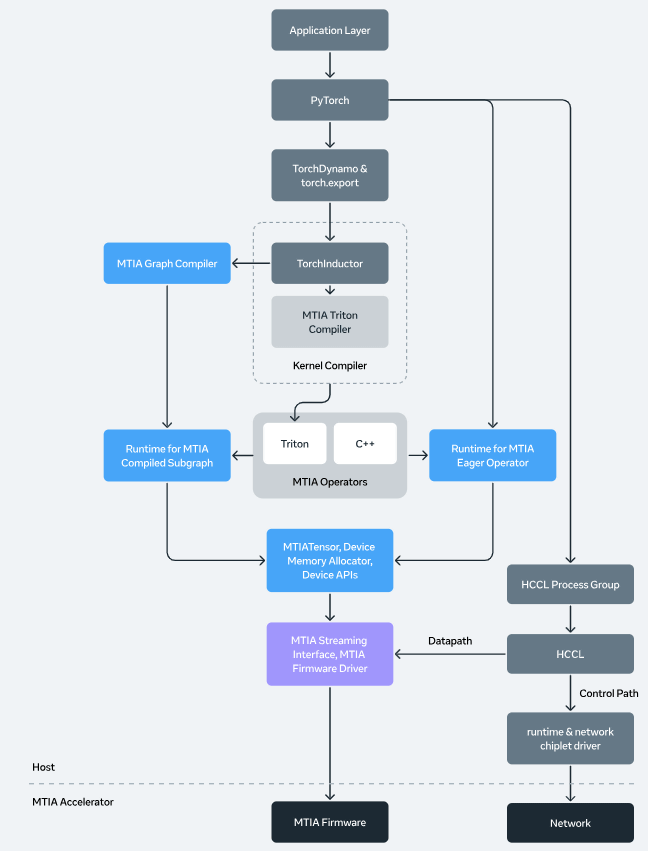
The MTIA series is also PyTorch-native, allowing developers to maintain a familiar ecosystem. The four chips are designed to use the same racks and network infrastructure, offsetting the significant costs associated with rapid chip development and deployment.
Related Posts:


in Hardware, Posted by log1o_hf