An AI chatbot that simulates conversations with women could improve the dating skills of single men

In recent years, more and more people are training chat AIs like ChatGPT and Gemini to interact with their ideal partner.
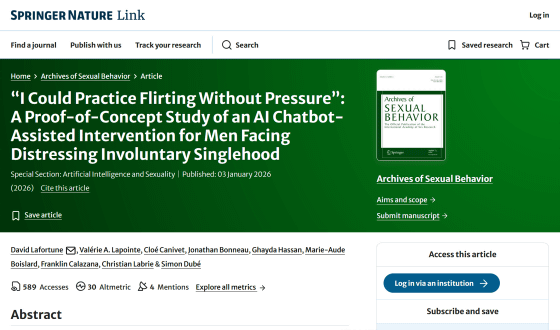
“I Could Practice Flirting Without Pressure”: A Proof-of-Concept Study of an AI Chatbot-Assisted Intervention for Men Facing Distressing Involuntary Singlehood | Archives of Sexual Behavior | Springer Nature Link
https://link.springer.com/article/10.1007/s10508-025-03356-3
Therapists test an AI dating simulator to help chronically single men practice romantic skills
https://www.psypost.org/therapists-test-an-ai-dating-simulator-to-help-chronically-single-men-practice-romantic-skills/
Loneliness is recognized as a serious public health crisis and is a global problem known to increase the risk of depression, anxiety, cardiovascular disease, and diabetes. While the presence of a trusted partner acts as a protective buffer that improves life satisfaction and physical health, the number of people around the world who are unable to find a romantic partner despite truly wanting one is on the rise. For many people, constant romantic failures can cause intense feelings of inferiority and sadness, leading to long-term frustration.
However, many men who are unwillingly single tend to avoid traditional mental health care. Reasons for this include distrust of therapists, financial issues, and a reluctance to talk about sexual insecurities. Some men who want to find a partner but can't find one turn to digital communities, develop rigid ideas about gender roles, and end up blaming women for their failures in love.
So, a research team led by Dr. David Lafortune, a sexology researcher at the University of Quebec in Montreal in Canada, conducted an experiment to see if an 'AI chatbot' could be used as a way to intervene with single men without the resistance that comes with traditional clinical settings.
In recent years, chat AI has rapidly developed, and at the time of writing, millions of people are conversing with romantic AI chatbots that adapt to the user's preferences and simulate the experience of having a partner. LaFortune and his team hypothesized that interactions with AI chatbots designed for single men could serve as a 'safe training ground for romantic communication.'

For the experiment, the research team developed a custom web platform called 'Kindling,' which looks and functions like a typical dating app, and an AI chatbot called 'Marie' that can interact with users on Kindling. Marie was trained on a vast amount of text data and given a background story, hobbies, and traits such as empathy, positivity, and generosity. She also had a library of psychological resources to help her respond flexibly to hostile remarks and difficult conversations.
The study recruited 32 heterosexual men who had been single for at least a year and were struggling with their lack of romantic relationships. Before chatting with Marie, participants used Kindle, a swipe-through app that replicates a smartphone dating app, to browse a diverse selection of realistic profiles of women in their late 20s to early 30s. By selecting a profile, participants could begin a text-based conversation with Marie.
The experiment took place in a laboratory with a licensed clinical psychologist present. Participants participated in structured sessions lasting less than two hours. The clinical psychologist monitored participants' emotional distress and encouraged brief periods of self-reflection between tasks. While participants knew Marie was an AI chatbot, they were asked to interact with her as if she were a real potential date.

The interaction with Marie was divided into three 15-minute steps, mirroring a typical modern date. In the first step, participants were asked to contact Marie and engage in small talk. Marie responded with a simple, friendly greeting, sending a message like, 'Hi, how are you feeling today? I'm Marie.'
In the second step, participants were asked to self-disclose to Marie, sharing their personal values, feelings, and past romantic experiences. This required the men to let down their defenses and show vulnerability to the AI chatbot, thereby testing whether the AI chatbot could foster emotional intimacy.
In the third step, participants were asked to overcome a rejection from a potential romantic partner. Marie was programmed to clearly indicate that she had no romantic feelings for the participant, allowing them to experience the pain of losing a relationship in a controlled environment.
Between each step, participants took short breaks to speak with a clinical psychologist. The psychologist asked participants about their negative thoughts and helped them process any feelings of inferiority that arose during their interactions with Marie. This introspective process was intended to help the men develop emotional awareness and recognize self-defeating patterns in dating.
The research team tracked the participants' mental well-being before and three months after the experiment. The results showed a significant reduction in the men's psychological anxiety, loneliness, and sexual distress. These effects were largely maintained in follow-up surveys one and three months after the experiment.

Many men reported that the simulation with Marie was realistic and accurately reflected the hurdles they would face on a real dating app. Some said the experiment was very enjoyable and allowed them to practice flirting with women without the usual fear of embarrassment. The participants also reported that the experiment made them feel less wary of women and more comfortable expressing themselves.
The participants' moods showed clear changes as they progressed through the three steps. During the self-introduction and self-disclosure steps, they reported a sense of acceptance and increased self-confidence and attractiveness. However, after the final step, when they were rejected in a romantic relationship, these positive feelings decreased, as expected. Nevertheless, the participants navigated the experience well, and the therapists did not need to address panic or intense sadness, and there was no significant increase in psychological distress after the session.
However, the participants' psychological profile, including their general hostility, rigid beliefs about gender roles, and tendency to blame women for romantic failures, remained unchanged after their interactions with Marie. Changing these deeply ingrained beliefs may require more than a single session and may require longer-term, more intensive intervention.
This study has several limitations, including a small sample size, almost all of the participants were highly educated, white, heterosexual, and did not include a control group. It's possible that the benefits stemmed from talking to a psychotherapist rather than an AI chatbot. It's also unclear what the long-term, everyday effects of interacting with an AI chatbot might be.
Going forward, the researchers hope to develop a more advanced version of Kindling with audio and video capabilities, and also to test whether the romantic and social skills developed in the digital space can help people build better relationships in the real world.
Related Posts:







in Free Member, AI, Science, Posted by log1h_ik