A company is using users' chat histories to create 'customer AI agent twins' for market research

Market research, essential for product development and marketing, has become a massive $150 billion industry. The Wall Street Journal reported that an AI startup called
Can AI Replace Humans for Market Research? - WSJ
https://www.wsj.com/cio-journal/can-ai-replace-humans-for-market-research-4f818890
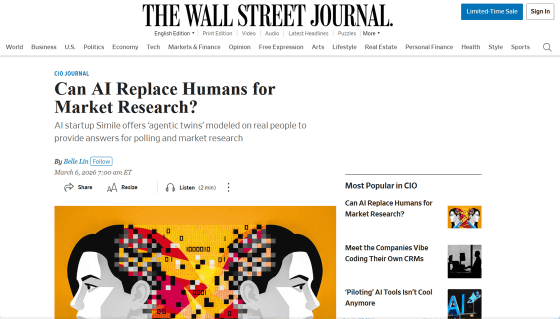
Simile, a Palo Alto, California-based AI startup, uses data collected from chats with humans to train AI agents and create 'agent twins,' digital clones of humans. Simile's AI agent twins inherit the preferences, personality, and other characteristics of their human counterparts, and users can collect various data from the agent twins through interviews. By combining this data with the subjects' behavioral and purchasing data, Simile can generate research results similar to those obtained through market research conducted on humans.
For a long time, market research has relied on traditional market research firms and consulting firms, which require significant costs and months of research time. However, Simile's AI agent twins offer faster, more affordable access to market research, potentially transforming the way market research is conducted.
According to Simile CEO Jun-Sung Park, customers can access Simile's online AI agent bank for a fee of $150,000 to several million dollars (approximately $24 million to several hundred million yen) per year. Customers can ask the AI agent twins a huge number of questions, reducing the cost and time required for market research. Simile also develops its own behavioral prediction AI model and combines it with various open-source models.
Simile was spun out of Stanford University in 2024 in response to growing interest in AI simulation technology. Park and his two co-founders also published a paper on AI-based interactive behavioral simulation in 2023. In February 2026, the company announced it had successfully raised $100 million (approximately 15.8 billion yen) in a Series A funding round.
CVS's AI agent twins are based on 2.9 million responses from over 400,000 real people with their consent. CVS uses its own data, such as past survey responses and support interactions, to calibrate the AI agent twins' responses. Internal testing has confirmed that the AI agent twins can reproduce known responses with 95% accuracy.
Sri Narasimhan, vice president of Enterprise Customer Experience and Insights at CVS, said the AI agent twins are unique in that they are 'always on' unlike humans. 'The real breakthrough for us is that they can dig deeper. They don't get bogged down by asking too many questions, and they don't get tired,' he said.
CVS has used AI agent twins in past surveys to find out how well people adhere to medication guidelines and what concerns they have about medications. They also believe that AI digital twins can be used to reach hard-to-reach demographics, such as medical professionals and patients with chronic illnesses. CVS plans to further expand its use of AI agent twins, and Narasimhan believes that traditional market research will become less necessary.
Gallup , a major market research company, has also begun a partnership with Simile and plans to provide more than 1,000 AI agent twins to its customers. Joe Daly, Global Managing Partner at Gallup, cited policy research, trend analysis, and corporate research as areas of expected interest to clients. 'AI agent twins will enable us to conduct research at a deeper level, on a larger scale, with fewer economic barriers than ever before,' Daly said.
Park predicts that in the future, Simile's customers will demand 'multi-agent simulation,' or the ability for AI agent twins to interact with each other. By analyzing the interactions between AI agent twins, it is expected that more complex scenarios that are replicated in the real world will be simulated.
Evan Brown, an emerging technology analyst at IT consulting firm Gartner , points out that market research is an area where AI agent twins are likely to be successful. While there is a risk of life-threatening malfunctions or hallucinations when using AI agent twins in medical settings, even if marketing fails, it is unlikely to become an immediately fatal problem.
Simile says it applies guardrails to its AI agent twins, such as role-based access control and monitoring for sensitive content, and CVS also protects against AI hallucinations and other inaccuracies by validating the answers of its AI agent twins with human responses and asking researchers to point out discrepancies and validate the results.
'It's important for us to keep the testing flowing and make sure it's being tested with real users. We never stop talking to real customers,' Narasimhan said.
Related Posts:



in AI, Posted by log1h_ik