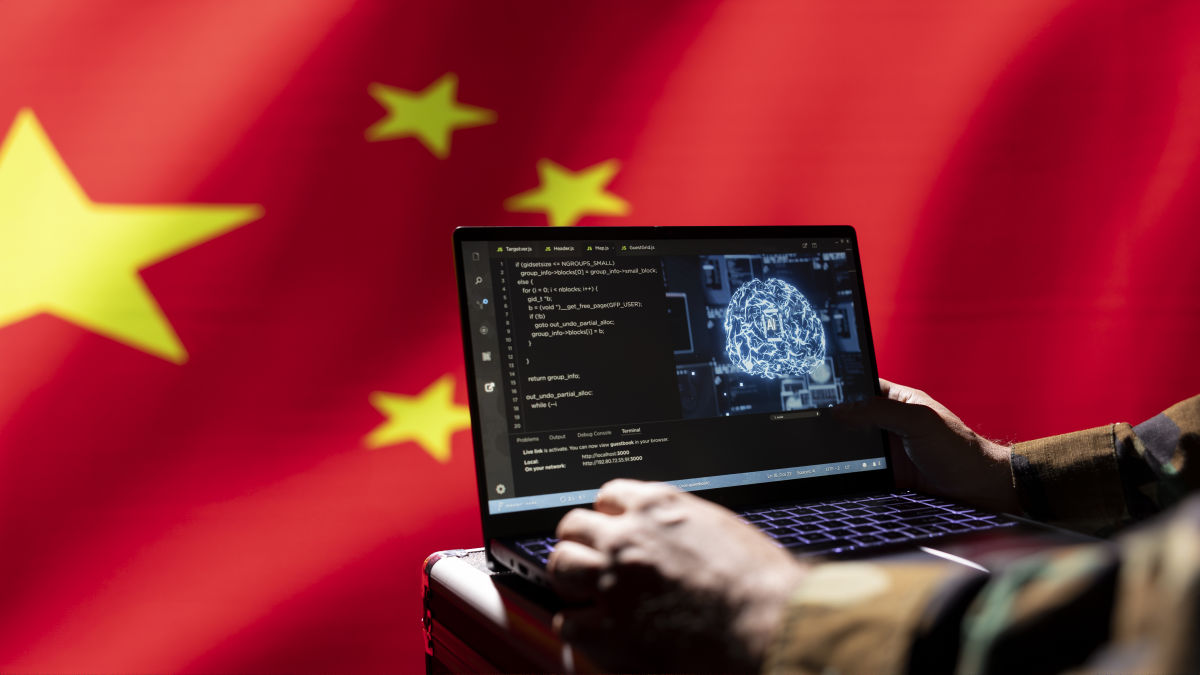
The People's Liberation Army of China is developing 'military humanoid robots,' 'space warfare robots,' 'flying drone corps,' and 'propaganda AI.'
Researchers at
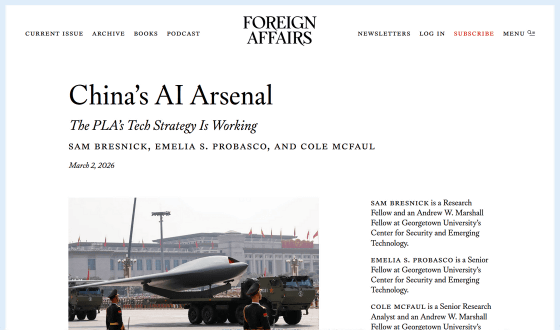
China's AI Arsenal | Foreign Affairs
https://www.foreignaffairs.com/china/chinas-artificial-intelligence-arsenal
Thousands of procurement documents show how China's army wants to weaponize AI
https://the-decoder.com/thousands-of-procurement-documents-show-how-chinas-army-wants-to-weaponize-ai/
The military parade held in China in September 2025 focused not on tanks and marching soldiers, as is typically the case in traditional military parades, but on AI-related technologies such as unmanned vehicles, underwater and aerial drones, and autonomous fighter jets. Georgetown University researcher Sam Bresnik and his colleagues analyzed procurement solicitation documents from the People's Liberation Army of China released over the past three years to identify how the military is seeking to utilize AI technology.
Drone armies, robot dogs, and decision-making systems
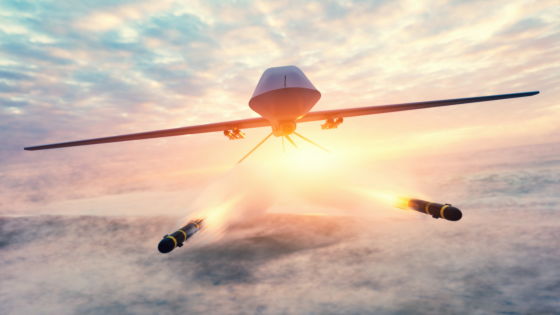
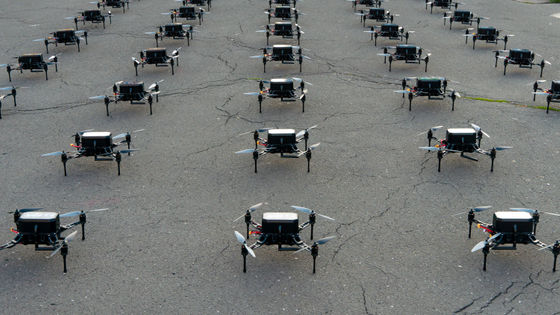
Procurement solicitation documents reveal that the People's Liberation Army is developing an army of aerial drones that can autonomously identify and track targets and coordinate attacks. It's also investing in robotic dogs and humanoid robots, as well as small robots for use in space in the event of a war between satellites, and a system to track U.S. submarines around the world.
Furthermore, China's political and military leaders are concerned that they lack sufficient trust in their own chain of command and will be unable to respond to a rapidly evolving war. Therefore, they are building AI-powered decision-making systems to compensate for the People's Liberation Army's lack of experience. The researchers point out that PLA soldiers are already using AI systems to simulate virtual battlefields and model enemy behavior.
Deepfake Initiatives
The People's Liberation Army's ambitions in information warfare go beyond traditional cyber defense, with multiple procurement solicitations explicitly calling for deepfake technology. The PLA sees AI-generated images, video, and audio as effective tools for shaping public opinion, manipulating adversaries' situational awareness, and manipulating decision-making in conflicts. The PLA is also developing algorithms to track international news, identify the political views of other nations, predict social unrest, and manipulate adversaries' perceptions.

◆ Rapid experiment cycle without waiting for a groundbreaking breakthrough
Regarding the People's Liberation Army's efforts to utilize AI, the research team points out, 'China is not waiting for a breakthrough in AI. It is experimenting with currently available technologies, hoping to accumulate incremental improvements over time. Many of the documents we examined are characterized by short development times, which allows for rapid and relatively low-cost experimentation across applications and domains.'
Additionally, the Chinese government is offering subsidies and tax incentives to encourage domestic technology companies to repurpose their products for defense applications, allowing the capabilities of its civilian technology sector and advanced industries to be harnessed for military purposes.
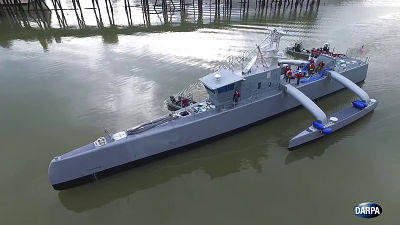
The research team also pointed out that many of the People's Liberation Army's AI deployment initiatives are modeled after the US Department of Defense's AI drone program,
◆ Risks of excessive automation
While the United States still requires experienced human judgement, the People's Liberation Army of China may come to rely on AI decision-making systems instead of inexperienced officers. This could result in misreading of military and diplomatic signals and incorrect decisions on the battlefield. It has also been pointed out that the People's Liberation Army of China has limited combat experience and lacks many of the data sets necessary for training AI for military purposes, such as classified images of military platforms and the radio signatures of radar weapons.
Another risk is that because some AI-powered decision-making systems rely on public data, enemy militaries could deliberately manipulate the information environment, for example by flooding social media with false signals or disrupting commercial satellite imagery providers, which could fool AI tools into making unintended or incorrect decisions.

Issues with the US government's use of AI
The researchers point out that the US still has advantages in computing power, technological talent, and operational experience, but they are concerned about domestic conflicts, such as the US cutting ties with AI developer Anthropic and calling for it to be designated a 'supply chain risk to national security.'
The research team concluded, 'While many of the People's Liberation Army's experiments are not surprising, some applications, particularly complex AI decision support systems and cognitive warfare tools, increase the risk of miscalculation and destabilization. As China continues to adopt emerging technologies and modernize its military, the United States should also engage in rapid iterative development of AI, responsible experimentation, and smart commercial partnerships to maintain its advantage.'
Related Posts:




in AI, Posted by log1h_ik