It turns out that AI sent a large amount of opposition to a proposed regulation to reduce air pollution from gas appliances

California regulators announced a proposed rule in June 2025 to phase out the sale of some gas fireplaces and gas water heaters in order to limit the amount of pollutants that contribute to smog. The rule was eventually blocked after tens of thousands of objections were filed, but it was discovered that more than 20,000 of the objections were AI-powered campaigns sent by the same company.
An AI-powered campaign may have killed a key vote on air quality - Los Angeles Times
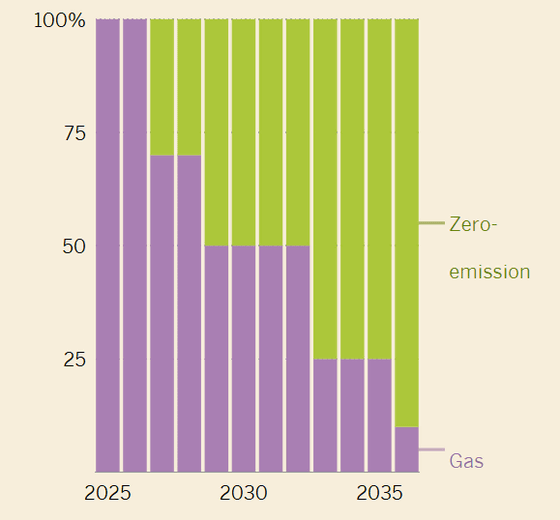
In June 2025, the Southern California Air Quality Management Department (AQMD) announced two proposed regulations to limit emissions of nitrogen oxides, the main pollutant that forms smog. One of the proposed regulations sets sales targets for 'zero-emission products' for equipment manufacturers, distributors, and installers, aiming for 30% of sales of products that do not emit pollutants in the first year of 2027, 50% in 2029, and 90% by 2036. As a result, gas-powered equipment was expected to be phased out.
The second proposed regulation would impose a $100 (approximately 15,000 yen) surcharge on each gas appliance and a $50 (approximately 8,000 yen) surcharge on gas water heaters. The AQMD projected that these regulations would reduce nitrogen oxides by six tons per day by 2061. However, there were concerns that the elimination of gas heaters, which are cheaper than electric heaters, and the additional fees would increase the burden on consumers. In the final vote, the regulation was rejected by a majority of 5 in favor and 7 against.
The overwhelming opposition to the proposed regulations has been attributed to the influence of tens of thousands of opposing messages sent to the AQMD. However, an investigation by the AQMD revealed that more than 20,000 emails opposing the proposed regulations were generated by a Washington, D.C.-based company called CiviClick . CiviClick calls itself 'the first and best AI-powered grassroots advocacy platform,' and its official website states that it 'helps public relations teams, organizations, nonprofits, and businesses mobilize supporters and influence policy.'

In Campaigns and Elections , a trade publication specializing in political campaigns, public relations consultant Matt Klink claimed credit for the CiviClick campaign. 'The proposed regulation failed to consider the high costs of the regulation, so we created an environment where residents could easily voice their concerns directly to the AQMD. The AQMD is not used to receiving tens of thousands of emails, so this initiative made a big difference in turning the situation around,' Klink said.
According to CiviClick CEO Chaz Clevinger, CiviClick conducts outreach to more than 500,000 local residents registered in its supporter database, and creates emails using the names of users who have submitted comments or given permission for the company to send emails on their behalf. The AQMD's cybersecurity team contacted a small number of email senders, and of the five who responded, two admitted to sending the messages, while three said they had no knowledge of the emails.
AQMD spokesperson Nahal Mogharabi said the agency was aware that some of the opposition emails may have been generated by AI, but that the agency had no choice but to treat them as official opinions because the public policy decision-making process relies on public input and there were no clear rules regarding how to handle messages generated by AI. However, Mogharabi declined to comment on whether the tens of thousands of opposition emails influenced the vote, as voting on proposed regulations is conducted by a committee composed of independently elected and appointed members.
'What we're seeing here is a new step in AI-driven deception,' said Samuel Woolley, a University of Pittsburgh researcher who studies disinformation and the use of emerging technologies in politics. 'These advances in AI threaten to severely undermine the connection between politicians and political organizations and the public, because they can make people believe they want things they don't. And the systems aren't designed to handle this.'
Related Posts:








in AI, Posted by log1e_dh