Research shows that lies told to protect others are rated as more moral than the truth

Lying is considered immoral in many cultures and is discouraged, but research suggests that people may view lies, under certain circumstances, as more moral than the truth.
Selective (dis)honesty: Choosing overly positive feedback only when the truth hurts - Cantarero - 2026 - British Journal of Social Psychology - Wiley Online Library
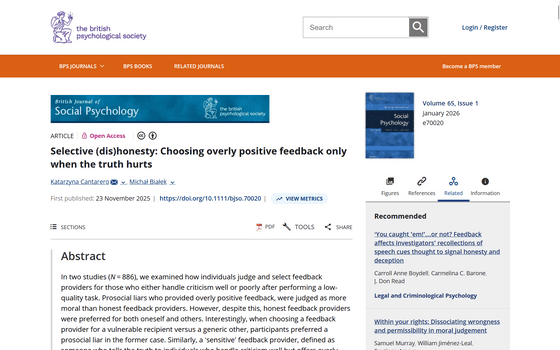
Truth hurts: Prosocial liars perceived as more moral, study finds
People sometimes lie to avoid hurting others. Social psychologist Katarzyna Cantarello and her colleagues investigated how much a person's honesty is actually valued by others, assuming people who are always honest or who tell 'white lies' that don't hurt others.
In their study, Cantarello and his colleagues created fictional characters—two chefs who cooked bad food and four people who gave the chefs their opinions—and randomly presented the characters' comments to approximately 900 Americans, asking for their feedback.
Chef 1: I can handle negative feedback well.
Chef 2: I don't handle negative feedback well.
Opinion 1: Lie to both chefs and tell them it was delicious.
Opinion 2: Tell both chefs the truth: 'It was bad.'
Opinionator 3: Lie to Chef 1 and tell the truth to Chef 2
Opinionator 4: Lie to Chef 2 and tell the truth to Chef 1
Approximately 900 Americans participated in the survey and were asked, 'What kind of person do you think this person is?' after reading four randomly presented statements. The questions were divided into four categories: 'good/bad,' 'ruthless/empathetic,' 'immoral/moral,' and 'violent/peaceful.'

The survey results showed that the person participants judged to be the most moral was 'someone who gives excessively positive feedback,' or Opinionator 1. This was followed by Opinionator 4, who 'lies to people who can't handle negative feedback well,' but there was little difference in the moral ratings of Opinionators 1 and 4. Opinionator 2, who always tells the truth, came in third, and Opinionator 3 was seen as the least immoral.
'These results are interesting. They suggest that being considerate of others' sensitivities is acceptable as long as it meets social needs,' said Cantarello.

In another study, Cantarello and his colleagues asked participants to choose which comment was most appropriate for each of three people: someone who has trouble dealing with negative feedback, a non-characterized person, and themselves.
The results showed that participants wanted honest opinions of themselves: 58.9% wanted honest opinions of themselves, while only 14.7% wanted sensitive white lies.
The most common type of person for whom a sensitive commenter was considered appropriate was someone who had difficulty dealing with negative comments (19.2%), followed by someone directed at themselves (14.7%) and someone without a character designation (9.3%).
The most common inappropriate comments (opinionator 3) were directed at people without a character (13.9%), followed by those directed at themselves (9.6%) and those who have difficulty dealing with negative comments (6.2%).
'In the second study, we found that when individuals solicit their own opinions, honest commenters are preferred over those who tell white lies,' Cantarello and his colleagues wrote. 'These two studies suggest that in situations where others are giving their opinions to others, people are more likely to morally evaluate consideration for others than strict consistency.'
Related Posts:







in Creature, Posted by log1p_kr