What is 'Triforce' created by Sega, Nintendo, and Namco?
Dolphin Emulator - Rise of the Triforce
https://ja.dolphin-emu.org/blog/2026/02/16/rise-of-the-triforce/
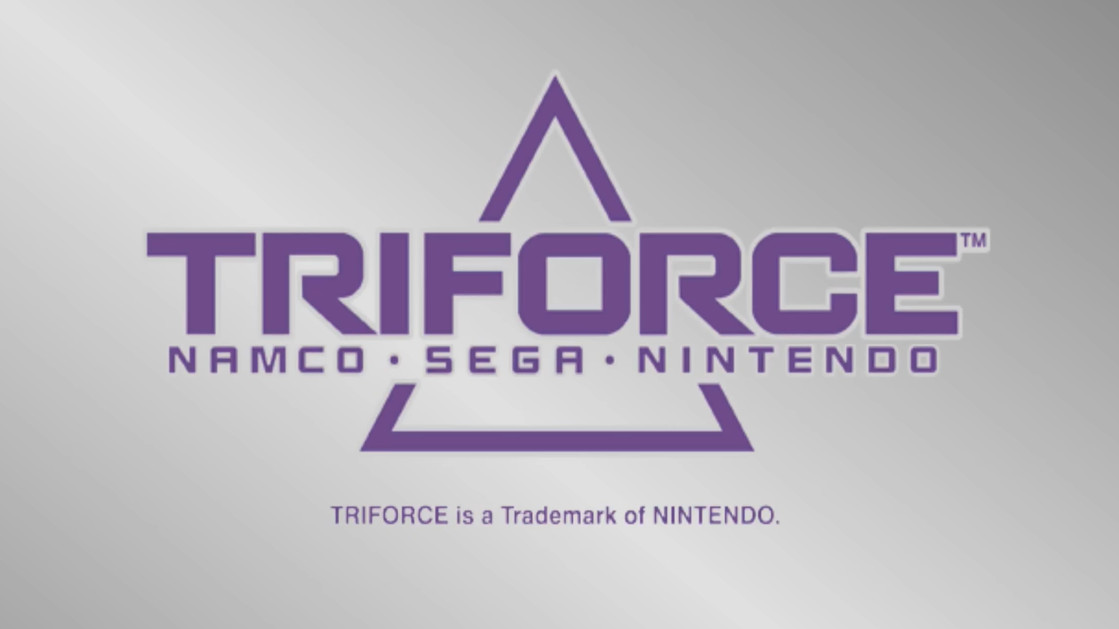
Triforce, released in 2002, is an arcade platform created through the collaboration of three leading Japanese game companies. The name comes from the Triforce, a treasure that appears in Nintendo's 'The Legend of Zelda' series, and symbolizes the collaborative relationship between the three companies.
The Triforce release date announced by Nintendo on February 18, 2002 is as follows:
Namco, Sega, and Nintendo Form Business Partnership to Jointly Develop 'Triforce,' a Next-Generation Commercial-Use General-Purpose 3D Computer Graphics Board
https://www.nintendo.co.jp/corporate/release/2002/020218.html
The Triforce Board, jointly developed by Namco, Sega, and Nintendo, utilizes the architecture of the Nintendo GameCube home video game console, fully utilizing the CG (computer graphics) rendering capabilities already proven on that console, providing software developers with a cost-effective development environment. Furthermore, its versatility benefits not only users but also amusement center operators, and is expected to lead to an expanded selection of software titles and improved investment efficiency.
Sega, Nintendo, and Namco formed this alliance with the aim of revitalizing the arcade market and streamlining development. At the time, the cost of developing arcade games was rising, but by sharing the technology of Nintendo's home console, the Nintendo GameCube, it became possible to provide higher quality games more quickly. This alliance attracted attention as a groundbreaking example of cooperation between companies that were once competitors.
An aluminum shell that covers the Triforce system board.
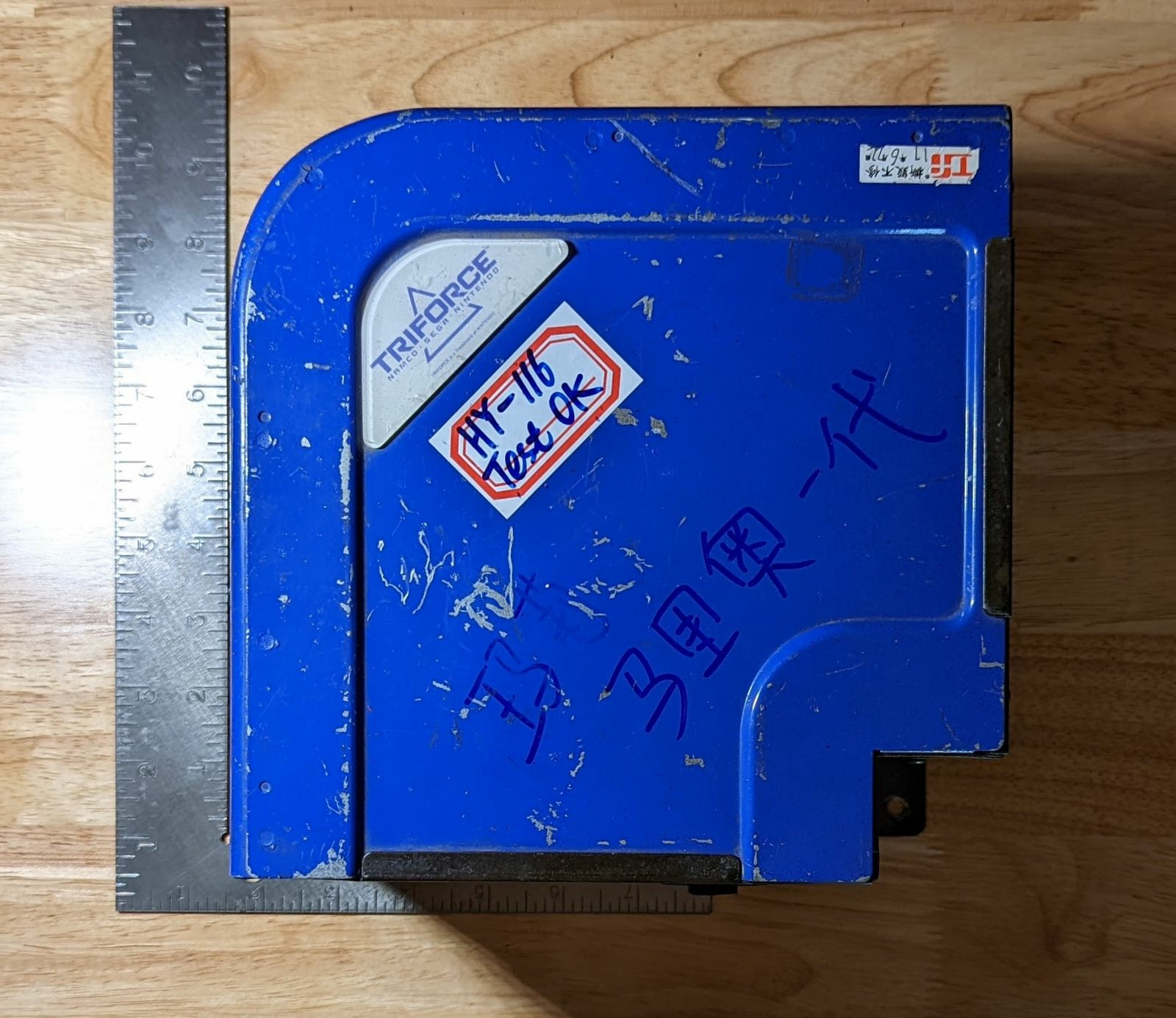
Each unit has a sticker with a serial number, game ID, and more.
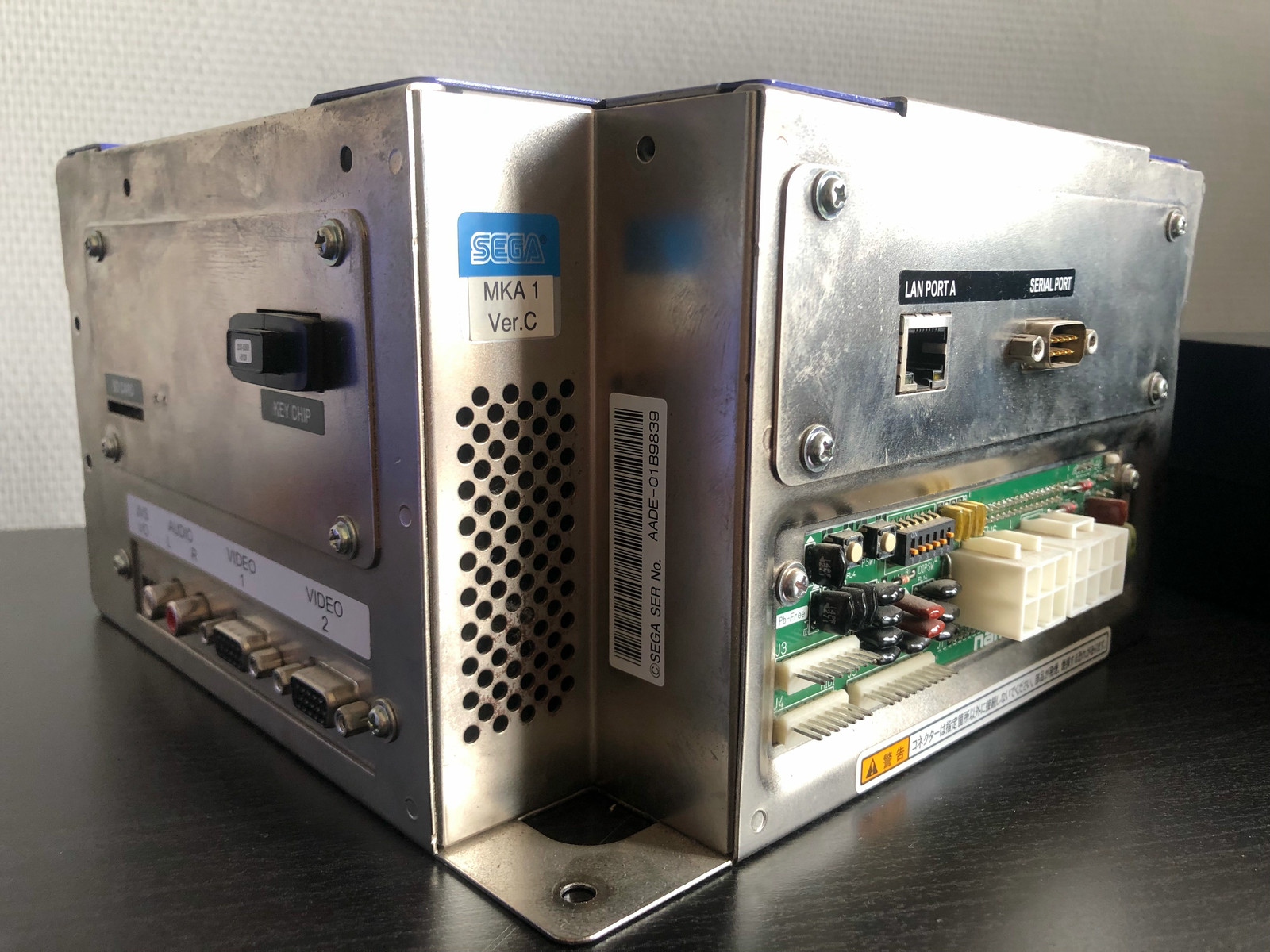
The back of the unit has
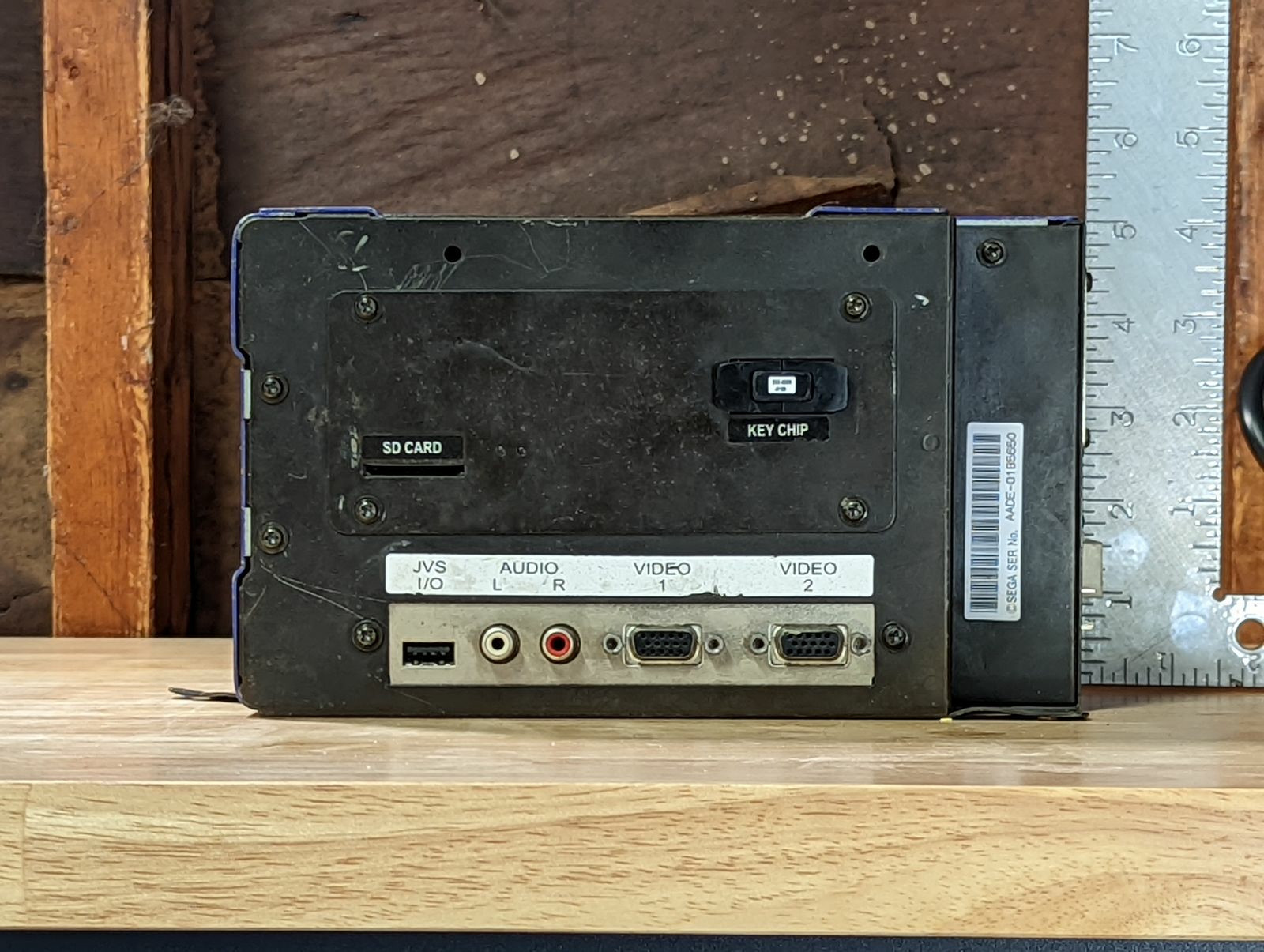
Along with LAN and serial ports, there is also a Namco expansion board.
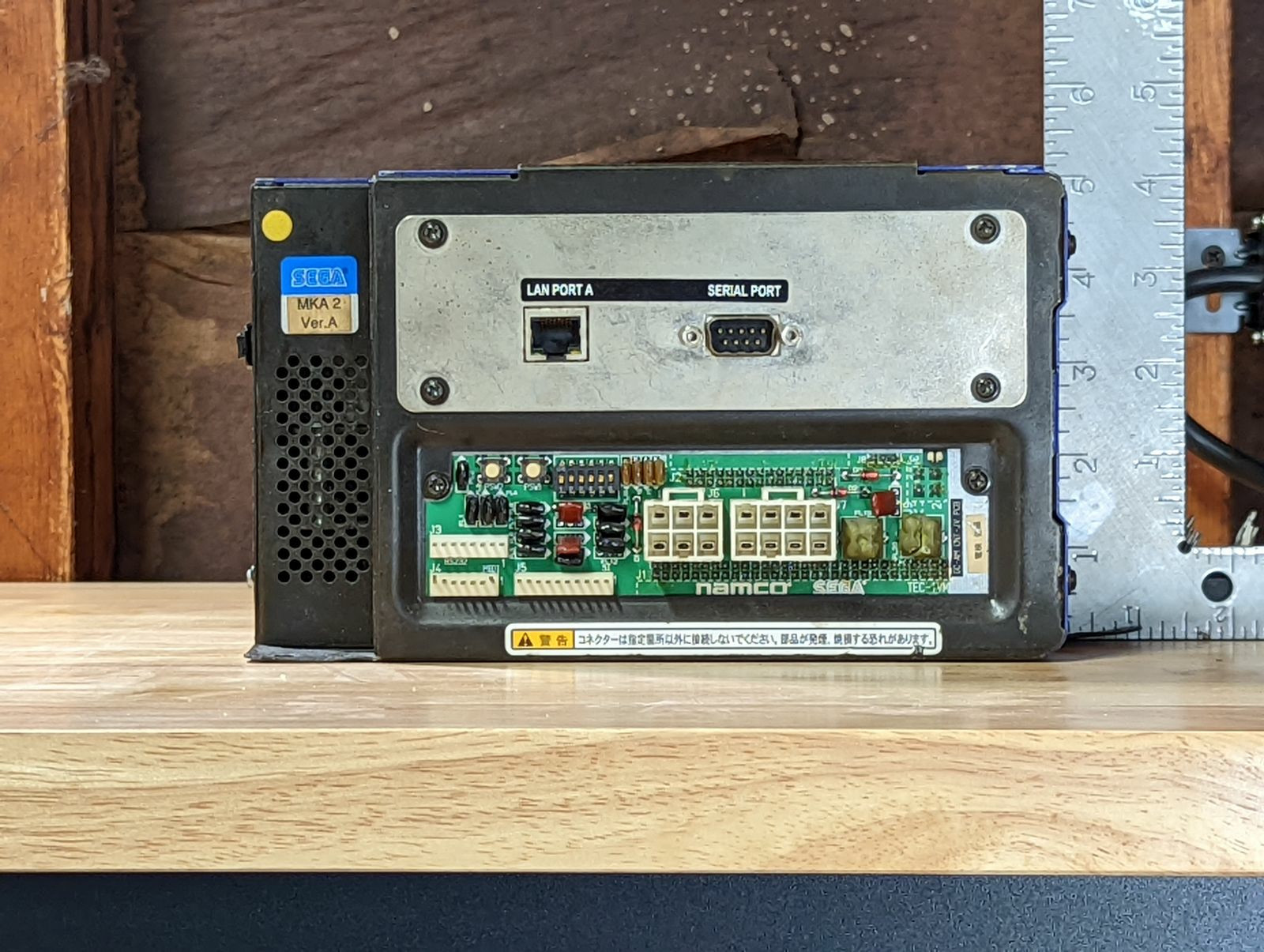
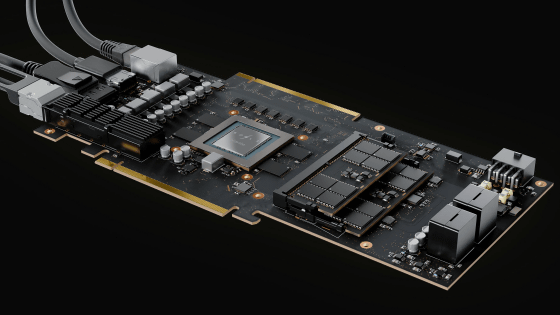
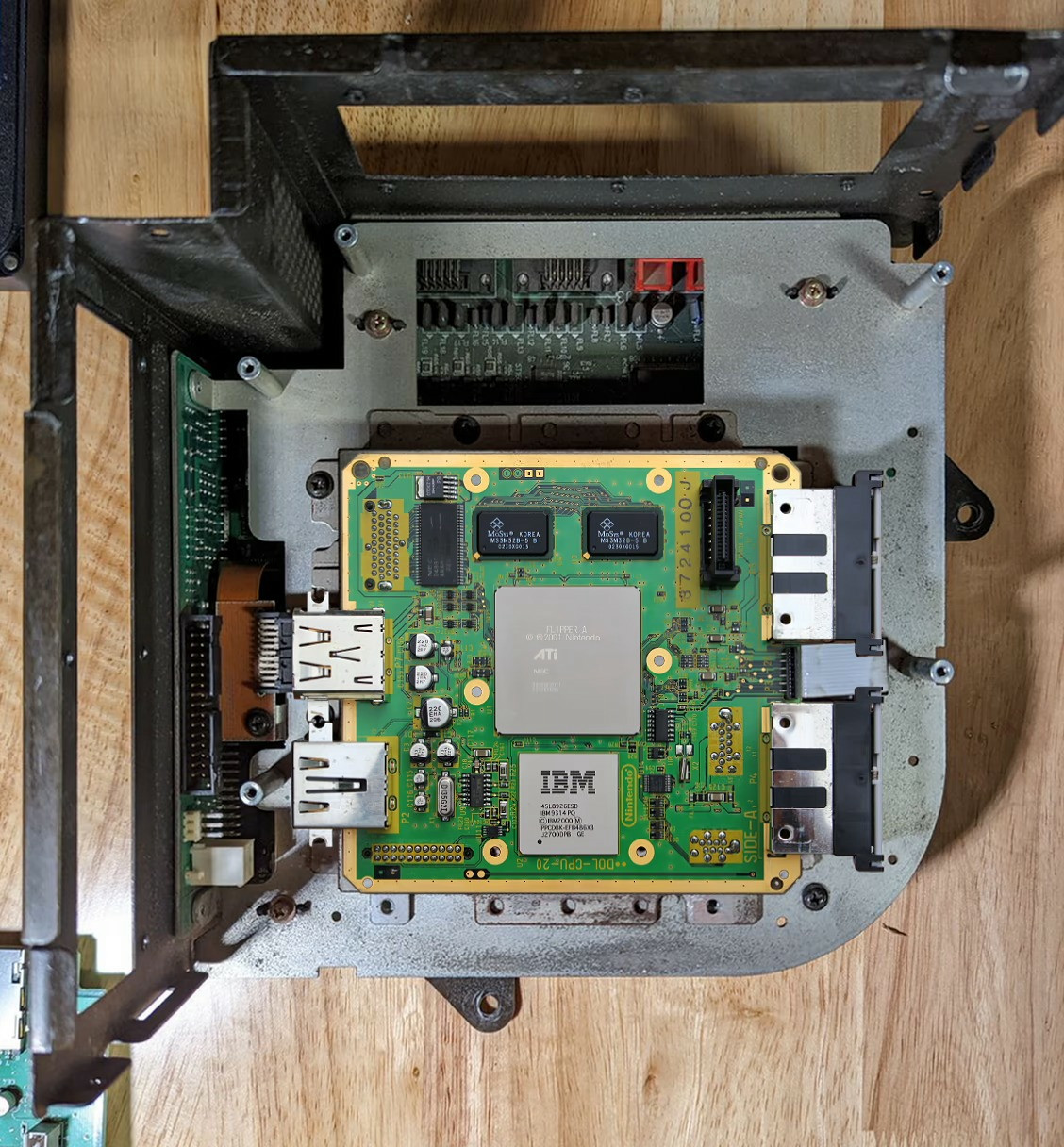
In addition to the standard Nintendo GameCube motherboard, the Triforce is equipped with two custom boards called the AM-Baseboard and AM-Mediaboard. Below is the GameCube motherboard installed in the Triforce.
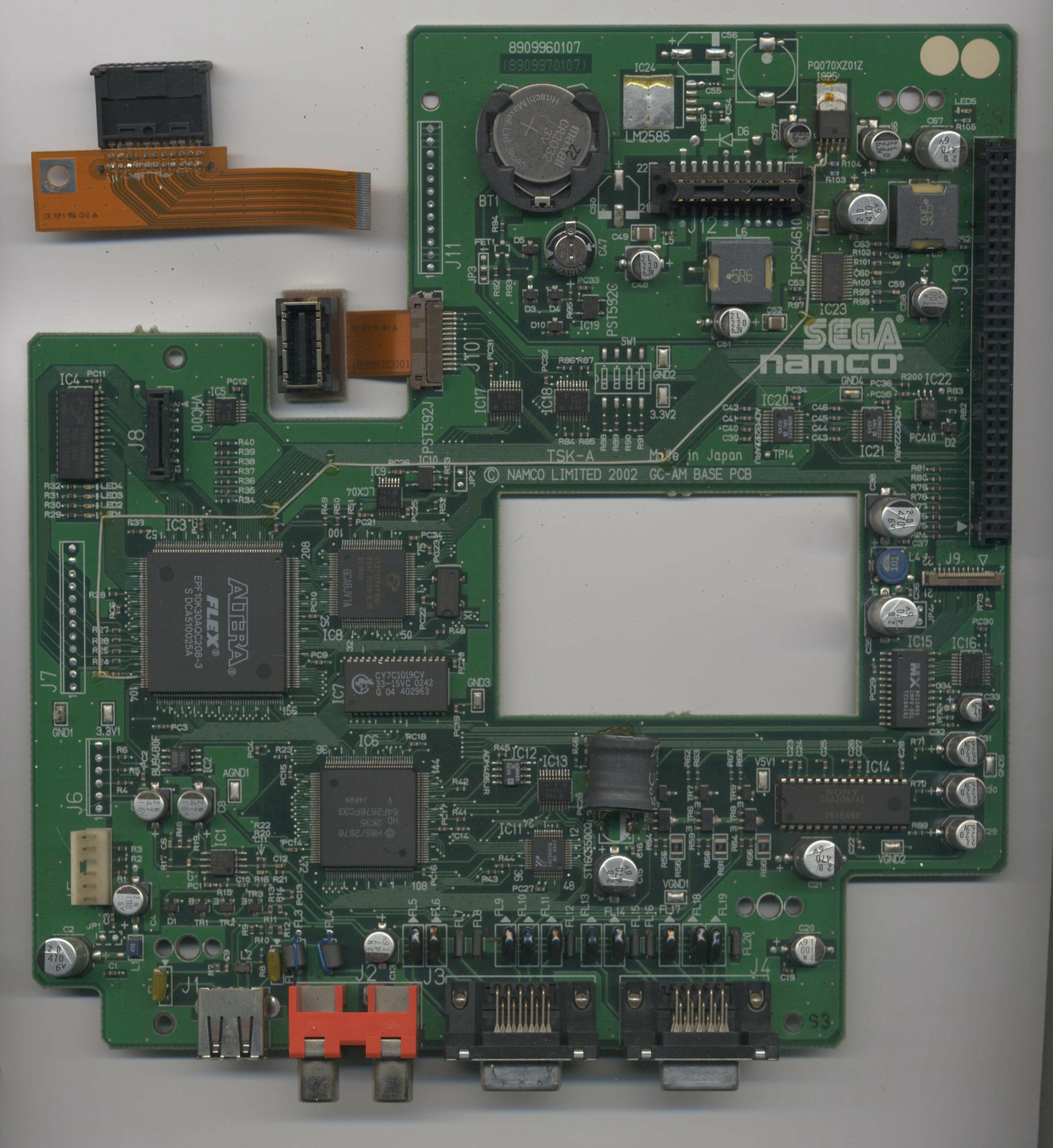
The M-Baseboard is responsible for managing functions specific to arcade games, including input/output control based on the JVS standard, card reader connections, coin counter processing, etc. This board enables advanced network connections with arcade cabinets and peripheral device control, which were not anticipated for home consoles.
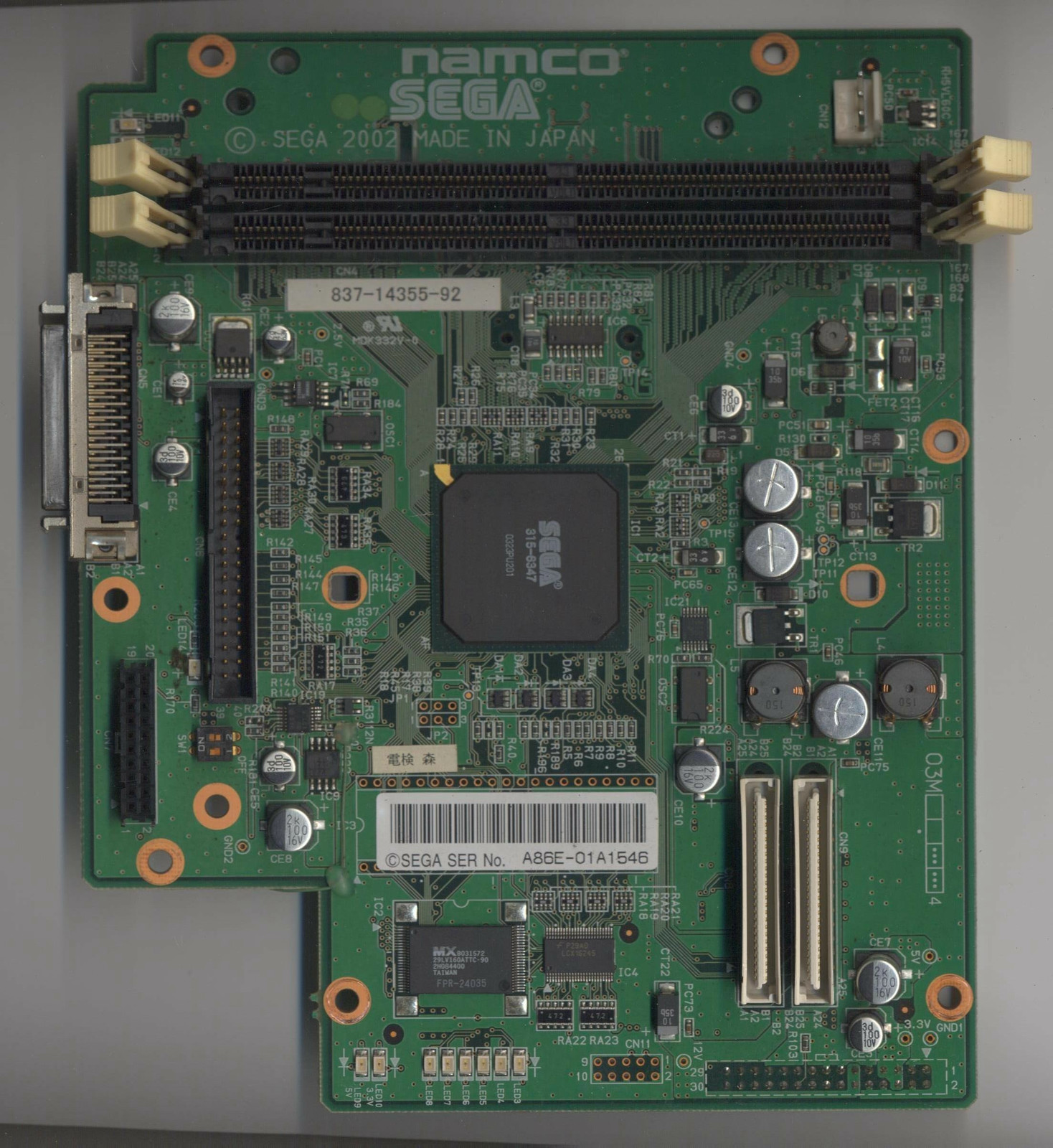
The AM-Mediaboard is a board for expanding storage interfaces and communication functions. It is equipped with a 10/100 Ethernet port and controls communication with Sega's GD-ROM drive and network DIMM board. Many Namco titles used NAND instead of GD-ROM to store game data, and the AM-Mediaboard enabled support for these media types.
The Triforce's hardware shares many similarities with the Nintendo GameCube, including an IBM PowerPC 750CXe CPU and a GPU called 'Flipper' from ATI, later acquired by AMD. However, to meet the unique demands of the arcade environment, the Triforce boasted 48MB of memory, twice that of the GameCube, as well as enhanced network functionality and a security chip. This allowed it to deliver performance that surpassed that of home consoles while also making porting to the GameCube easier.
Several popular titles have been developed using this board, including Namco's 'Mario Kart Arcade GP' series, which marked the first time that Nintendo characters officially appeared on a third-party arcade cabinet.
Mario Kart Arcade GP 2 (Japan) - YouTube
In addition, Sega's 'Virtua Striker 4' was also released on this board.
Virtua Striker 4 Ver. 2006 Arcade - YouTube
The baseball game 'Gekitou Pro Yakyuu: Shinji Mizushima All-Stars VS Pro Yakyuu' was developed based on the concept of 'What if players from Shinji Mizushima's baseball manga appeared in real professional baseball?' and was released for the PlayStation 2 and Nintendo GameCube, but was also released in arcades. Although there are some minor differences in the system, there are apparently very few differences between the home and arcade versions.
Gekitou Pro Yakyuu: Mizushima Shinji Allstars vs Pro Yakyuu Arcade - YouTube
'F-ZERO AX,' developed by Sega, was able to link data with the home version of 'F-ZERO GX.'
F-Zero AX Arcade - YouTube
There's also an even more exciting version of 'F-ZERO AX,' the 'F-Zero AX Monster Ride.' While the features and available pilots are more limited than the standard version, the suspended birdcage-like cabinet creates a truly immersive experience. It's not available outside of Japan, and is quite rare even in Japan.
F-Zero AX Monster Ride - YouTube
Related Posts: