Why do people in their 40s find life harder than their 20s? What happens when they reach their 60s?

Many people in their 20s may have felt energized after a late-night party or an all-nighter, but as they reach their 40s, fatigue suddenly begins to build up and they feel a lack of energy for everything.
The truth about energy: why your 40s feel harder than your 20s, but there may be a lift later on
https://theconversation.com/the-truth-about-energy-why-your-40s-feel-harder-than-your-20s-but-there-may-be-a-lift-later-on-274250
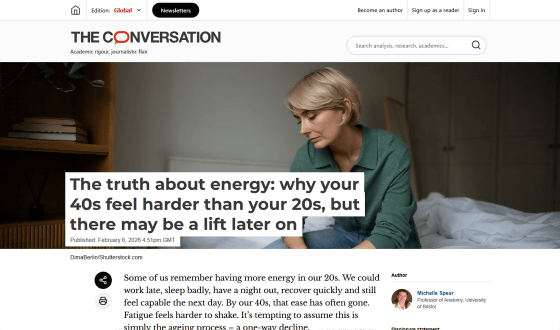
During early adulthood, in your 20s, many biological systems in your body reach their peak: muscle mass remains at its highest level even without deliberate training, and muscle, being a metabolically efficient tissue, helps regulate blood sugar levels and reduces the effort required for everyday activities.
At the cellular level, the number of mitochondria that convert food into energy increases and they become more efficient, producing energy with less waste and inflammatory by-products. Furthermore, younger people also sleep more deeply, and even if they sleep less, they experience more slow-wave sleep , which is closely related to physical recovery, making it easier for the body to recover from fatigue.
In addition, when we are young, our bodies have stable hormonal rhythms. Predictable patterns of hormone secretion—such as the stress hormone cortisol , melatonin , which regulates sleep and the body's internal clock, growth hormone, and sex hormones—help us maintain stable energy levels throughout the day.
Speer explained these physical states: 'Simply put, in your 20s, you have plenty of energy and the luxury of wasting it, so it's perfectly fine.'

In your 40s, your basic biological systems remain the same, but small changes begin to occur in each. For example, muscle mass starts to gradually decline in your late 30s unless you exercise, and this loss of muscle mass means that daily activities use more energy.
Additionally, while mitochondria still produce energy, they become less efficient, exposing the negative effects of lack of sleep and stress that were compensated for by abundant energy in your 20s. Sleep also changes in your 40s, with more frequent awakenings and less deep sleep, reducing your ability to recover. This can lead to the feeling of accumulated fatigue.
Hormonal fluctuations in middle age, especially in women, can disrupt the rhythms of body temperature regulation, sleep, and energy production, making people feel as though they don't have enough energy to meet their daily needs.
In addition to these biological changes, Speer points out that in our 40s, the 'demands of life' reach their peak. Rising career positions require leadership and responsibility, and home tasks like caring for children and parents increase cognitive and emotional strain. Activity in the prefrontal cortex, responsible for planning, decision-making, and impulse control, increases, and mental multitasking can be just as energy-draining as physical labor.
'That's why your 40s feel so demanding,' Speer said. 'Your biological efficiency starts to change at the exact moment when demands are greatest.'

Many people in their 40s suffer from a lack of energy and fatigue, but this condition doesn't necessarily worsen with age. Hormone levels tend to stabilize after the volatile midlife, and life roles tend to simplify with retirement and children growing up. Reduced stress and a more stable daily routine may actually improve sleep efficiency in older age.
Importantly, our energy-related muscles and mitochondria adapt as we age, so even people in their 60s and 70s can expect to regain muscle strength, improve their metabolism, and experience increased subjective energy within a few months of strength training.
'A common mistake we make is to assume that midlife fatigue is a sign of personal failure or the beginning of inevitable decline, but anatomically it's neither,' says Speer. 'Midlife fatigue is best understood as a mismatch between biology and demands - a subtle shift in efficiency at a point when cognitive, emotional and practical loads are highest.' 'Energy in the second half of life is still highly variable, and fatigue typical of your 40s is not the end of the road. Fatigue at this stage is not a warning of inevitable decline, but a signal that the rules have changed.'
Related Posts:







in Free Member, Science, Posted by log1h_ik