Research suggests 50% of lifespan may be determined by genetics

Molecular and cellular biologists at the Weizmann Institute of Science , a world-renowned multidisciplinary research center in Israel, have created a mathematical model to estimate the extent to which human lifespan is influenced by genetics, excluding deaths due to external factors such as accidents and infectious diseases. After analyzing data spanning more than a century, they concluded that 50% of lifespan is due to genetic factors.
Heritability of intrinsic human life span is about 50% when confounding factors are addressed | Science
https://www.science.org/doi/10.1126/science.adz1187
Lifespan may be 50% heritable, study suggests | Live Science
https://www.livescience.com/health/ageing/lifespan-may-be-50-percent-heritable-study-suggests
Previous studies have underestimated the heritability of human lifespan. Twin studies, based on the premise that 'if a trait is heavily influenced by genetics, the correlation between identical twins should be much higher than the correlation between fraternal twins,' estimated the heritability of lifespan to be 20-25%. Large-scale family studies have also estimated a lower figure of around 6%. However, a study published in 2025 by a research team including Harvard Medical School suggests that genetic factors account for less than 2% of the variance in lifespan, while environmental factors account for approximately 17%, suggesting that they have a much greater impact on health and longevity than genetic factors.
Research shows that environment and choice, rather than genes, influence human lifespan - GIGAZINE

The main reason for the difficulty in estimating life expectancy is that it takes a long time to collect data. Another factor that makes analysis difficult is the involvement of various factors in mortality, including extrinsic mortality due to violence, accidents, infectious diseases, etc., and intrinsic mortality due to genetic mutations and age-related diseases.
After analyzing data spanning more than a century, a research team led by molecular and cell biologist Ben Shenhav of the Weizmann Institute of Science concluded that current estimates of the heritability of lifespan are too low. They attributed the low heritability estimates to the fact that they lumped together extrinsic and intrinsic mortality, and examined the heritability of intrinsic mortality, excluding extrinsic causes. The paper points out that most large cohorts used in longevity studies are data on people born in the 18th and 19th centuries, when extrinsic mortality was quite high.
In addition to extrinsic mortality, the research team also investigated the impact of the 'cutoff age'—the minimum number of years to include in the data analysis—on heritability estimates. According to the paper, the impact of these two factors—extrinsic mortality and cutoff age—on heritability estimates of lifespan has never been systematically investigated.
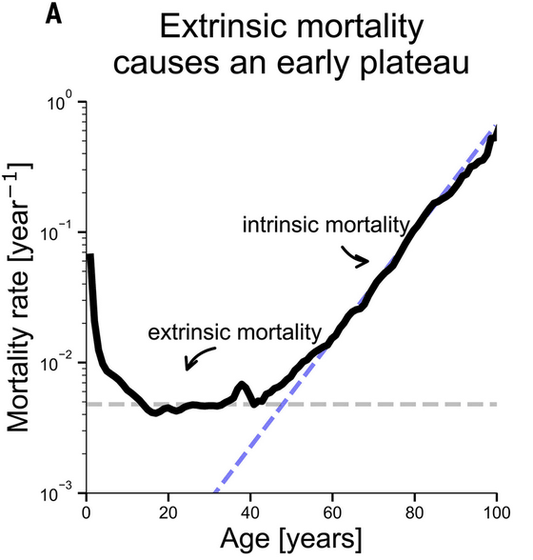
As a result, it was found that the impact of extrinsic mortality tends to plateau between the ages of 20 and 40, but increases exponentially with age. The graph below shows age on the horizontal axis and mortality on the vertical axis, with the solid line representing extrinsic mortality and the blue dotted line representing intrinsic mortality. It was also found that extrinsic mortality declined sharply from the 19th century to the 20th century.
However, past cohort data lack sufficient cause-of-death information to correct for extrinsic mortality, making it difficult to simply exclude it. Therefore, the research team developed a method to generate genetically distinct populations with unique lifespan distributions as a mathematical model to estimate the heritability of intrinsic mortality. This enabled standardized estimation of the heritability to lifespan after adjusting for both extrinsic mortality and the cutoff age, the research team said.
'When twin studies were conducted based on this mathematical model, taking extrinsic mortality into account, the estimated heritability of intrinsic mortality increased to approximately 55%, roughly double the previously thought figure. This figure is consistent with the heritability of mouse lifespan and most other physiological traits, which are thought to be around 50% on average,' the researchers noted.
If human lifespan is highly heritable, identifying longevity genes could shed light on the mechanisms of aging and potentially contribute to medical and public health treatments. Joris Dieren, a geneticist at Leiden University in the Netherlands and co-author of the study, said, 'It's important to note that an estimated 50% heritability doesn't guarantee a long life, nor does it mean one is destined for a short life. What this study shows is that the tendency to live a long life is genetic, and the rest is determined by what you do and where you live. Environment remains very important, and people should strive to optimize their lifestyles as much as possible.'
Related Posts:





in Science, Posted by log1e_dh