Cancer hijacks neurons to send signals that suppress the immune system, study finds
A study has found that tumors, including those in the lung, attempt to promote their own growth by hijacking nearby sensory neurons, which then send signals to the brain and suppress the defensive activity of immune cells at the tumor site.
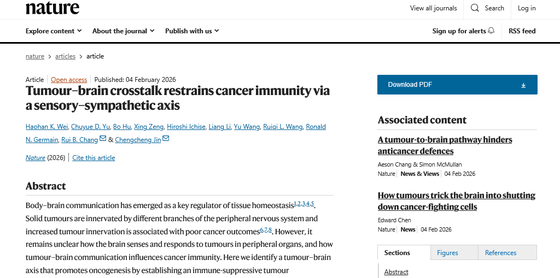
Tumour–brain crosstalk suppresses cancer immunity via a sensory–sympathetic axis | Nature
How tumors trick the brain into shutting down cancer-fighting cells
Previous research has focused on the direct interaction between immune cells surrounding cancer tumors and tumor cells, but it has not been fully elucidated how the brain senses tumors and regulates the immune response, or how signaling through nerves between tumors and the brain affects the immune response.
A research team led by Anna-Maria Globig, a cancer immunologist at the Allen Institute for Immunology in Seattle, Washington, used genetically modified mouse models to replicate the conditions under which tumors naturally develop. They then visualized peripheral nerves around tumors and analyzed which nerve fibers converged on tumors. By closely examining the quantity and activity of immune cells, they measured the impact of nerves on the immune response.
Yale neuroscientist and co-author of the paper, Lui Zhang, predicted that the neurons would signal the presence of tumors to the brain and help the mice fight them.
The results showed that rather than helping the immune system fight tumors, the neurons had a detrimental effect of inhibiting the immune system's attack on cancer. The team also found that tumors hijacked the signaling pathways they identified between the brain and lung tumors in mice, causing other neurons returning from the brainstem to the tumors to send a neurotransmitter called norepinephrine via the vagus nerve , ultimately suppressing immune cells that kill tumors in mice.

In fact, when researchers genetically inactivated sensory neurons, they reported a greater than 50% reduction in tumor growth, suggesting that the neurons suppressed the defensive activities of immune cells at the tumor site, allowing cancer cells to grow unchecked.
The study identified a 'tumor → brain → tumor' signaling pathway in which tumor-derived information is transmitted to the brainstem, which then releases norepinephrine, stimulating and suppressing immune cells surrounding the tumor. 'Tumors hijack this signaling axis and use it for their own purposes,' explained Dr. Globig.
There have been several previous studies showing that cancer affects the nervous system. A paper published in April 2025 by Adam Kepecs and his colleagues from the Department of Neurology at the University of Washington School of Medicine showed that the tendency for terminal cancer patients to lose interest in daily activities is not just an inevitable psychological reaction to physical decline, but that tumor growth in the body causes neurotransmission across multiple brain regions, ultimately suppressing the release of dopamine in the brain's motivation center, leading to a decrease in motivation.
Cancer not only debilitates the body, but may also hijack the brain and weaken the mind - GIGAZINE

Claire Magnon, a cancer neuroscientist at the French National Institute for Health and Medical Research in Paris, first published molecular biology research in 2013 showing that nerves may promote cancer progression. 'We're just beginning to understand how nerves develop,' Magnon said. 'When we first demonstrated the link between nerves and tumors, we faced some backlash, but I'm really pleased that researchers are no longer skeptical.'
The discovery that neurons suppress the immune system is expected to lead to the development of new methods for cancer treatment.
Related Posts:







in Science, Posted by log1e_dh