The launch of Artemis 2, the first manned lunar orbit mission in 50 years, has been postponed due to winter storms in Florida and a fuel leak.
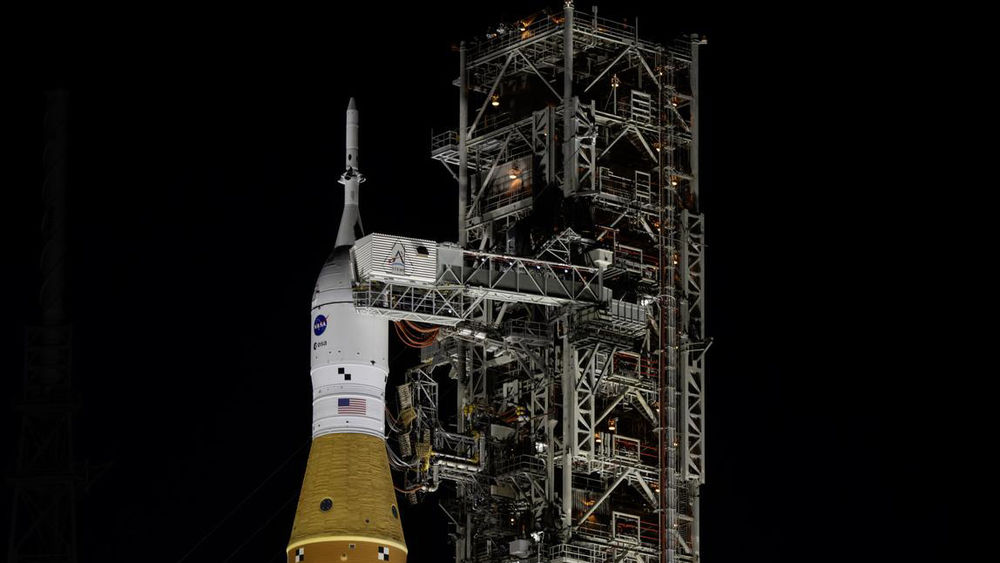
NASA is currently working on the Artemis program, a lunar landing project for astronauts. Following the launch of the unmanned Artemis 1 mission in November 2022, preparations are underway for the manned lunar orbit mission Artemis 2. Artemis 2 was originally scheduled to launch on February 6-7, 2026, but a postponement of the planned launch date was announced due to a severe cold snap in the eastern United States and a technical error in the fuel system.
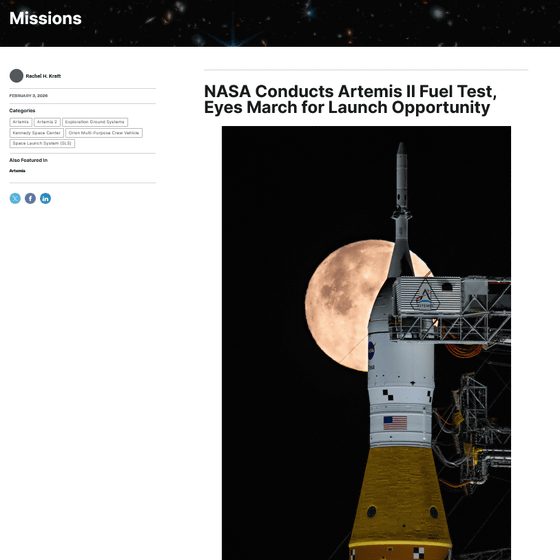
NASA Conducts Artemis II Fuel Test, Eyes March for Launch Opportunity - NASA
https://www.nasa.gov/blogs/missions/2026/02/03/nasa-conducts-artemis-ii-fuel-test-eyes-march-for-launch-opportunity/
Cold weather in Florida is pushing back the Artemis II launch | The Verge
https://www.theverge.com/science/870767/nasa-artemis-ii-mission-launch-delay-sls-space-launch-system-orion-moon
NASA Begins Practice Countdown For First Human Moon Mission Since 1972 : ScienceAlert
https://www.sciencealert.com/nasa-begins-practice-countdown-for-first-human-moon-mission-since-1972
Artemis 2 will be the first manned lunar orbit mission since Apollo 17 in 1972, and will use the giant rocket SLS and the spacecraft Orion to send four astronauts into lunar orbit.
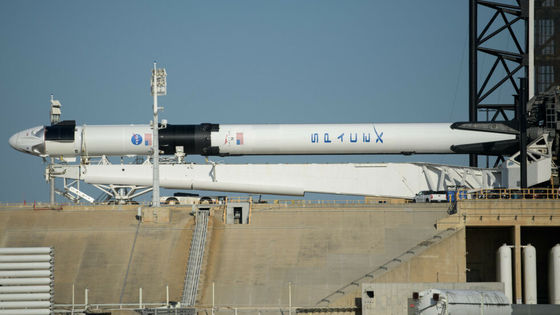
NASA had planned to hold a final rehearsal, known as a 'wet dress rehearsal,' including the actual fuel injection of Artemis 2, at the end of January 2026. The wet dress rehearsal involved filling the rocket with liquid propellant, and after the rehearsal was completed, Artemis 2 was scheduled to be launched on February 6 or 7, 2026.
However,a winter storm named 'Fern' struck the eastern United States over the weekend of January 24-25, 2026, causing delays to various pre-launch operations and test schedules. The cold wave caused heavy snowfall, icy roads, and significant drops in temperature in the eastern United States, including Washington, D.C., and, according to a CBS News report, recorded the highest number of flight cancellations in a single day since the start of the COVID-19 pandemic. The winter storm also caused electricity prices to rise, with electricity prices in Virginia, home to the world's largest data center, soaring by as much as nine times.
A severe cold wave in the eastern United States caused electricity prices to rise ninefold in Virginia, home to the world's largest data center, possibly due to high electricity demand at data centers - GIGAZINE

Because the cryogenic environment also affects the handling of ground equipment and propellant, NASA adjusted its work plan to ensure safety. As a result, the wet dress rehearsal was delayed by two days, and the earliest launch date was announced to be February 8, 2026.
A subsequent wet dress rehearsal confirmed the exact same procedures for filling the rocket with liquid hydrogen and liquid oxygen. The rehearsal successfully filled the tanks with cryogenic propellants, and a team was dispatched to the launch pad to complete the Orion launch and safely drain the rocket's fuel. Cold weather caused delays in the start of the refueling process, and it was reported that it took time to bring some interfaces up to an acceptable temperature before the propellant filling process could begin.
During the test, the first terminal countdown maneuver was also conducted, and with 5 minutes and 15 seconds remaining, the launch sequencer automatically stopped the countdown due to a 'sudden increase in the liquid hydrogen leak rate.' Because additional data was obtained, particularly regarding the fuel system surrounding the liquid hydrogen, NASA decided not to proceed with the launch, but to postpone the Artemis 2 launch schedule in order to conduct further analysis and take necessary measures.
NASA Administrator Jared Isaacman said in a post on X, 'With the gap between SLS launches now more than three years, we fully expected to face challenges. That's exactly why we conduct wet dress rehearsals; these tests are designed to highlight any issues before flight and maximize the probability of success to set the launch date. As always, our top priority is the safety of our astronauts, our workforce, our systems, and the public. As mentioned above, we will launch only when we are confident we are ready to tackle this historic mission. We will conduct additional wet dress rehearsals and then aim for the March window.' He announced that the earliest Artemis 2 launch would be March 2026.
With the conclusion of the wet moving dress rehearsal today, we are off the February launch window and targeting March for the earliest possible launch of Artemis II.
— NASA Administrator Jared Isaacman (@NASAAdmin) February 3, 2026
With more than three years between SLS launches, we fully anticipated encountering challenges. That is precisely…
The press conference on the results of the Artemis 2 wet dress rehearsal can be viewed below.
NASA's Artemis II Fueling Test News Conference (Feb. 3, 2026) - YouTube
Related Posts:


in Science, Posted by log1e_dh